It's Monday morning. Your CFO asks an unexpected question: "What's our total assignment cost by region? And how many people are we bringing to Europe next quarter?"
Your mobility manager takes a breath. They know the answer exists somewhere — across three different systems, scattered spreadsheets, vendor invoices, and case files. By the end of the day, after manually piecing together data, cleaning inconsistencies, and hoping nothing changes by presentation time, they'll have something close to an answer.
This scenario plays out in mobility teams across the world. But it shouldn't have to.
The Hidden Cost of Manual Mobility Reporting
The numbers tell a stark story.
A manufacturing company recently spent 40+ hours — an entire working week — building offline dashboards to answer a single ad hoc leadership question. Forty hours that could have been spent on strategic mobility decisions, employee experience improvements, or compliance risk mitigation.
But this isn't an outlier. It's the norm.
Global mobility reporting is broken. Not because teams are inefficient, but because the entire system is designed for yesterday's problems:
- Data lives in silos. Mobility information is scattered across payroll systems, immigration platforms, vendor portals, compliance databases, and spreadsheets. A single assignment might touch a dozen different systems.
- Every question requires a search expedition. A question from leadership triggers a chain reaction: pull data from System A, cross-reference with System B, check spreadsheet C for the latest updates, verify against vendor D. Manual, fragile, time-consuming.
- Data decays by the minute. By the time the report is formatted and ready to present, something has changed. A visa status updated. A cost adjusted. An assignee's location confirmed. Teams can't confidently say their data is current.
- Reporting crowds out strategy. Mobility teams spend disproportionate time preparing answers instead of interpreting them. They're data collectors rather than advisors. And leadership gets delayed answers instead of real-time insight.
The cost? Delayed decisions, missed opportunities, compliance blind spots, and teams working at burnout levels on work that machines should handle.
The Global Mobility Reporting Reality Check
Here's what we're hearing from HR leaders and mobility managers:
- 75% of companies worldwide still rely on spreadsheets for core global mobility operations.
- Teams are managing increasingly complex assignments across 180+ countries with fragmented visibility.
- A single non-compliant step can trigger delays, legal exposure, and employee dissatisfaction.
- Leadership expects real-time dashboards while mobility teams are still building offline reports.
The gap between expectation and capability is widening. And it's unsustainable.
Enter xpath AI Reports: Mobility Data That Actually Works for You
What if your mobility data could answer questions instead of requiring you to dig through it?
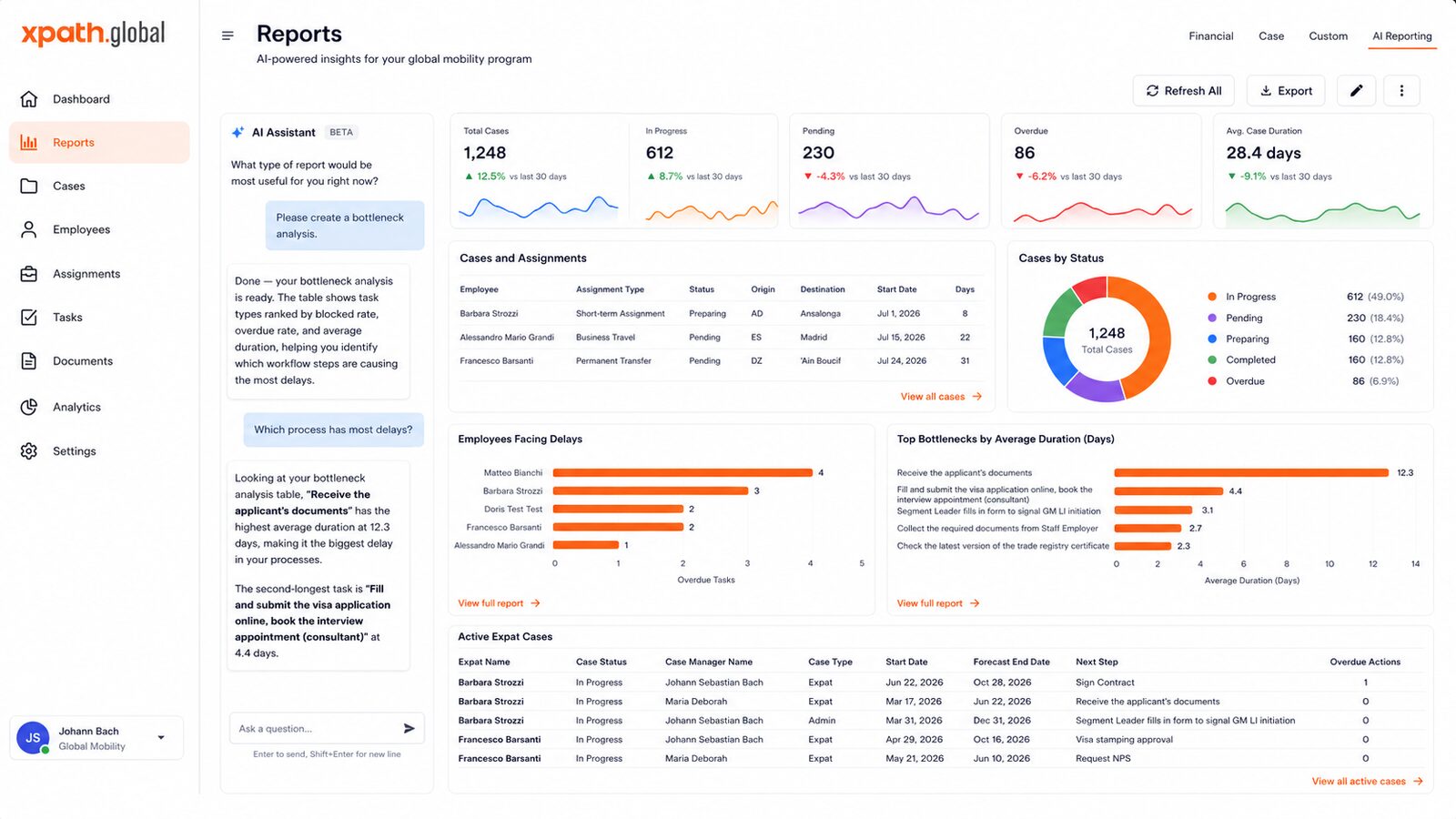
xpath AI Reports transforms static mobility data into interactive, queryable intelligence. Instead of waiting days for a report, teams ask questions in plain language — in any language — and receive instant, accurate answers directly from live xpath platform data.
"No external tools. No data exports. No spreadsheet manipulation. No waiting."
This isn't a separate reporting layer. It's built directly into the xpath platform — the same system managing your assignments, documents, compliance, vendors, and workflows. Your data lives in one place. Your insights come from that single source of truth.
How xpath AI Reports Works (In Plain English)
The mechanics are simple, but the impact is profound:
1. Your data stays in one unified xpath platform
All mobility information — assignments, costs, timelines, compliance status, vendor deliverables, documents, approvals — lives in xpath's unified mobility platform. Whether you're tracking cases in the HR portal, vendor deliverables through the provider portal, or assignee experience in the expatriate portal, all the data is connected and current.
2. You ask questions naturally
"How many expatriates do we have in Germany right now?" "Which assignments are at risk of missing compliance deadlines?" "What's our total mobility spend by business unit?" "Show me the vendor deliverables that are overdue." You ask in plain language. xpath's AI understands context and nuance.
3. You get instant answers
xpath queries live data across the entire platform and returns interactive dashboards. Not tomorrow. Not in an hour. Instantly. You can drill down, filter, and explore the data in real-time.
4. Your insights stay current
Because the data is live across xpath's unified system, every answer reflects the most current information across all three portals (HR, vendor, assignee). No stale reports. No assumptions about what may have changed.
What You Can Actually Do With xpath AI Reports
The power of xpath AI Reports comes from scope — and from the fact that it's connected to the entire xpath mobility ecosystem. You're not limited to pre-built dashboards. You can interrogate:
Assignment & Assignee Intelligence
- Distribution by country, business unit, role, or duration
- Pipeline of upcoming arrivals and departures
- Assignee status and readiness
- Family composition and dependant needs
Cost Visibility
- Total assignment costs by region, department, or individual
- Lump sum spend and forecasting
- Vendor costs and cost overruns
- Budget remaining by approval category
Compliance & Risk
- Documents expiring soon (passports, work permits, visas)
- Compliance deadlines by country
- Flagged cases and risk status
- Approvals pending and bottlenecks
Operational Efficiency
- Case processing time by type
- Vendor deliverables and SLA adherence
- Team workload distribution
- Approval timelines and decision points
Program Performance
- Assignment success rates
- Time-to-productivity metrics
- Employee satisfaction by assignment type
- Retention and repatriation trends
This isn't about making reports prettier. It's about giving leadership (and your team) the insight to make better decisions, faster.
Why xpath AI Reports is Different: It's Connected to Everything
xpath AI Reports doesn't sit in isolation. It's part of an integrated platform that handles the entire mobility lifecycle:
- Workflow visibility: If you're using xpath's AI Workflow Builder to automate assignment processes, you can instantly see how assignments are progressing through each step.
- Document tracking: Since xpath auto-generates your assignment letters, cost projections, and compliance documents, you can track document completion and signature status in real-time.
- Vendor accountability: With vendor deliverables managed in xpath, you have visibility into what's been completed, what's at risk, and where bottlenecks exist.
- Compliance confidence: All your compliance checks, approvals, and document expirations are in the system — and instantly queryable through AI Reports.
The difference: You're not importing data into a separate analytics tool. You're analyzing the same system your team uses every day. Current. Accurate. Complete.
The Real Impact: Who Benefits and How
For HR Directors & Mobility Leaders
You shift from reactive reporting to strategic advising. Instead of spending days assembling answers, you're bringing insight to the table. Leadership asks a question, and you respond in the moment with confidence and current data. You become the person who helps leadership understand what's happening in the mobility program — not the person they ask after they've already made a decision.
Time saved: 10-15 hours per week on ad hoc reporting and data assembly.
For CFOs & Finance Leaders
Real-time visibility into mobility costs eliminates surprises. You see cost trends, budget impact, and vendor performance without waiting for month-end reconciliation. You can answer investor questions, board inquiries, and budget reviews with confidence and speed.
Outcome: Better cost control, faster decision-making, fewer financial surprises.
For Compliance & Immigration Teams
You have instant visibility into what's at risk. Instead of manually tracking expiring documents and compliance deadlines across hundreds of cases, the system flags them. You see bottlenecks before they become problems. You prove compliance to auditors with data, not memory.
Outcome: Fewer compliance failures, stronger audit positions, proactive risk management.
For Your Entire Mobility Team
You spend less time in spreadsheets and more time solving problems. Data entry and report assembly become automated. Your team focuses on exceptions, edge cases, and assignments that need human judgment — not administrative busywork.
Outcome: Higher engagement, lower burnout, better retention.
When AI Reports Actually Matters: Real Scenarios
Scenario 1: The Unexpected Board Question
Your board asks, "What's our total expatriate population across APAC, and what's the employment risk profile?" With AI Reports, you have an answer in minutes. Without it, your team spends two days assembling the data.
Scenario 2: The Compliance Audit
An auditor asks for proof of assignment timelines, compliance steps completed, and document verification across 150 cases. With AI Reports, you generate an interactive dashboard showing every case, every compliance step, every document status. The audit moves faster and your team looks prepared (because they are).
Scenario 3: The Cost Blow-Out
Your CFO notices mobility spend is trending higher than budgeted. They ask which region, which types of assignments, which vendors are driving the increase. Without AI Reports, you estimate. With AI Reports, you know. Instantly. You can drill down to specific assignments and see exactly where the cost is going.
Scenario 4: The Strategic Expansion
Your company is considering expansion into three new countries. Leadership needs to understand the cost, timeline, and compliance complexity for each. With AI Reports, you can model each scenario, show the compliance workflow requirements, and project costs — before any assignments start.
The Difference: Before and After
Before AI Reports
- Leadership asks a question on Monday
- Mobility team spends Tuesday-Wednesday gathering data
- Thursday morning, team starts analyzing and formatting
- Friday afternoon, report is finally ready (but some data may have changed)
- Decision delayed until the following week
With AI Reports
- Leadership asks a question
- Answer appears in minutes
- Team can explore the data interactively
- Decision happens today
- Strategic work can actually be strategic
Why This Matters Now
Global mobility is accelerating. Companies are moving people faster, expanding to new markets, and managing increasingly complex assignments across 180+ countries. At the same time, teams are stretched thin and expected to do more with fewer resources.
Manual reporting doesn't scale. Spreadsheets don't scale. Cross-referencing systems and cleaning data doesn't scale. AI does.
Seventy-five percent of companies still rely on spreadsheets for mobility work. Most teams are one ad hoc data request away from a crisis. The companies winning in global mobility aren't the ones with the biggest teams — they're the ones with better visibility and faster decision-making.
"AI Reports gives you that edge."
Getting Started: It's Simpler Than You Think
You don't need to rebuild your systems. You don't need new infrastructure or massive change management.
If you're already using xpath for assignment management, your mobility data is already there. You ask a question. You get an answer. You make a better decision.
If you're not yet on xpath, or if you're managing mobility across fragmented systems, that's exactly the problem xpath was built to solve. xpath consolidates all your mobility data — assignments, documents, approvals, vendor work, compliance status — into one connected platform. AI Reports is the intelligence layer on top.
The shift from administrative to strategic happens naturally when the administrative work disappears.
The Path Forward: xpath Is Ready
If your mobility team is spending excessive time on reporting, if you're missing ad hoc leadership questions, if your data is fragmented across systems, or if you simply want to move faster and more confidently — it's time to see what xpath AI Reports looks like.
xpath AI Reports is live. It's working today. Mobility teams are using it right now to answer questions in minutes instead of days, to advise leadership instead of chasing data, and to move from reactive reporting to strategic insight.
The teams that embrace xpath's AI capabilities now — starting with AI Reports — will have a decisive advantage. They'll move faster, make better decisions, spend their time on what actually matters, and prove their value to leadership with real-time data.
"Everything else should be automated."
Ready to see how xpath AI Reports transforms your mobility program? Let's talk about your biggest reporting challenge and show you what real-time insight actually looks like.
See how live mobility data turns into plain-language answers across assignments, costs, compliance and vendors.
Explore xpath AI Reports