












Italy Checklist: Sponsoring Highly Skilled Migrant Visas
Grab a copy of a guide to international employee relocation
View E-book
Most HR professionals know that moving an employee across borders involves visas and relocation logistics. What catches companies off guard is everything else: payroll tax exposure in a country where the employee spent 45 days, a data protection violation triggered by sharing personnel files across jurisdictions, or a social security liability that nobody flagged until an audit. Global mobility compliance covers tax, payroll, immigration, labor law, and data protection for every employee type crossing a border. Get it wrong, and the consequences range from financial penalties to operational shutdowns. This guide gives HR and relocation managers a practical framework to get it right.
| Point | Details |
|---|---|
| Compliance covers more than visas | Tax, payroll, labor law, and data protection are integral parts of global mobility compliance. |
| Tracking and policies are essential | Centralized location tracking and well-defined policies reduce risk and streamline operations. |
| Technology drives efficiency | Using HR tech platforms automates compliance tasks and provides real-time alerts for potential issues. |
| Partnering reduces risk | Collaboration with legal, tax experts, and EOR services helps secure compliance in unfamiliar jurisdictions. |
| Continuous improvement matters | Regular audits and training keep your global mobility compliance program robust and up-to-date. |
Global mobility compliance is the practice of meeting every legal obligation that applies when your organization moves employees across borders. It is not a single regulation or a checklist you complete once. It is an ongoing, multi-jurisdictional responsibility that shifts every time an employee changes location, assignment type, or employment status.
According to a compliance overview from Atlas HXM, global mobility compliance encompasses adherence to tax, payroll, immigration, labor law, and data protection requirements for moving employees across borders, including short-term travelers, expatriates, and international hires. That last category matters more than most teams realize. A business traveler who attends client meetings in Germany for 60 days may trigger a permanent establishment risk. A remote hire in Singapore may create payroll obligations your finance team never anticipated.
The scope of compliance covers:
Using a mobility compliance checklist helps HR teams audit their current exposure across all these areas before a problem surfaces. The goal of achieving mobility compliance is not just avoiding penalties. It is building a program that can scale as your workforce grows internationally.
“Global mobility compliance is not a one-time event. It is a continuous operational discipline that requires coordination across HR, finance, legal, and external specialists.”
Knowing what compliance covers is step one. Knowing how to operationalize it is where most programs either succeed or fall apart. The core mechanics of an effective compliance program include centralized tracking of employee locations and durations, clear policies on tax, payroll, immigration, and benefits, proactive risk assessments, technology for reporting and alerts, and using Employer of Record (EOR) services for local compliance.
Here is how those mechanics translate into daily HR operations:
Pro Tip: Do not wait for an employee to self-report their travel. Build automated location tracking into your mobility platform so compliance triggers are caught in real time, not during year-end tax reconciliation.
The payroll tax compliance risks associated with digital nomads and remote workers are a growing blind spot. Many HR teams still treat these employees as domestic hires, which creates significant legal exposure in the countries where those employees actually work.

Organizations that manage global mobility well do not rely on instinct or ad hoc decisions. They use structured methodologies that are repeatable, auditable, and adaptable. Proven compliance methodologies include developing written compliance policies, leveraging technology for tracking, engaging legal and tax experts, conducting regular audits, and training HR teams. Centralized and regional service delivery models are used by approximately 65% of organizations.
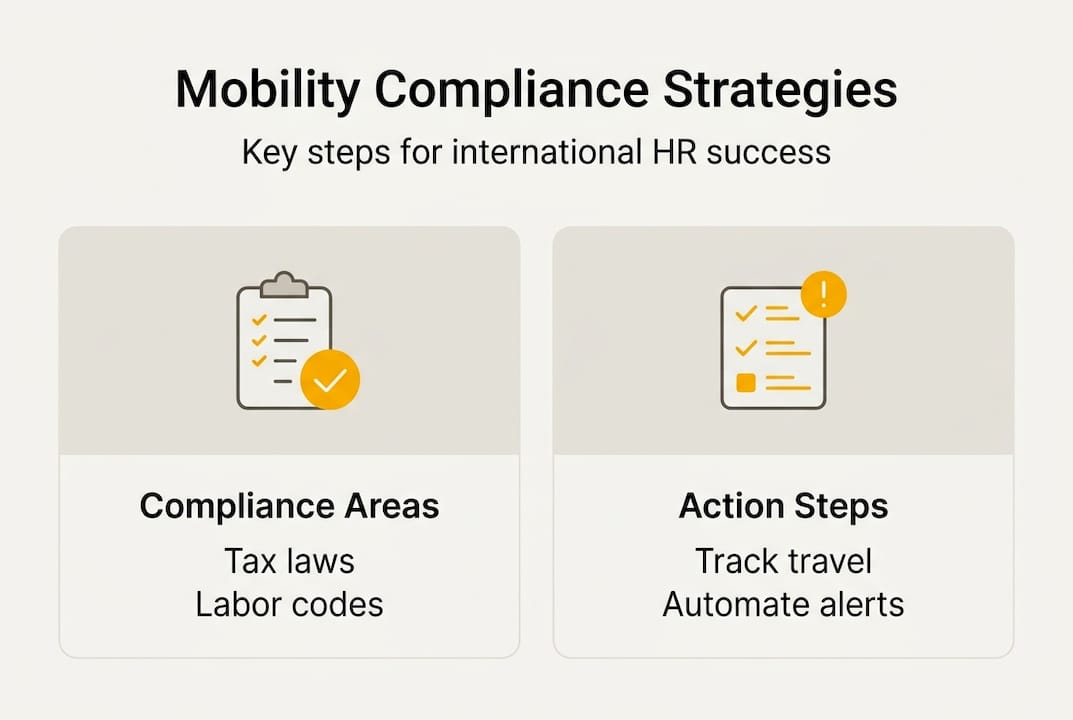
Here is a comparison of the two most common delivery models:
| Feature | Centralized model | Regional model |
|—|—|—|
| Decision authority | Single global team | Regional HR leads |
| Policy consistency | High | Moderate |
| Local responsiveness | Lower | Higher |
| Cost efficiency | Higher at scale | Better for complex regions |
| Best for | Large global programs | Diverse regulatory environments |
Most large multinationals use a hybrid approach, centralizing policy and technology while giving regional teams authority over local execution. The right choice depends on your headcount, the number of countries you operate in, and how much regulatory variation exists across your footprint.
Key methodologies to implement:
Pro Tip: Tie your budgeting and compensation planning directly to your compliance calendar. Tax equalization calculations, shadow payroll deadlines, and tax and social security filing dates should all live in the same system so nothing falls through the cracks.
Even well-resourced HR teams make compliance mistakes. The most damaging ones share a common pattern: they were predictable, preventable, and expensive. Understanding where risk concentrates helps you build defenses before a regulator does it for you.
“The biggest compliance failures in global mobility are rarely dramatic. They are the result of small process gaps compounding over time until they become a significant legal or financial liability.”
Here are the most common risk factors and their business impact:
| Risk factor | Potential consequence | Mitigation approach |
|---|---|---|
| Incomplete location tracking | Unexpected tax liability | Automated tracking tools |
| Inconsistent policies | Legal disputes, inequity claims | Written, reviewed policy framework |
| Missed visa renewals | Employee deportation, work stoppage | Calendar alerts, vendor management |
| No shadow payroll | Double taxation, penalties | Payroll compliance review |
| Poor data handling | GDPR fines, reputational damage | Data transfer agreements |
The tax risks in mobility programs are particularly acute because they often involve multiple overlapping obligations: the employee’s home country, the host country, and sometimes a third country if the employee is a third-country national. Each layer adds complexity.
Mitigation strategies that work:
The centralized tracking of employee locations and durations is the single most effective risk control available to HR teams. Without it, you are managing compliance reactively, which is always more expensive than getting ahead of it.
Frameworks and risk tables are useful. But the real test is whether your HR team can execute compliance consistently across dozens of assignments, multiple countries, and a workforce that does not always follow the plan. Here is how to translate compliance knowledge into operational reality.
Pro Tip: Follow telecommuting compliance steps for remote and hybrid workers separately from traditional expatriates. The triggers, thresholds, and obligations are different, and conflating the two creates gaps in both programs.
For organizations operating in the European Union, GDPR employee mobility requirements add another layer of obligation. Employee data transferred between EU and non-EU countries must be governed by approved transfer mechanisms, and your mobility platform needs to support that. Building relocation program mastery means treating data protection as a compliance pillar, not an afterthought.
The organizations that execute compliance best share one trait: they treat it as a program, not a project. Compliance is not something you achieve once and move on from. It is a living discipline that requires dedicated ownership, technology support, and regular review.
If your compliance program still relies on spreadsheets, email chains, and disconnected vendors, you are carrying more risk than you need to. xpath.global was built specifically to eliminate that fragmentation.
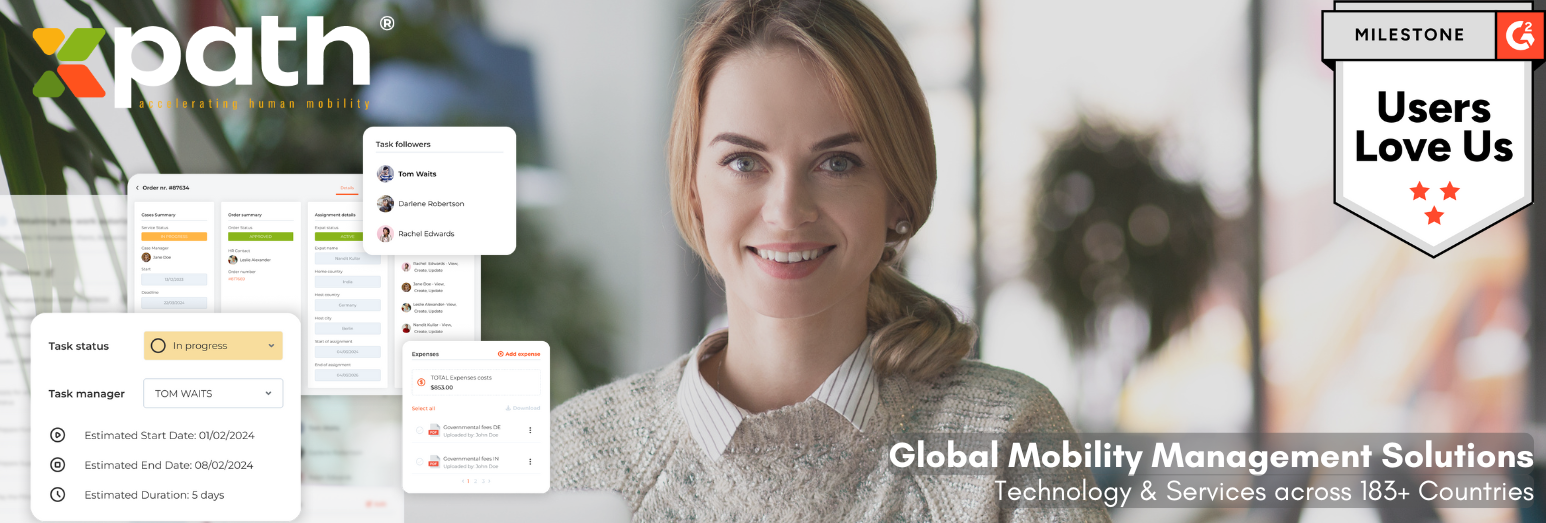
The platform gives HR and relocation managers a single environment to track assignments, manage vendors, automate compliance workflows, and report on program performance across every jurisdiction. You can contact HR experts on the xpath.global team to get compliance advice tailored to your organization’s specific footprint and risk profile. If you are evaluating your tech stack, explore mobility technology solutions that integrate tracking, reporting, and vendor management in one place. And if you are building or rebuilding your relocation program from the ground up, the relocation programs resource library gives you the frameworks to do it right.
Non-compliance can result in fines, legal action, work stoppages, and damaged employee trust. The compliance scope spans tax, payroll, immigration, labor law, and data protection, meaning exposure can come from multiple directions simultaneously.
Centralized tracking systems combined with automated alerts and clear written policies give HR teams real-time visibility into employee locations, visa status, and tax thresholds without relying on manual updates.
Centralized and regional models are the most common, with about 65% of organizations using one or a hybrid of both. The right model depends on your program size, geographic spread, and regulatory complexity.
EOR services allow organizations to employ workers in countries where they have no legal entity, ensuring local payroll and legal compliance without the cost and time of setting up a foreign subsidiary.
Italy Checklist: Sponsoring Highly Skilled Migrant Visas
Grab a copy of a guide to international employee relocation
View E-book