






The average global relocation costs $78,500 per employee, yet many organizations still manage the process through disconnected spreadsheets, fragmented vendor relationships, and reactive compliance checks. For HR managers and global mobility professionals, this combination of high spend and operational complexity creates significant exposure: cost overruns, assignment failures, and regulatory penalties that could have been avoided. This guide moves from that confusion to a structured, actionable understanding of relocation vendor management, covering who does what, where the risks concentrate, and how to build a vendor strategy that consistently delivers compliant, cost-effective relocations.
Key Takeaways
| Point | Details |
|---|---|
| Centralized vendor management | Coordinating all vendors through a single hub reduces compliance and handoff risks. |
| Cost optimization opportunity | Effective vendor selection and performance tracking can yield significant savings for your mobility program. |
| Complexity drives risk | Handling multiple vendors increases operational and compliance risks, so integration is key. |
| Data-driven vendor evaluation | Use scorecards and KPIs to measure and improve vendor performance consistently. |
| Tech-enabled solutions | Modern digital platforms streamline vendor orchestration and compliance for HR leaders. |
What relocation vendors actually do
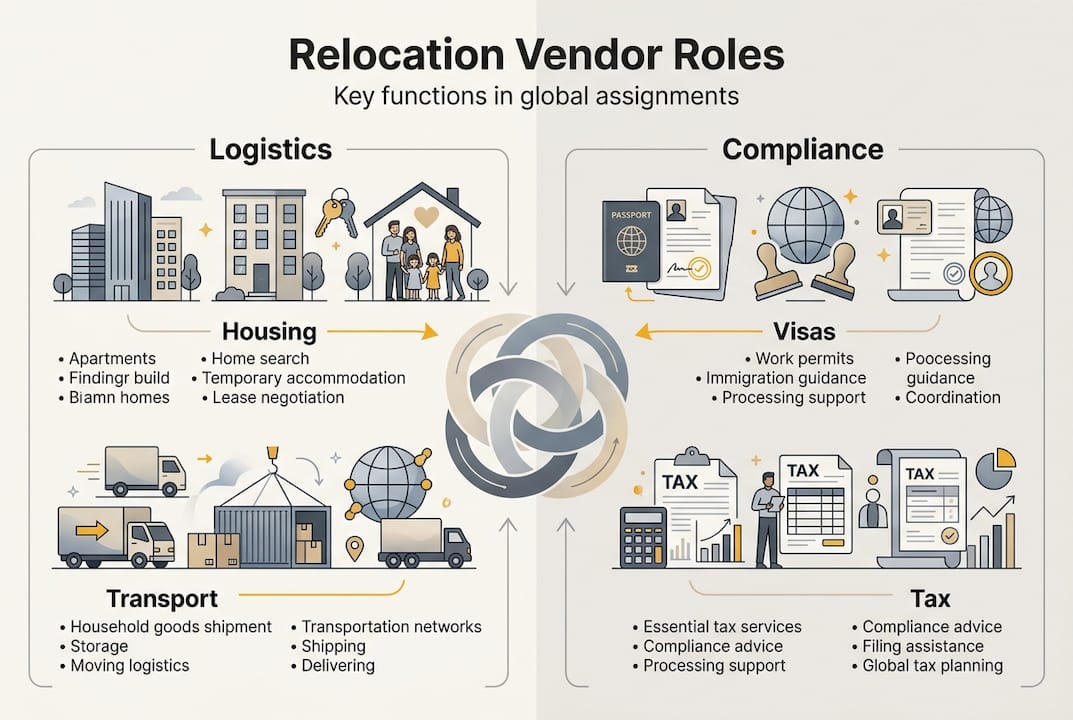
Relocation vendors are specialized service providers that support the movement of employees from one location to another, whether domestically or across international borders. Their scope extends well beyond moving boxes. A well-structured vendor ecosystem covers every stage of the employee relocation lifecycle, from pre-departure planning through final settling-in support and, where applicable, repatriation.
Understanding the full range of services these vendors provide is foundational to effective program design. The corporate relocation services guide outlines how these services typically break down across the following categories:
- Pre-departure support: Policy counseling, cost projections, and departure planning
- Immigration and visa services: Work permit applications, visa processing, and compliance documentation
- Household goods shipping: Packing, transport, customs clearance, and delivery coordination
- Temporary housing: Short-term accommodation while permanent housing is secured
- Destination services: Area orientation, school search, and cultural training
- Tax and social security compliance: Cross-border tax equalization, filing support, and social security coordination
- Settling-in support: Utility setup, banking assistance, and local registration
- Exit and repatriation services: Lease termination, return shipment, and tax closeout
Note that top 5 relocation firms control 45% of the market, which means a significant portion of the industry is served by niche, specialized providers rather than large relocation management companies (RMCs). This fragmentation is both an opportunity and a coordination challenge.
Pro Tip: Before engaging any vendor, document a detailed scope of work and service level agreement (SLA) that specifies deliverables, timelines, escalation paths, and compliance obligations. Vague scopes are the leading cause of service gaps and disputed invoices.
Why effective vendor management is essential
Having outlined what vendors offer, it is important to understand why managing them effectively is both a strategic and operational necessity. Poor vendor management does not simply result in inconvenience. It creates measurable financial, legal, and reputational risk for the organization.
“Compliance failures, cost overruns, and employee dissatisfaction are not random outcomes. They are predictable consequences of uncoordinated vendor relationships and unclear accountability structures.”
The risks of inadequate vendor oversight include:
- Compliance failures: Immigration violations, missed tax filing deadlines, and data privacy breaches
- Cost escalation: Unauthorized service upgrades, duplicate billing, and uncontrolled exceptions
- Assignment failure: Employee disengagement caused by poor housing, delayed permits, or inadequate support
- Data security exposure: Sensitive employee data shared across multiple vendors without adequate controls
- Accountability gaps: When something goes wrong, unclear vendor roles make resolution slow and costly
The complexity compounds when organizations coordinate multiple niche vendors simultaneously. As managing 7+ vendors per relocation demonstrates, compliance risks escalate sharply when that many providers are involved in a single move. Following global mobility best practices for vendor governance is not optional at this scale. It is a program requirement.

Relocation vendor tasks: A side-by-side comparison
To clarify how various vendors fit together, the table below compares common provider types by core function, primary responsibility, and key compliance considerations.
| Vendor type | Core function | Primary responsibility | Key compliance area |
|---|---|---|---|
| Relocation management company (RMC) | End-to-end program coordination | Vendor orchestration, policy administration | Cost control, SLA oversight |
| Immigration law firm | Legal visa and permit processing | Work authorization, compliance filings | Immigration law, right-to-work |
| Tax advisory firm | Cross-border tax compliance | Tax equalization, filing, social security | Income tax, treaty application |
| Destination services provider | Local settling-in support | Housing search, school search, orientation | Data privacy, local regulations |
| Household goods mover | Physical relocation of belongings | Packing, shipping, customs clearance | Customs compliance, insurance |
| Temporary housing provider | Short-term accommodation | Lease management, check-in support | Tenancy law, data handling |
| HR technology platform | Data and workflow integration | Case management, reporting, automation | GDPR, data residency |
On average, 7+ vendors are engaged per international relocation. Each handoff between these providers is a potential point of failure. Overlapping responsibilities, particularly between RMCs and niche vendors, require explicit role definition to prevent duplication or gaps in service delivery.
Operational challenges and risks when managing multiple vendors
Understanding vendor functions is only half the equation. HR leaders must also anticipate the key operational challenges that cause relocations to struggle or fail entirely. The following are the most common pain points encountered in multi-vendor mobility programs:
- Visa and immigration delays: Processing backlogs in key destination countries can delay start dates by weeks or months, disrupting business operations and employee plans.
- Housing shortages: Tight rental markets in major business hubs create significant pressure on destination services providers, often forcing employees into suboptimal temporary arrangements.
- Communication breakdowns: When vendors operate in silos, critical information such as permit approval dates or housing availability does not reach the right parties in time.
- Compliance handoff failures: Tax and immigration vendors may each assume the other is tracking a specific obligation, resulting in missed deadlines or duplicate filings.
- Family-related assignment risks: Spouse employment, school placement, and cultural adjustment issues are frequently underestimated and undersupported by vendor programs.
- Data privacy inconsistencies: Different vendors apply different standards to employee data handling, creating regulatory exposure under frameworks such as GDPR.
Visa backlogs and housing shortages contribute to 40% of assignment failures, a figure that underscores how operational risks translate directly into program outcomes. Each of these failure modes is preventable with the right governance structure and technology support.
Statistic callout: International visa backlogs and housing shortages contribute to 40% of assignment failures, making proactive vendor coordination one of the highest-leverage investments an HR team can make.
How to optimize your relocation vendor strategy
With the challenges clearly mapped, HR can take a structured approach to vendor optimization. The goal is not simply to reduce the number of vendors, but to ensure that every provider in the ecosystem is accountable, measurable, and aligned with program objectives.
Key steps in building an optimized vendor strategy include:
- Vendor assessment: Evaluate current providers against defined criteria including geographic coverage, compliance track record, technology integration capability, and pricing transparency.
- Due diligence: Verify credentials, insurance coverage, data security certifications, and references before onboarding new vendors.
- SLA alignment: Establish clear, measurable service level agreements with defined KPIs for each vendor category.
- Regular performance reviews: Conduct quarterly or semi-annual reviews using a standardized vendor scorecard.
- Technology integration: Require vendors to connect with your central mobility platform for real-time data sharing and workflow automation.
The following scorecard framework provides a practical starting point for tracking vendor performance:
| KPI | Measurement method | Target benchmark | Review frequency |
|---|---|---|---|
| Cost variance | Actual vs. projected spend | Within 5% of budget | Quarterly |
| Compliance rate | Audit findings, missed deadlines | 98% or above | Quarterly |
| Employee satisfaction | Post-move survey scores | 4.0 out of 5.0 or above | Per assignment |
| SLA adherence | On-time delivery of milestones | 95% or above | Monthly |
| Data security incidents | Reported breaches or near-misses | Zero tolerance | Ongoing |
28% of companies reduced relocation costs by 10% in 2023 through vendor optimization alone. Reviewing your employee relocation steps and aligning them with vendor accountability structures is one of the most direct paths to measurable savings.
Pro Tip: Leverage a centralized mobility technology platform to create a single source of truth for all vendor interactions. When every task, document, and communication is logged in one system, compliance audits become straightforward and accountability is never ambiguous.
Future trends in relocation vendor management
Looking ahead, several trends are reshaping how HR and global mobility teams engage with and leverage vendors. The pace of change is accelerating, and organizations that adapt early will gain a measurable competitive advantage in talent mobility.
- Platform consolidation: Top firms are consolidating and digitizing their service offerings, reducing fragmentation and improving performance visibility across the vendor ecosystem.
- Automated compliance monitoring: Real-time compliance tracking tools are replacing manual audit cycles, enabling HR teams to identify and resolve issues before they escalate.
- Digital vendor marketplaces: Platforms that aggregate vetted providers across immigration, housing, tax, and logistics are replacing traditional RMC models with more transparent, flexible alternatives.
- Data-driven vendor selection: Predictive analytics are enabling HR teams to select vendors based on historical performance data rather than relationships or brand recognition alone.
- Employee-centric technology: Mobile apps and self-service portals are becoming standard expectations, with vendors increasingly required to integrate with employee-facing platforms.
The mobility technology advances driving these changes are also influencing how organizations approach remote work mobility trends, creating new vendor categories and compliance requirements that did not exist five years ago. HR’s role is evolving from administrative coordinator to strategic technology integrator, and vendor management is at the center of that shift.
Streamline your global mobility program with the right partners
As you work to transform your relocation vendor strategy, the complexity of coordinating multiple providers, maintaining compliance across jurisdictions, and delivering a consistent employee experience can feel overwhelming. xpath.global was built specifically to address that challenge.

The xpath.global platform gives HR and global mobility teams a single environment to manage vendors, track compliance, automate workflows, and access a marketplace of 60,000+ vetted services across 183 countries. Whether you are rationalizing an existing vendor portfolio or building a new mobility program from the ground up, talk to our global mobility experts to see how the platform supports every stage of the relocation lifecycle. You can also explore our resources on mobility technology and master employee relocation to deepen your program knowledge before your next move.
Frequently asked questions
What are relocation vendors responsible for?
Relocation vendors manage logistics, immigration, and compliance tasks across the full employee move lifecycle, including housing, tax support, destination services, and ongoing assignment coordination.
How can HR ensure compliance when using multiple vendors?
Centralized case management, clearly defined SLAs, and regular performance audits are essential, as compliance risk rises with 7+ vendors unless governance structures are firmly in place.
What is the average global employee relocation cost?
The average global relocation costs $78,500 per employee, while domestic moves typically range from $15,000 to $75,000 depending on distance, family size, and benefit level.
What leads to failed relocations?
Relocations most commonly fail due to visa processing delays, housing shortages, and multi-vendor coordination breakdowns, with these factors contributing to 40% of failures across international assignments.
How can companies cut relocation costs?
Structured vendor optimization, including SLA alignment and performance-based reviews, helped 28% of companies cut costs by 10% in 2023 without reducing the quality of employee support.