






TL;DR:
- International workforce management involves coordinating HR functions across multiple countries with complex legal and cultural differences.
- Compliance, relocation, and cultural adaptation are primary challenges that require strategic frameworks and local expertise.
- Successful programs emphasize flexibility, local relationships, and continuous measurement over rigid procedures.
Managing a global workforce looks straightforward on paper. Hire the right people, place them in the right markets, and let local managers handle the details. In practice, multinational HR teams quickly discover that international workforce management spans immigration law, cross-border taxation, relocation logistics, cultural integration, and real-time compliance monitoring across dozens of jurisdictions. Most organizations underestimate this complexity until a compliance breach, a failed assignment, or a costly payroll error forces a reckoning. This guide walks through the core pillars, primary challenges, strategic frameworks, and practical implementation steps that HR professionals and global mobility managers need to build programs that actually work.
Key Takeaways
| Point | Details |
|---|---|
| Comprehensive management required | Global HR operations demand integrated systems for compliance, relocation, and culture. |
| Frameworks and flexibility | Blending structured frameworks with local adaptation drives international workforce success. |
| Technology powers efficiency | Automation and standardization make compliance and worldwide HR management possible. |
| Continuous improvement is critical | Tracking KPIs and soliciting feedback enables ongoing optimization of international HR programs. |
Defining international workforce management
Having set the stage with the challenges and importance, it is essential to define what international workforce management represents for today’s HR leaders.
International workforce management is the coordinated practice of overseeing HR functions for employees working across multiple countries. It goes well beyond standard HR administration because every country introduces its own labor code, tax regime, immigration rules, and cultural expectations. A policy that works seamlessly in Germany may create legal exposure in Brazil or operational friction in Japan.
For HR professionals, the scope is broad. Key mechanics include talent acquisition, workforce planning, global payroll and benefits standardization, compliance management covering labor laws, taxes, and immigration, employee relocation including visas and housing, performance tracking, and cross-cultural training. Each domain connects to the others, meaning a gap in one area creates risk in several more.
“Effective international workforce management is not a single process. It is an integrated system where talent planning, compliance, and employee experience must move in sync across every country of operation.”
To make the scope concrete, consider the key domains HR teams must manage:
- Talent acquisition: Sourcing and hiring across borders while meeting local labor market regulations and work authorization requirements.
- Workforce planning: Forecasting headcount needs across regions and aligning talent supply with business expansion timelines.
- Global payroll and benefits: Standardizing compensation structures while adapting benefits to local statutory requirements and market norms.
- Compliance management: Monitoring labor law changes, tax obligations, and immigration mandates in every country where employees are based.
- Employee relocation: Coordinating visas, housing, schooling, and destination services for relocating employees and their families.
- Performance tracking: Measuring productivity and assignment success against globally consistent benchmarks.
- Cross-cultural training: Preparing employees and managers to work effectively across cultural boundaries.
Understanding mobility services for HR teams means recognizing that these domains are interdependent. Talent acquisition decisions trigger relocation workflows. Relocation triggers immigration and tax compliance obligations. Compliance gaps affect employee retention. The entire system must be managed as a single, connected program.
Core challenges: Compliance, relocation, and cultural integration
Defining the scope sets the foundation, but navigating international workforce management means facing unique and high-stakes challenges.
Compliance is consistently the highest-stakes challenge. Labor laws change frequently, immigration regulations shift with political cycles, and tax treaties between countries require careful interpretation. A single misclassification of an employee’s tax residency status can trigger penalties, back taxes, and reputational damage. Methodologies emphasize balancing global standardization with local adaptations, using centralized or regional models to manage this tension effectively.

| Factor | Centralized model | Regional model |
|---|---|---|
| Policy consistency | High | Moderate |
| Local adaptability | Low | High |
| Compliance oversight | Easier to monitor | Requires local expertise |
| Cost efficiency | Higher at scale | Better for diverse regions |
| Speed of implementation | Faster globally | Faster locally |
Relocation compliance adds another layer. Managing employee relocation programs involves coordinating work permits, tax equalization calculations, housing allowances, and family support services simultaneously. Here is how a compliant relocation process typically unfolds:
- Initiate immigration assessment and work permit application well before the assignment start date.
- Calculate tax exposure in both the home and host country, and apply tax equalization if required.
- Coordinate housing, schooling, and destination services for the employee and dependents.
- Confirm social security contributions and bilateral agreement applicability.
- Complete final compliance checks before the employee departs.
Cultural integration is frequently underestimated. Research consistently shows that assignment failure rates are higher when cultural preparation is inadequate, yet many organizations treat cultural training as optional. Employees who struggle to adapt professionally or personally in a new country are more likely to request early repatriation, which wastes the entire investment in their relocation.
Following mobility best practices means building cultural readiness into the relocation process from the start, not as an afterthought. Similarly, compliance risks for digital nomads illustrate how even informal work arrangements across borders can trigger unexpected tax and immigration obligations.
Pro Tip: Align compliance reviews and relocation policy design with your annual talent planning cycle. Catching potential compliance issues before assignment decisions are finalized reduces disruption and cost significantly.
Strategic frameworks and trends in global workforce management
Understanding the obstacles leads naturally to the question of how leading organizations are meeting these challenges.
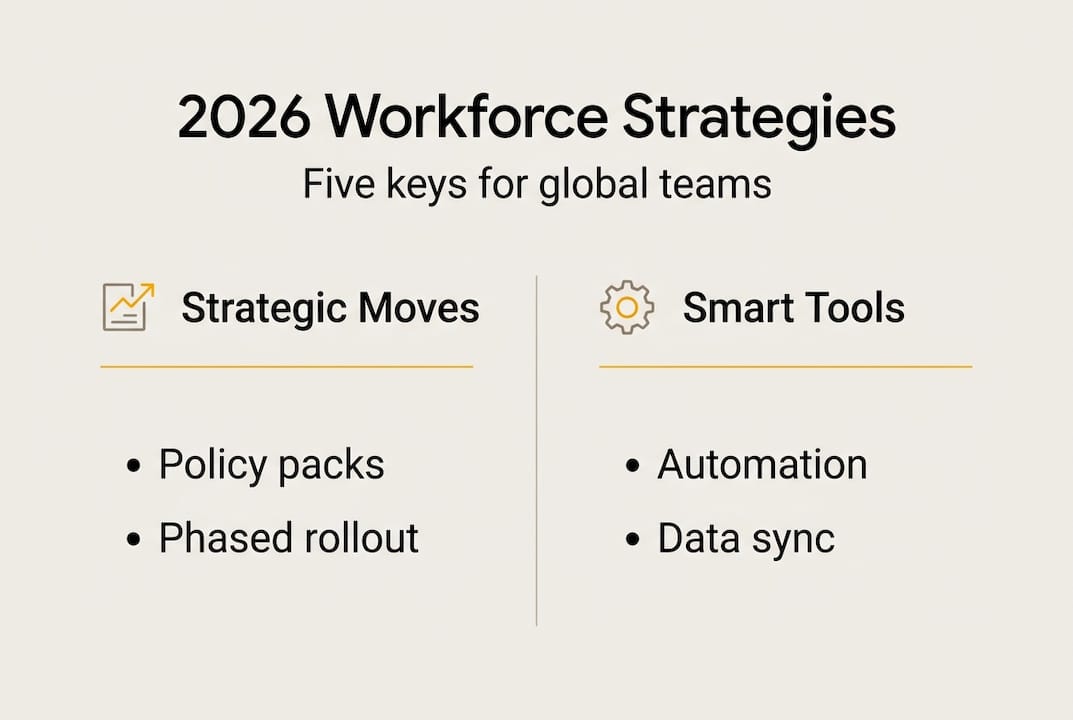
Strategies include phased rollouts with global templates combined with local policy packs, formal remote work policies, alignment with talent planning, and external benchmarking for costs and DEI metrics. These approaches reflect a shift away from one-size-fits-all global programs toward adaptive frameworks that preserve consistency while respecting local realities.
| Framework | Best suited for | Key advantage |
|---|---|---|
| Global template with local packs | Large multinationals | Consistency with local compliance |
| Single-country rollout | Market entry phase | Lower risk, faster learning |
| Phased regional approach | Mid-size expansion | Scalable and manageable |
| Fully decentralized model | Highly diverse markets | Maximum local adaptability |
Current trends are reshaping how HR teams approach international relocation workflow design and program governance. The most significant shifts include:
- Remote and hybrid work policies: Formal frameworks for managing employees who work across borders without traditional assignments are now essential.
- DEI benchmarking: Organizations are measuring diversity outcomes in global mobility programs, tracking whether assignment opportunities are equitably distributed.
- AI and automation: Automated compliance monitoring, document processing, and payroll validation are reducing manual errors and administrative burden.
- Data harmonization: Centralizing workforce data across HRIS, payroll, and mobility platforms enables better forecasting and real-time compliance reporting.
- Vendor technology integration: Direct connectivity between HR platforms and service providers reduces coordination delays and improves transparency.
For HR teams mastering global mobility, the strategic imperative is clear. Frameworks must be built for change, not just for current conditions.
Pro Tip: Invest in data harmonization before deploying automation tools. Clean, consistent workforce data across systems is what makes AI-driven compliance reporting and cost forecasting actually reliable.
Implementing international workforce management: Practical steps for HR
With the frameworks and best practices in place, what does practical implementation actually look like for an HR team?
Talent acquisition, workforce planning, and global payroll standardization are foundational for effective international workforce management. Without these three pillars operating reliably, every downstream process, from relocation to compliance reporting, becomes harder to execute.
Here is a practical implementation workflow for HR teams building or scaling an international workforce management program:
- Conduct a program audit: Map your current state across all key domains, identifying gaps in policy, technology, and vendor coverage.
- Define a global policy framework: Establish core policies for compensation, relocation, compliance, and performance that apply across all countries, with documented local exceptions.
- Select and integrate technology: Choose platforms that centralize case management, automate workflows, and connect to global service providers without requiring manual data re-entry.
- Build compliance processes: Establish country-specific compliance checklists, assign ownership, and create escalation paths for high-risk situations.
- Establish communication protocols: Define how HR, employees, managers, and vendors communicate throughout assignment and relocation processes.
- Train HR and line managers: Ensure that everyone involved in global mobility decisions understands the compliance obligations and process requirements.
- Launch with a pilot: Test the full program in one or two countries before scaling globally, using lessons learned to refine the approach.
Common pitfalls HR teams should avoid include:
- Underestimating the time required to obtain work permits and visas in complex jurisdictions.
- Failing to document local policy exceptions, which creates inconsistency and compliance risk over time.
- Overlooking the employee experience dimension, which affects assignment acceptance rates and retention.
- Relying on spreadsheets for compliance tracking across multiple countries.
A strong corporate relocation services guide and robust employee immigration services are two areas where external expertise consistently reduces implementation risk.
Measuring success and continuous improvement
Even the strongest programs must demonstrate value. Here is how HR leaders can prove and continually improve their impact.
Performance tracking is a core component of international workforce management, yet many organizations track activity metrics rather than outcome metrics. The distinction matters because activity metrics measure effort while outcome metrics measure business impact.
Essential KPIs for international workforce management programs include:
- Assignment success rate (percentage of assignments completed as planned)
- Compliance error rate (number of compliance incidents per 100 assignments)
- Employee retention rate post-assignment
- Time-to-productivity for relocated employees
- Cost per assignment versus budget
- DEI representation in global mobility programs
Organizations that implement structured feedback loops, gathering input from relocating employees, receiving managers, and service providers, consistently identify process improvements that reduce costs and improve outcomes. Following mobility best practices means treating measurement as an ongoing discipline, not a periodic exercise.
The uncomfortable truth most experts miss
Most published frameworks for international workforce management are built around the assumption that organizations can achieve a stable, well-documented state if they just follow the right steps. That assumption is rarely accurate in practice.
Global operations are inherently messy. Regulations change without warning. Key local contacts leave. Vendor performance varies by country and by quarter. The organizations that manage international workforces most effectively are not the ones with the most detailed playbooks. They are the ones that build genuine flexibility into their programs, empower local HR and mobility teams to make judgment calls, and treat every assignment failure as a learning opportunity rather than an exception to be explained away.
Conventional guides focus on frameworks and tools but understate the value of local relationships and critical thinking. A trusted immigration attorney in a complex jurisdiction, or a local HR manager who genuinely understands the cultural dynamics of a new market, is often worth more than any automated workflow. Real global mobility case studies consistently show that human expertise and adaptability are what close the gap between a good program on paper and one that actually delivers results in the field.
Ready to simplify your global workforce management?
HR leaders who have worked through the frameworks, compliance requirements, and implementation steps described in this guide are well-positioned to build programs that deliver real business value. The next step is putting the right tools and expertise behind those programs.
xpath.global provides a unified platform and expert consulting services designed specifically for multinational HR teams managing relocation, immigration, and compliance at scale. Whether you are building a program from scratch or optimizing an existing one, you can contact a workforce expert to discuss your specific needs, explore the relocation program guide for practical next steps, or review available mobility technology solutions to find the right fit for your organization.
Frequently asked questions
What is the main difference between international and domestic workforce management?
International workforce management adds layers of complexity such as cross-border compliance, relocation coordination, and the need to adapt HR policies for multiple legal systems simultaneously. Domestic HR operates within a single regulatory environment, which significantly reduces compliance risk and administrative overhead.
How do companies maintain compliance when managing a global workforce?
Companies use a mix of centralized policies, local partnerships, and automation tools to meet tax, labor, and immigration mandates in every country. Balancing global standardization with local adaptations through centralized or regional models is the most widely used approach.
What role does technology play in international workforce management?
Technology enables automation of HR processes, supports compliance tracking, and helps standardize global payroll and workforce data. AI-driven tools are increasingly used to flag compliance risks and reduce manual errors across multi-country programs.
Which KPIs should HR track in international workforce management?
Key KPIs include assignment success rate, compliance error rate, retention of transferred employees, and time-to-productivity benchmarks. Performance tracking across these dimensions helps HR leaders demonstrate program value and identify areas for improvement.