






TL;DR:
- Effective management of relocation documents is critical to maintain compliance, prevent delays, and protect employee data throughout international assignments. Implementing a structured, lifecycle-based approach with centralized, automated systems minimizes errors, enhances transparency, and ensures timely renewals. Simplifying processes through standardized templates and clear responsibilities enables HR teams to handle complex mobility challenges efficiently and confidently.
When an employee’s work permit expires mid-assignment because a renewal reminder was never set, the consequences go far beyond paperwork. The assignment stalls, legal exposure grows, and the employee’s confidence in your organization erodes. This scenario plays out more often than HR professionals would like to admit. Poorly managed relocation documentation creates compliance risks, operational delays, and significant employee frustration. This guide offers a structured, practical approach to building document management processes that support compliance, protect employee data, and keep international relocations moving without costly interruptions.
Key Takeaways
| Point | Details |
|---|---|
| Preparation is vital | Equip your team with the right tools and checklists before relocation starts. |
| Follow clear steps | Use a structured, lifecycle-based approach for managing each document touchpoint. |
| Prioritize compliance | Regular audits and secure storage help meet international legal requirements. |
| Automate reminders | Automated alerts for expirations and reviews reduce costly human error. |
| Keep processes simple | Standardized workflows outperform complicated custom systems in global mobility. |
Understanding the challenges of relocation document management
Before diving into solutions, let’s clarify exactly what makes relocation document management so challenging for HR teams.
International relocations require coordinating a large, varied set of documents across multiple jurisdictions, each with its own regulatory requirements, deadlines, and formatting standards. The sheer volume creates vulnerability. A single missed file or an outdated version of a host-country employment contract can trigger a compliance breach or delay the entire assignment.
Organizational document challenges in international relocations often result in compliance risks and workflow bottlenecks that ripple across the entire mobility program. Common failure points include:
- Lost or misplaced files due to reliance on email threads and shared drives without structured naming conventions
- Outdated records that reflect superseded visa categories, expired permits, or old compensation figures
- Missed regulatory deadlines for work permit renewals, tax filings, or social security registrations
- Inadequate data privacy controls that expose personally identifiable information (PII) in violation of regulations such as the EU General Data Protection Regulation (GDPR) or equivalent local laws
- Version control failures where multiple versions of the same document circulate without a clear record of which is current
These failures are not merely administrative inconveniences. A missing visa or an incorrectly filed residency document can render an employee legally unable to work in the host country. Beyond the legal risk, the experience of being caught in a documentation gap is disorienting and stressful for the employee, undermining the broader employee value proposition your organization is trying to deliver.
Effective HR document strategies treat documentation not as a clerical task but as a compliance-critical function requiring the same rigor applied to financial reporting or legal contracts. When you approach it from that perspective, the investment in structured systems, clear ownership, and digital tools becomes straightforward to justify.
“A single overlooked document in an international relocation file can delay an entire assignment by weeks and expose the company to regulatory penalties in the host country.” The cost of one compliance failure almost always exceeds the cost of building a robust document management system.
Secure long-term document storage is also a critical, often underestimated, dimension of this challenge. Secure document archiving ensures that records remain intact, tamper-proof, and retrievable for audits or legal proceedings long after the assignment ends.
Preparing your HR team: Tools and requirements checklist
Understanding the challenges highlights the importance of readiness. Here’s how you and your team can prepare for relocation documentation with the right tools and clear requirements.
The foundation of any effective document management program is a well-defined inventory of what needs to be managed, who is responsible for each item, and what technology supports the process. Having a centralized, cloud-based document management system is essential for organizing relocation documentation across global teams and multiple jurisdictions.

Core document requirements by category
| Document category | Examples | Primary responsibility |
|---|---|---|
| Identity and immigration | Passport, visa, work permit, entry clearance | HR and immigration counsel |
| Employment and legal | Contract, offer letter, tax equalization agreement | HR and legal team |
| Compliance and tax | Social security registration, tax ID, bilateral agreement | Tax advisor and HR |
| Personal and family | Dependent visas, school enrollment records, medical insurance | Employee with HR support |
| Property and housing | Lease agreements, utility contracts, temporary housing confirmation | Relocation coordinator |
| Destination onboarding | Local bank account, driving license transfer, local registration | Employee with destination services |
Every relocation file should map to this structure from day one. Gaps in any category signal a process risk that needs immediate resolution.
Beyond the document inventory, the tools you use must meet a minimum set of capability standards. Your document management platform should include:
- Encrypted cloud storage with role-based access controls to protect PII
- Version control that records every change and maintains a complete audit trail
- Digital signature integration for collecting approvals on contracts and consents
- Automated expiry reminders for time-sensitive documents such as visas and work permits
- Compliance monitoring dashboards that flag incomplete or outdated files in real time
- Mobile access so employees can upload documents from any location during the relocation process
Following document management best practices also means establishing a clear governance model. Assign a named owner to each document category, define update triggers (for example, a change in assignment scope or a host-country law amendment), and document escalation paths for urgent compliance issues.
Well-structured corporate documentation, including documenting corporate events such as policy sign-offs and compliance confirmations, reinforces the audit trail that regulators and internal auditors expect to see.
Pro Tip: Conduct a pre-departure file audit at least four weeks before every relocation start date. Review every document in the employee’s file against your checklist, confirm expiry dates, verify that signatures are in place, and flag any missing items with a clear resolution deadline. This single practice eliminates the majority of last-minute compliance surprises.
Step-by-step guide: Managing documents through the relocation lifecycle
Once your team is prepared, apply these sequential steps for end-to-end document management throughout every relocation.
A systematic, lifecycle-based approach to document management increases compliance and process transparency for relocations. Managing documentation as a static task rather than a lifecycle process is one of the most common and costly mistakes HR teams make.
Numbered steps for lifecycle document management
-
Pre-relocation: Collect and verify. Open a digital case file for the employee at assignment initiation. Collect all primary identity, employment, and immigration documents. Verify authenticity, confirm expiry dates extend beyond the planned assignment end date, and obtain digital signatures on all contracts. Cross-reference the file against your standard checklist.
-
Immigration filing: Submit and track. Coordinate with immigration counsel to submit visa and work permit applications. Record submission dates, application reference numbers, and expected decision timelines in the central system. Set automated reminders for follow-up milestones.
-
Active relocation: Track and update. Once the employee is in the host country, maintain a live document register. Log any new local registrations such as social security enrollment, municipal registration, or local tax identification. Update the file when original documents are amended or renewed.
-
Mid-assignment review. Conduct a scheduled review at the midpoint of any assignment longer than six months. Verify that no documents have expired or are approaching expiry, that local compliance registrations remain current, and that any changes in assignment scope are reflected in the employment contract.
-
Pre-return compliance check. Before repatriation or assignment close, confirm that host-country tax obligations have been filed, that exit notifications required by local law have been submitted, and that the employee’s file is complete and accurate.
-
Post-move: Archive and review. Transfer the completed assignment file to long-term secure document archiving in a format that preserves document integrity. Retain records for the minimum periods required by applicable tax and employment laws, which typically range from five to ten years depending on jurisdiction.
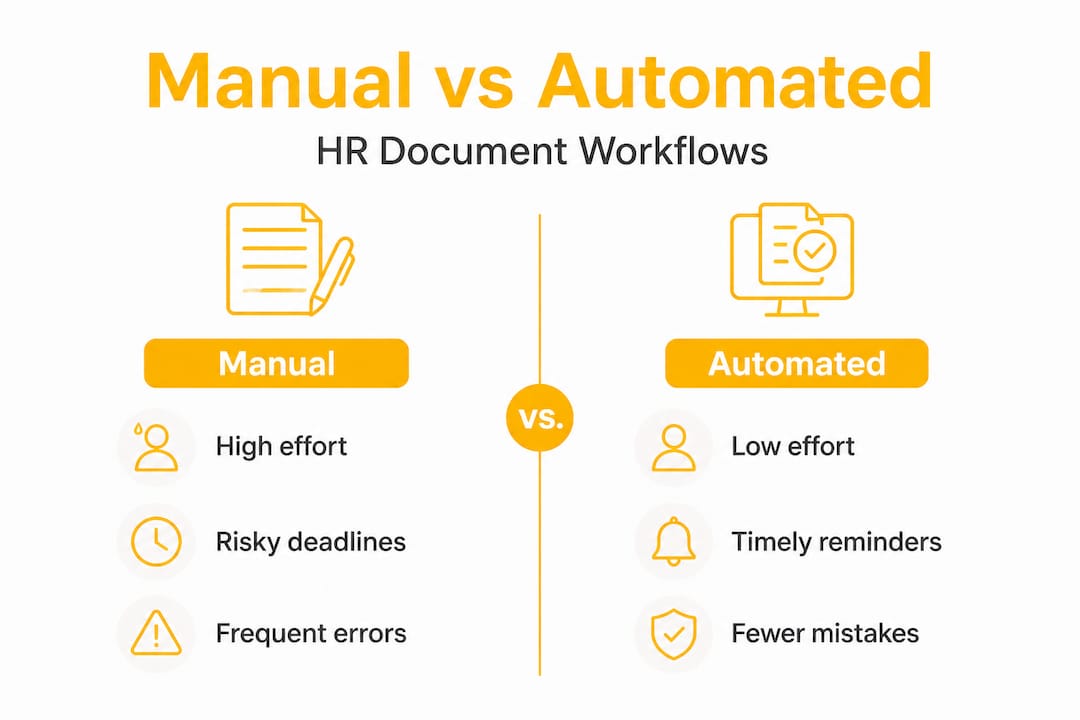
Manual vs. automated workflow comparison
| Stage | Manual process effort | Automated process effort | Error risk (manual) | Compliance level (automated) |
|---|---|---|---|---|
| Pre-relocation collection | High: email coordination | Low: digital portal upload | High | Strong |
| Immigration tracking | Medium: spreadsheet updates | Low: system-generated alerts | Medium | Strong |
| Active relocation updates | High: ad hoc reminders | Low: automated triggers | High | Consistent |
| Mid-assignment review | High: calendar-dependent | Low: scheduled workflow | Medium | Consistent |
| Archiving | Medium: manual filing | Low: automatic case closure | Medium | Auditable |
Peer verification, meaning a second reviewer confirming document completeness before each stage closes, adds a critical quality control layer that automation alone cannot replace. Build peer verification into your relocation workflow checklist as a formal step, not an informal practice.
Support for improving document workflow also means integrating your document system with supporting document checklists that adapt to each assignment type, country combination, and employee profile.
Pro Tip: Configure automated expiry reminders at 90 days, 60 days, and 30 days before any visa, work permit, or critical compliance document expires. Three-stage reminders give you sufficient lead time to initiate renewal without emergency processing fees or compliance gaps.
Mistakes to avoid and compliance checkpoints
Even well-prepared teams can stumble. Here’s how to sidestep the biggest mistakes and confidently meet compliance obligations.
Missed document updates are a leading cause of compliance breaches in international relocations. Knowing where the process typically breaks down allows HR teams to implement preventive controls rather than reactive fixes.
Top five mistakes to avoid:
-
Weak access controls. Granting unrestricted access to sensitive relocation files exposes PII and creates audit vulnerabilities. Implement role-based permissions so that each team member accesses only what is relevant to their function.
-
Failing to update expired files. A document that was valid at assignment start may expire mid-assignment. Without automated tracking, renewals are missed and compliance gaps open quietly.
-
Overlooking host-country local laws. Immigration and employment law varies significantly between countries. Assuming that a process that works in one jurisdiction applies universally is a frequent and expensive error.
-
Neglecting employee privacy compliance. Cross-border data transfers of employee records must comply with applicable data protection laws. Transfers of EU employee data to non-EU countries, for example, require appropriate safeguards under GDPR.
-
Relying on informal communication. Using personal email or messaging applications to share sensitive documents bypasses audit trails and creates document management failures that are difficult to reconstruct during a compliance review.
Compliance checkpoints by relocation phase:
- Pre-relocation: Verify passport validity, obtain all required entry visas, confirm work authorization, execute employment contracts
- Active assignment: Monitor permit expiry, confirm local tax and social security registrations, validate housing lease compliance
- Mid-assignment review: Cross-check all document expiry dates, confirm compliance filings are current, update file for any assignment scope changes
- Post-assignment: File host-country tax returns, submit exit notifications, archive complete record set
These international compliance tips are most effective when integrated into workflow systems rather than left to individual team members to remember and execute manually.
“One overlooked renewal notice for a work permit is sufficient to halt an international assignment, expose the employer to regulatory penalties, and damage the professional relationship with the relocating employee.” The operational disruption from a single missed document can far exceed the cost of the renewal itself.
Schedule periodic audits of all active assignment files on a quarterly basis. Combine this with structured use of PDF archiving for compliance to maintain tamper-evident records that satisfy auditors and legal counsel alike.
Our take: Why simple is best for global mobility document management
Having covered practical steps and safeguards, let’s step back for a candid perspective on what actually works long-term in global mobility document management.
There is a persistent temptation in HR and global mobility to solve document management problems by building complex, bespoke systems. The logic is understandable: international relocations are complicated, so the systems managing them should match that complexity. In practice, the opposite is usually true. Overly complex document workflows create confusion, increase training burden, and introduce new failure points that undermine the compliance goals they were meant to support.
The most effective document management programs we see consistently share one characteristic: they are built on standardized templates, simple checklists, and clearly defined update triggers. When every team member knows exactly what documents are required at each stage, who is responsible for collecting them, and what event prompts an update, the process becomes reliable regardless of team size or employee turnover.
There is an important distinction to draw here between true automation and unnecessary IT complexity. Automation should eliminate repetitive, low-judgment tasks like expiry reminders and version archiving. It should not add layers of configuration, approval routing, or reporting that require significant ongoing IT support to maintain. The goal of technology in document management is to reduce administrative burden, not to create new administrative functions just to operate the tools.
HR professionals should be skeptical of platforms that promise transformation through complexity. The value of a good streamline document management system lies in how quickly and reliably it surfaces the information you need, not in how many features it contains. Effective global mobility document management is rooted in repeatable, transparent processes that any qualified team member can execute and audit. Simple does not mean unsophisticated. It means well-designed for the purpose it serves.
Take the next step: Solutions for global HR document management
If you’re ready to put these strategies into action for your organization, here’s where you can find specialized resources and assistance.
Building a reliable document management program for international relocations requires the right combination of process discipline, technology, and expert guidance. xpath.global provides HR and global mobility teams with a unified platform designed specifically to address these challenges at scale.
Connect with relocation experts who specialize in international HR document compliance and can help you design processes tailored to your assignment portfolio. Explore the full range of relocation services for HR professionals, covering everything from immigration coordination to vendor management and compliance tracking. For teams looking to modernize how they handle relocation files, xpath.global’s streamlined document management capabilities provide the automation, audit trails, and centralized visibility your program needs to operate with confidence across multiple jurisdictions.
Frequently asked questions
What documents are essential for international relocation compliance?
Key documents include passports, visas, work permits, proof of address, insurance records, signed employment contracts, and local tax and social security registrations. The precise set varies by origin and host country.
How can HR teams ensure document security when relocating employees?
Use encrypted cloud-based systems with role-based access controls, multi-factor authentication, and regular audit trails to protect sensitive employee records and maintain compliance with applicable data protection laws.
What’s the best way to update documents post-relocation?
Schedule periodic document reviews at defined intervals and configure automated reminders for expiring documents so that renewals are initiated well before compliance deadlines arrive.
How do you minimize the risk of missing compliance deadlines?
Implement a structured checklist system mapped to each relocation phase and automate deadline tracking within your mobility platform to reduce reliance on manual calendaring and individual memory.
Recommended
Previous article