






TL;DR:
- Austria’s 2026 reform introduces mandatory border screenings and expands Eurodac database coverage.
- Family reunification restrictions and processing pauses until September 2026 impact asylum-linked cases.
- Skilled worker inflows remain uncapped, but increased administrative burdens may delay processing times.
Austria’s immigration landscape shifted dramatically in March 2026 when the government approved what analysts describe as the largest reform in 20 years, reshaping how HR professionals and relocation managers plan international assignments. The changes affect border screening protocols, asylum processing, and critically, family reunification timelines, with a processing pause until September 2026 creating immediate disruption for expat families. For corporate mobility teams, understanding what changed, what stayed the same, and where compliance gaps now exist is not optional. This guide breaks down every major element of the reform and translates it into practical action for HR leaders.
Key Takeaways
| Point | Details |
|---|---|
| 2026 reform overview | Austria’s new law enforces stricter border controls, changes family reunification, and updates skilled worker policies. |
| Impact on HR | HR teams face new compliance demands, but skilled worker flows remain largely uncapped under the new rules. |
| Family reunification pause | Processing of asylum-linked family visas is paused until September 2026, with quotas to follow. |
| Proactive compliance steps | Companies should review mobility programs, update policies, and seek expert advice for edge cases and ongoing changes. |
Understanding Austria’s 2026 immigration overhaul
The March 2026 reform represents Austria’s most significant restructuring of its asylum and migration framework since 2006. Approved by the Council of Ministers, the legislation was designed to align Austria with the EU Pact on Migration and Asylum, introducing a series of structural changes that affect multiple immigration categories simultaneously.
The core components of the reform include:
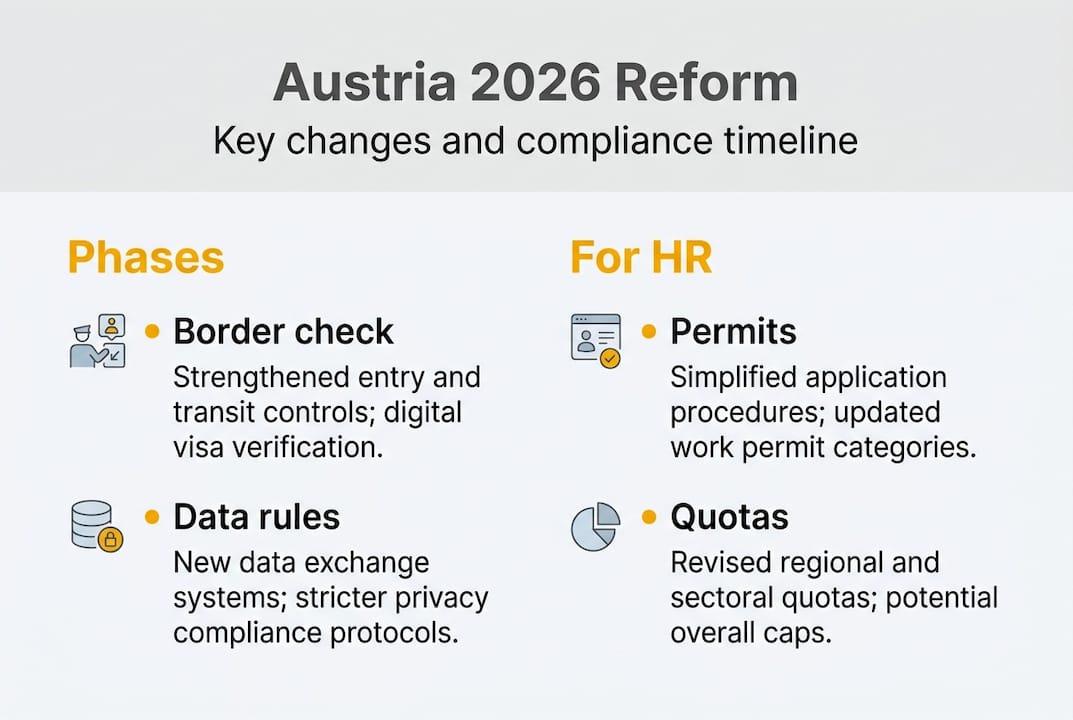
- Border screening procedures: All third-country nationals entering without authorization are now subject to mandatory screening at the border, including biometric registration under the expanded Eurodac database.
- Return centers: A new network of administrative return centers has been established to process individuals who do not qualify for asylum, accelerating deportation timelines.
- Expanded Eurodac coverage: The biometric database now captures a broader set of individuals, including those who cross borders irregularly, improving cross-EU tracking.
- Family reunification restrictions: New quotas and a temporary processing pause limit the ability of asylum-linked family members to join relatives already in Austria.
- Skilled worker inflows: Corporate immigration streams remain uncapped and are actively encouraged under the reform.
The timeline for implementation is structured in phases. Border screening and Eurodac expansion took effect in June 2026. Return center operations began rolling out in the same period. Family reunification quotas are expected to be formally defined after the processing pause lifts in September 2026.
| Reform element | Status | Effective date |
|---|---|---|
| Border screening | Active | June 2026 |
| Eurodac expansion | Active | June 2026 |
| Return centers | Rolling out | June 2026 |
| Family reunification pause | Active | Until Sep 2026 |
| Post-pause quotas | Pending | Post-Sep 2026 |
| Skilled worker inflows | Uncapped | Ongoing |
For HR leaders managing posted workers compliance or navigating single permit guidelines, the reform does not directly restrict corporate immigration channels. However, the administrative burden on immigration authorities has increased, which means processing times for all permit categories may lengthen in the short term. HR teams should factor this into their assignment planning timelines, particularly for roles requiring urgent relocation.
How HR teams and corporate mobility are impacted
The practical implications for HR managers and relocation coordinators depend heavily on which immigration category their employees fall under. The official policy announcement confirms that corporate HR teams retain uncapped work permit inflows, while family-linked migration is now subject to significant restrictions. This distinction is critical for program planning.

| Process area | Pre-2026 | Post-2026 |
|---|---|---|
| Skilled worker permits | Uncapped, standard processing | Uncapped, potentially slower processing |
| Family reunification (asylum-linked) | Processed on rolling basis | Paused until Sep 2026, then quota-based |
| Border entry documentation | Standard checks | Mandatory biometric screening |
| Return and deportation | Case-by-case | Accelerated via return centers |
| EU Blue Card applications | Standard | Unchanged, still favorable |
For HR teams, the following numbered action plan reflects the immediate priorities:
- Audit all active cases: Identify which employees have family members in the asylum-linked reunification pipeline and flag them for individual case review.
- Update policy handbooks: Revise relocation policy documents to reflect the new family reunification restrictions and processing timelines.
- Train mobility coordinators: Ensure your team understands the distinction between asylum-linked family migration and standard dependent visa categories.
- Align with legal counsel: Engage immigration attorneys to review pending applications and assess exposure to the new quota framework.
- Revise assignment timelines: Build additional buffer time into relocation schedules to account for increased administrative load on Austrian immigration authorities.
For employees whose family situations fall outside the asylum-linked category, the impact is more limited. Standard dependent visas and family member residence permits for skilled workers are not subject to the same restrictions. However, HR teams should still monitor remote work laws and employer obligations for foreign workers across the EU, as Austria’s reform may signal similar shifts in neighboring jurisdictions.
Pro Tip: If an employee’s family reunification case is delayed due to the pause, explore whether a Schengen C short-stay visa or a cross-border commuter permit can serve as a legal bridge to maintain family proximity while the primary application is processed. These alternatives are not affected by the current restrictions and can significantly reduce disruption for critical staff.
Family reunification pause, quotas, and edge cases
Family reunification is where the 2026 reform creates the most immediate and operationally complex challenges for HR. The pause on processing asylum-linked family reunification cases runs until September 2026, and post-pause quotas are planned but not yet formally defined. This uncertainty makes forward planning difficult, and HR teams managing impacted employees need a structured approach.
Key facts HR teams must understand:
- The pause applies specifically to asylum-linked family reunification, not to standard dependent permits for skilled workers.
- There is no six-month processing deadline during the pause period, meaning cases can remain in limbo indefinitely until September 2026.
- Applications filed before the reform took effect may retain the terms of the previous legal framework, but only if no material changes have been made to the application since its initial submission.
- Post-pause quotas will likely be set annually, creating a competitive allocation system similar to those seen in other EU member states.
- Employees whose Austrian lockdown implications previously disrupted their mobility planning may find their situation compounded by the new restrictions.
“Pre-2026 filings retain old rates if unchanged since initial application.” This means HR teams should advise employees against amending pending applications without first consulting an immigration attorney, as any modification could reset the application to current law terms.
For edge cases, the guidance is nuanced. An employee who filed a family reunification application in late 2025 and has not altered it stands a reasonable chance of being processed under the previous framework. However, if that employee has since changed employers, adjusted their salary, or updated their address, the application may be reclassified under the new rules.
Pro Tip: For employees in critical roles whose family situations are caught in the pause, consider whether the family member qualifies for an independent visa category, such as a student visa or a job-seeker visa, which could allow them to enter Austria legally while the primary reunification case is resolved.
Critical compliance steps for 2026 and beyond
With the regulatory environment now clearly defined, HR and mobility professionals need a structured compliance roadmap. The urgency is real: pre-2026 filings may remain under old terms only if unchanged, which means any administrative misstep can shift an employee’s case into a less favorable legal framework.
Compliance checklist for HR teams:
- Conduct a full case audit: Review every active immigration file to identify which cases are affected by the new rules.
- Freeze pending amendments: Advise employees not to modify any pre-2026 applications until legal counsel has assessed the risk.
- Update documentation standards: Ensure all employee files include current contract terms, salary certificates, and residence documentation that meet the new screening requirements.
- Set internal deadlines: Establish internal milestones for permit renewals and new applications that account for longer processing times.
- Monitor quota announcements: Track official government communications for the post-September 2026 quota framework as it is defined.
Best practices for ongoing compliance include:
- Regular legal audits: Schedule quarterly reviews of your mobility program’s legal exposure with an immigration attorney familiar with Austrian law.
- Policy refresh cycles: Update your relocation policy handbook at least twice per year to reflect regulatory changes.
- Cross-country benchmarking: Compare Austria’s framework against neighboring jurisdictions to anticipate spillover effects on regional mobility programs.
- EU Blue Card monitoring: Stay current on EU Blue Card compliance updates, as Austria’s reform aligns with broader EU Pact implementation that will affect Blue Card eligibility and processing across member states.
The March 2026 policy announcement signals that Austria intends to maintain a dual approach: welcoming skilled corporate talent while tightening control over asylum-linked migration. HR programs that treat these as separate compliance tracks will be better positioned than those applying a single, uniform policy framework to all immigration categories.
Our take: What most compliance guides miss about Austria’s rules
Most compliance guides treat Austria’s 2026 reform as a binary story: skilled workers are welcome, asylum seekers face restrictions. The reality is more operationally complex, and HR teams that rely on that simplified narrative will encounter friction.
The deeper issue is that Austria is simultaneously competing for global talent and tightening the conditions under which that talent can bring their families. For senior professionals, family stability is a core factor in accepting international assignments. When family reunification becomes uncertain or quota-bound, your best candidates may decline relocation offers, regardless of how favorable the work permit process is.
HR leaders should be pressing their legal partners for clarity on the post-September 2026 quota structure now, before it is formally announced. Waiting for official guidance means reacting rather than planning. The organizations that will navigate this reform most effectively are those that treat cross-border employer obligations as a continuous strategic function, not a periodic administrative task. Inflexible reliance on pre-2026 processes is a liability. The reform rewards agility.
Get expert support and streamline your mobility program
Managing Austria’s 2026 immigration reform requires more than updated policy documents. It requires a mobility infrastructure that can adapt in real time to regulatory changes, track case-level compliance, and support employees through complex family situations.

xpath.global provides expert relocation support for HR teams navigating exactly these challenges, from case audits and legal coordination to full program design. Whether you need to review your current mobility program for remote work scenarios or want a structured relocation services guide tailored to Austria’s new framework, our team is ready to help you move forward with confidence and compliance.
Frequently asked questions
What is the main change in Austria’s 2026 immigration law for employers?
The 2026 reform introduces mandatory border screenings and expanded Eurodac registration, restricts family reunification for asylum-linked cases, and maintains uncapped inflows for skilled workers and corporate immigration streams.
How does the family reunification pause affect international employees?
Family reunification for asylum-linked cases is paused until September 2026, requiring HR teams to plan for significant delays and explore alternative visa categories such as Schengen C visas or independent resident permits for affected family members.
Can companies still relocate skilled workers without quotas?
Yes. The government’s restrictions do not apply to most skilled-worker and corporate immigration streams, which remain uncapped and are actively supported under the new framework.
What should HR do for edge-case applications filed before 2026?
Pre-2026 filings may remain under the original terms if no material changes have been made since submission, but HR teams should advise employees against amending applications without legal review to avoid triggering reclassification under current law.
Recommended
- Czech Republic Implements New Employer Obligations for Reporting Foreign Workers – xpath.global
- Key Challenges in Global Immigration Compliance For HRs – xpath.global
- Hungary: Reduction in Quota for Employment Permit – xpath.global
- ECJ Re-evaluates Austrian Legislation on Posted Workers – xpath.global