






Managing expatriate expenses across multiple countries is complex and error-prone. Integrating cloud-based expense tracking can speed up reporting by over 30%. Integrated digital tools are essential to handle multi-jurisdictional global mobility expense tracking. This article covers prerequisites, setup, common mistakes, and outcomes for HR teams seeking to improve tracking efficiency and cost control.
Table of Contents
- 🔸Prerequisites: What You Need Before Starting Expense Tracking
- 🔸Step-By-Step Setup And Use Of Expense Tracking Systems
- 🔸Common Mistakes And How To Avoid Them In Global Mobility Expense Tracking
- 🔸Expected Outcomes And Success Metrics For Expense Tracking Implementations
- 🔸Explore Global Mobility Expense Tracking Solutions
- 🔸FAQ
Prerequisites: what you need before starting expense tracking
Before you implement expense tracking tools, it’s crucial to establish these prerequisites to ensure a smooth and compliant process. Access to cloud-based platforms and understanding compliance are essential for successful global mobility expense tracking.
Start by identifying the key expense categories relevant to international assignments. These typically include relocation costs, housing allowances, tax equalization payments, travel expenses, and daily living allowances. Each category may have different compliance requirements depending on the jurisdiction.
Secure access to a cloud-based global mobility expense platform that handles multi-currency transactions and automated compliance checks. The platform should integrate with your existing HR systems and support vendor collaboration across multiple countries. Integrating people science in HR can help optimize tool selection and implementation strategies.

Train HR teams and expatriates thoroughly on the tools and expense policies. Without proper training, even the best platforms underperform. Training should cover submission procedures, approval workflows, currency conversion protocols, and documentation requirements. Global mobility enhancing employee experience demonstrates how well-trained teams improve overall assignment outcomes.
Gather baseline historical expense data to set budgets and expectations. Analyze past assignments to identify spending patterns, common cost overruns, and compliance gaps. This data establishes benchmarks for measuring improvement and helps calibrate automated alerts for budget thresholds.
Key prerequisites checklist:
- 🔸Documented expense categories and compliance requirements for each jurisdiction
- 🔸Cloud-based platform with multi-currency and vendor collaboration capabilities
- 🔸Comprehensive training program for HR staff and expatriates
- 🔸Historical expense data analyzed and benchmarked
- 🔸Integration roadmap connecting expense tracking to payroll and HR systems
- 🔸Stakeholder buy-in from finance, legal, and global mobility teams
Countries like Cyprus offer tax and visa incentives that directly impact expense tracking requirements. Understanding such jurisdictional nuances before implementation prevents costly compliance errors.
Step-by-step setup and use of expense tracking systems
Now that you have the prerequisites, let’s walk through exactly how to set up and start using the expense tracking system efficiently. Following these steps ensures your implementation delivers maximum value from day one.
Step 1: Choose a cloud-based platform specialized in global mobility expenses. Generic expense tools lack the multi-jurisdictional compliance features and vendor collaboration capabilities you need. Selecting specialized global mobility platforms with mobile and compliance features optimizes expense management. Evaluate platforms based on currency support, compliance automation, integration capabilities, and mobile accessibility.
Step 2: Train HR and expatriates on system usage and submission policies. Schedule hands-on training sessions that walk through real scenarios. Create quick-reference guides for common tasks like submitting receipts, requesting approvals, and handling currency conversions. Training should emphasize the importance of timely submissions and complete documentation.
Step 3: Standardize expense categories, currencies, and compliance rules globally. Define consistent naming conventions and category structures across all countries. Configure automatic currency conversion using current exchange rates. Build compliance rules directly into the system so submissions are validated automatically. This standardization eliminates reconciliation headaches later.
Step 4: Automate approval workflows and reminders for timely reimbursements. Set up multi-level approval chains based on expense amounts and categories. Configure automatic reminders for pending approvals and overdue submissions. Automation reduces manual follow-up and accelerates reimbursement cycles.
Step 5: Integrate vendor collaboration and mobile app real-time expense reporting. Connect your platform with relocation vendors, tax advisors, and immigration consultants for seamless data sharing. Deploy mobile apps that allow expatriates to photograph receipts, submit expenses instantly, and track approval status in real time. Expatriate management technology strategies provide proven frameworks for maximizing these integrations.
Pro Tip: Pilot the system with a small group of expatriates before full rollout to fine-tune workflows. Select 5-10 assignments representing different countries, expense types, and complexity levels. Use their feedback to adjust approval chains, clarify policies, and improve mobile app usability. This pilot approach catches issues early when they’re easier to fix.
Global mobility technology and services continue evolving rapidly. Stay current with platform updates and new features that can further streamline your processes.
Common mistakes and how to avoid them in global mobility expense tracking
Understanding these common errors prepares you to spot and fix issues proactively during your tracking implementation. Even well-planned implementations encounter predictable pitfalls that derail efficiency gains.
Insufficient training increases data entry errors and delays. When expatriates don’t understand submission requirements or HR teams struggle with approval processes, error rates spike. Training gaps lead to 20% higher expense submission errors; fragmented systems cause up to 25% longer processing. Schedule recurring training sessions quarterly and create video tutorials for complex scenarios.
Non-standardized expense categories cause reconciliation issues. If different countries use different category names or structures, consolidating reports becomes a nightmare. Finance teams waste hours manually recategorizing expenses for accurate budgeting. Establish global standards from day one and enforce them through system controls.
Delayed submissions from expatriates frequently trigger rejections needing resubmissions. When expatriates wait weeks to submit receipts, details become fuzzy and documentation goes missing. Set clear submission deadlines and use mobile app push notifications to encourage timely reporting. Some organizations implement submission windows tied to payroll cycles for consistency.
Ignoring compliance leads to costly violations and audit risks. Each jurisdiction has specific rules about expense documentation, tax treatment, and reporting requirements. Manually tracking these across dozens of countries is impossible. Build compliance checks into your platform and consult local experts for complex situations. Avoiding global mobility policy mistakes prevents expensive regulatory penalties.
Fragmented systems reduce visibility and slow approvals. When expense data sits in multiple disconnected tools, managers lack real-time visibility into spending patterns. Approval requests get lost in email chains. Consolidate all expense tracking into a single platform with integrated dashboards and automated workflows.
Pro Tip: Implement mandatory recurring training sessions and leverage mobile apps to encourage timely expense submissions. Monthly micro-training sessions covering one specific topic keep knowledge fresh without overwhelming busy schedules. Mobile apps with offline capability ensure expatriates can submit expenses even with spotty internet access.
Key mistakes to avoid:
- 🔸Skipping comprehensive training for cost savings
- 🔸Allowing country-specific category customizations
- 🔸Accepting delayed submissions without consequences
- 🔸Relying on manual compliance checks
- 🔸Maintaining multiple disconnected expense systems
- 🔸Ignoring expatriate feedback about system usability
Expected outcomes and success metrics for expense tracking implementations
Knowing what success looks like helps you set expectations and measures to evaluate your expense tracking initiative’s effectiveness. Clear metrics enable data-driven optimization and demonstrate ROI to stakeholders.
Typical implementation takes 3-6 months for full operational tracking. The first month focuses on platform configuration and integration. Months two and three involve training and pilot testing. Months four through six scale to full deployment with continuous refinement based on user feedback.
Expense approval times reduce by 40%, compliance improves 25%, and manual processes cut by 30% with AI automation. These improvements compound over time as users become more proficient and processes stabilize.
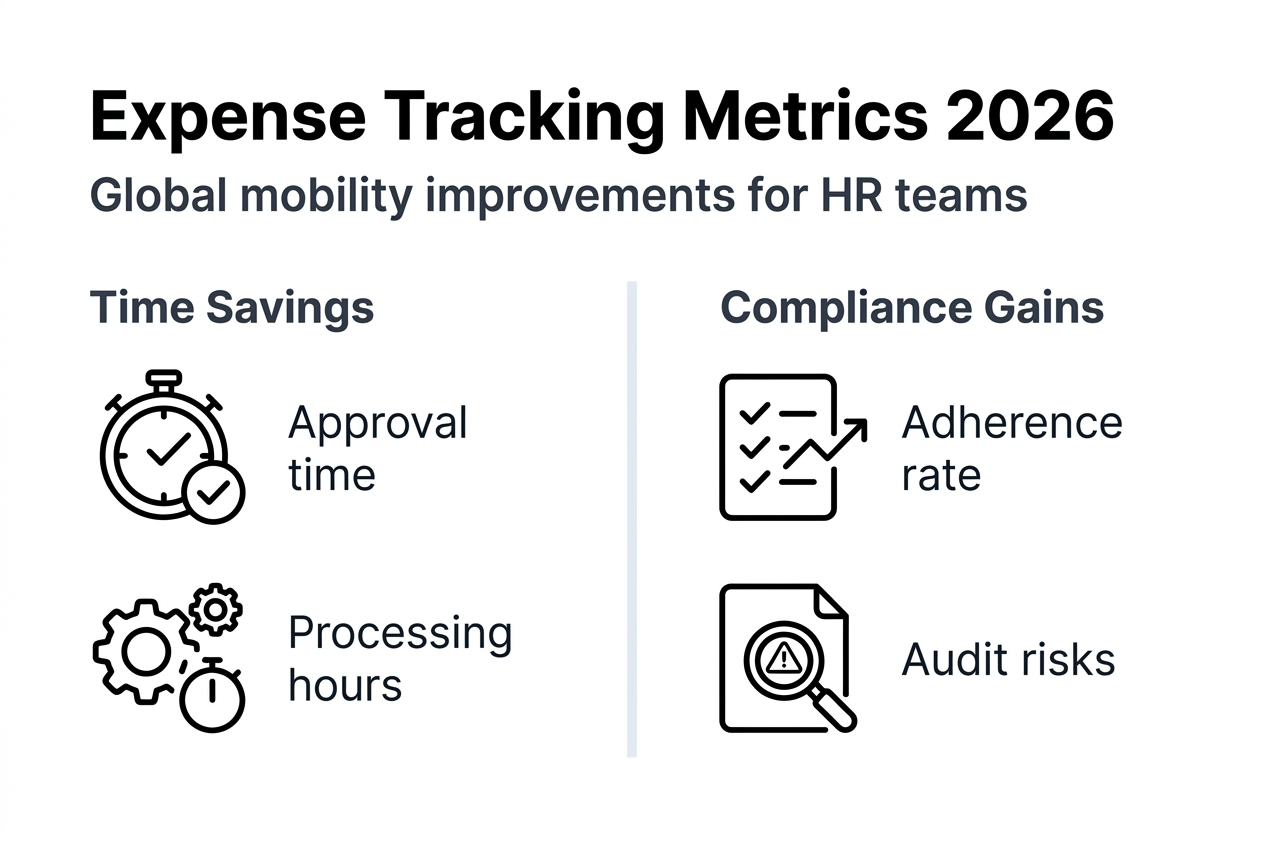
Compliance adherence rises by approximately 25%, reducing risk and audit issues. Automated validation catches errors before submission, while built-in compliance rules ensure jurisdictional requirements are met. This reduction in violations translates directly to lower legal exposure and fewer costly corrections.
Accuracy and timeliness of expatriate expense submissions increase by 50%. Mobile apps make submitting expenses as easy as taking a photo. Real-time validation prevents incomplete submissions. Push notifications remind expatriates of pending items. The combination dramatically improves data quality.
AI-driven automation cuts manual processing time by 30%. Machine learning algorithms can categorize expenses, flag anomalies, and route approvals intelligently. This frees HR teams to focus on exception handling and strategic planning rather than data entry.
Real-time dashboards enable detecting budget overruns 40% earlier for better cost control. Instead of discovering overspending during quarterly reviews, managers receive instant alerts when assignments approach budget thresholds. This early warning enables proactive cost management.
| Metric | Before Implementation | After Implementation | Improvement |
|---|---|---|---|
| Approval cycle time | 7-10 days | 3-4 days | 40-50% faster |
| Compliance violations | 15-20 per quarter | 3-5 per quarter | 75% reduction |
| Manual processing hours | 40 hours/month | 25 hours/month | 35% reduction |
| Submission accuracy | 70% | 95% | 25% improvement |
| Budget variance detection | 60 days lag | 15 days lag | 75% faster |
AI automation in HR continues advancing, promising even greater efficiency gains in the coming years. Organizations that adopt these technologies early gain competitive advantages in talent mobility.
Success metrics to track monthly:
- 🔸Average approval cycle time from submission to reimbursement
- 🔸Percentage of submissions requiring corrections or resubmissions
- 🔸Compliance violation count by jurisdiction and category
- 🔸User adoption rates for mobile app versus manual entry
- 🔸Budget variance between projected and actual assignment costs
- 🔸Time spent on manual expense processing by HR team
Explore global mobility expense tracking solutions
With a clear roadmap and understanding of best practices, consider leveraging expert technology providers like xpath.global to transform your expense tracking. Specialized platforms deliver capabilities generic tools cannot match.
xpath.global offers integrated cloud-based platforms tailored for global mobility expense tracking. Features include multi-jurisdictional compliance, automated approvals, vendor collaboration, and real-time mobile reporting. Their solutions help HR teams optimize international assignment costs and improve compliance across 183 countries.
The platform consolidates immigration, tax, relocation, and expense management into a single interface. This integration eliminates data silos and provides comprehensive visibility into total assignment costs. Vetted service providers across 60,000+ mobility services ensure you have expert support wherever assignments take you.
Technology for expatriate management has evolved dramatically. Modern platforms use AI to generate templates, automate workflows, and predict budget needs. Mobile apps give expatriates control while maintaining compliance guardrails. Digital RFQ systems accelerate vendor procurement.
Explore xpath.global’s services to streamline your global mobility expense processes and boost efficiency. Their end-to-end ecosystem supports HR teams, relocation vendors, and expatriates throughout the assignment lifecycle.
FAQ
What expense categories are most critical to track in global mobility?
Key categories include relocation costs, housing allowances, tax equalization payments, travel expenses, and daily living allowances across jurisdictions. Tracking these ensures comprehensive budget and compliance management. Each category may have different tax treatment and documentation requirements depending on the host country.
How can HR teams ensure compliance across multiple countries?
Use integrated platforms with embedded compliance rules for each jurisdiction. Implement automated workflow approvals and continuous training to stay updated with changing regulations. Partner with local tax and legal experts for complex situations that require specialized knowledge.
What are the benefits of mobile apps for expatriate expense submissions?
Mobile apps enable timely submissions, reduce delays, and increase data accuracy significantly. They allow real-time tracking and automatic reminders, minimizing errors and re-submissions. Offline capability ensures expatriates can work even without internet connectivity.
How long does it typically take to see results post-implementation?
Most organizations observe measurable improvements within 3-6 months of full deployment. Early wins include faster approvals, increased compliance, and reduced manual effort, which compound over time. Pilot programs often show benefits within 4-6 weeks for participating assignments.