











Italy Checklist: Sponsoring Highly Skilled Migrant Visas
Grab a copy of a guide to international employee relocation
View E-book
Most HR professionals think mobility services are just about booking flights and finding apartments. That’s like saying a CFO only balances checkbooks. Global mobility services are comprehensive HR programs managing international employee movements, including relocation logistics, immigration, tax compliance, payroll, cultural training, and assignment administration. These services form the backbone of how companies move talent across borders while maintaining compliance, controlling costs, and delivering exceptional employee experiences. This guide breaks down exactly what mobility services encompass, how they work, and why they matter for your organization’s global workforce strategy.
| Point | Details |
|---|---|
| Mobility program scope | Global mobility services encompass relocation logistics, immigration, tax compliance, payroll, compensation, cultural training, and assignment administration across the full employee lifecycle. |
| Strategic alignment | Mobility programs should align with business goals and workforce planning to maximize assignment impact and talent deployment. |
| Policy governance | Clear policies for eligibility, approvals, and governance are essential to manage compliance, risk, and program consistency. |
| Technology and costs | Technology platforms and flexible policies enable visibility, cost control, and a better employee experience across global assignments. |
Global mobility services represent a comprehensive framework that organizations use to manage every dimension of international employee assignments. These services extend far beyond simple relocation logistics to encompass strategic workforce planning, compliance management, and employee support throughout the entire assignment lifecycle.
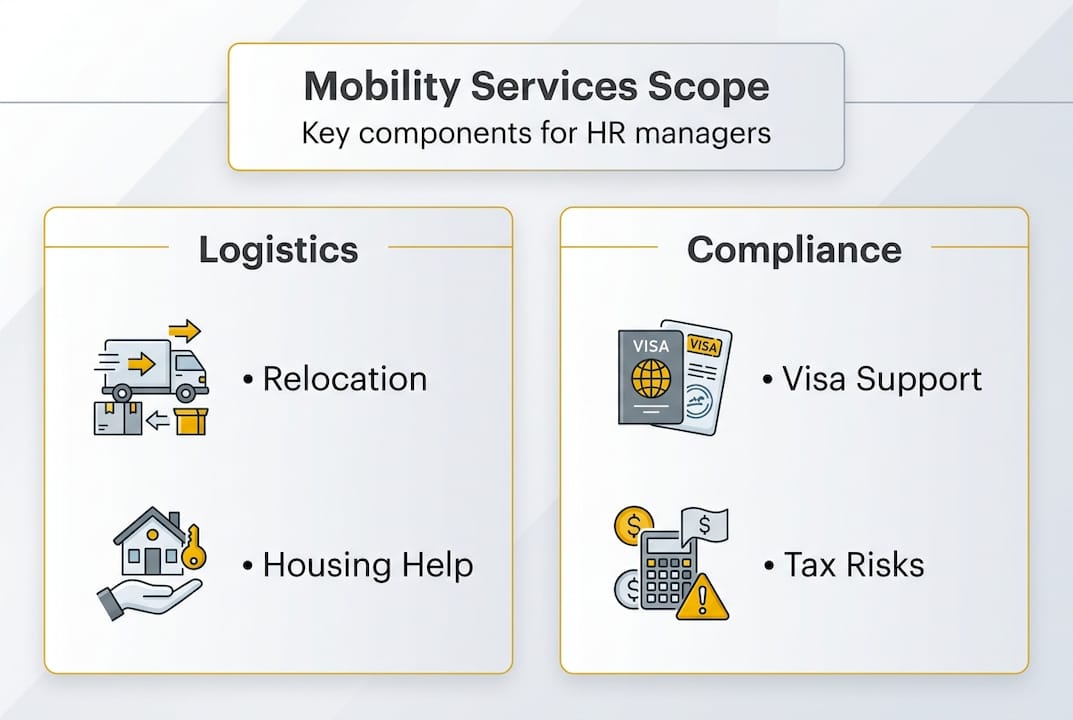
At their core, these services address the fundamental challenge of moving employees across international borders while managing complex regulatory requirements and maintaining business continuity. The scope includes several interconnected components:
The variety of assignment types adds another layer of complexity. Organizations now manage short-term assignments lasting weeks or months, long-term assignments spanning years, permanent transfers, global mobility employee immigration for remote workers, and business travel that may trigger compliance obligations. Each assignment type carries distinct logistical requirements, tax implications, and employee support needs.
For HR and global mobility managers, these services function as both operational tools and strategic enablers. Operationally, they ensure employees can work legally in host countries, receive appropriate compensation, and access support services. Strategically, they enable talent deployment that supports business expansion, knowledge transfer, and leadership development across global operations.

The integration of these components determines program success. When immigration delays housing search, or tax planning happens too late, the entire employee experience suffers. Effective mobility services coordinate all elements simultaneously, creating seamless transitions that protect both the organization and the employee.
Delivering effective mobility services requires methodologies that connect operational execution with strategic business objectives. Organizations that treat mobility as purely transactional miss opportunities to leverage international assignments for competitive advantage.
Strategic alignment with business goals forms the foundation of modern mobility services. This means understanding why assignments happen, whether they support market expansion, skill development, or critical project delivery, and designing services that maximize assignment success. When mobility teams participate in workforce planning discussions, they can proactively address talent gaps and succession needs through international assignments.
Policy development creates the governance framework for mobility programs. Comprehensive policies address:
Vendor coordination represents a critical operational methodology. Organizations typically work with immigration attorneys, relocation companies, tax advisors, and destination service providers across multiple countries. Effective coordination means selecting qualified vendors, negotiating service agreements, managing handoffs between providers, and monitoring service quality. The complexity multiplies when managing assignments across dozens of countries simultaneously.
Technology platforms have become essential for tracking assignees and automating compliance workflows. Modern global mobility technology enables centralized visibility into assignment status, automated task management, document repositories, and reporting capabilities that were impossible with spreadsheets. These platforms integrate vendor management, employee portals, and compliance tracking in unified systems.
Cross-functional collaboration ensures mobility services address all organizational requirements. HR manages employee experience and career development. Legal teams oversee immigration compliance and contract issues. Finance handles cost projections, tax obligations, and budget management. Procurement negotiates vendor agreements. When these functions operate in silos, gaps emerge that create risk or degrade service quality.
Pro Tip: Partner with Employer of Record services for edge cases where establishing a legal entity isn’t feasible. This approach lets you deploy talent to new markets quickly while maintaining compliance with local employment laws.
The methodology also includes continuous improvement through data analysis and stakeholder feedback. Tracking metrics like assignment success rates, time to deployment, cost per assignment, and employee satisfaction reveals opportunities to streamline processes and enhance service delivery. Organizations that master employee relocation programs regularly benchmark their approaches against industry practices and adapt policies to changing business needs.
Compliance challenges represent the most significant risk area in global mobility services. The intersection of multiple countries’ tax codes, immigration regulations, labor laws, and social security systems creates a complex environment where mistakes carry serious financial and legal consequences.
Tax residency rules create immediate compliance obligations. Most countries apply the 183-day rule for tax residency, meaning employees working in a location for more than half a year may become tax residents subject to local income tax. This triggers tax equalization calculations, withholding requirements, and potential double taxation scenarios that require careful planning. Short-term assignments initially planned for weeks can inadvertently cross this threshold, creating unexpected tax liabilities for both employee and employer.
Permanent establishment risk emerges when employee presence creates a taxable business presence in a host country. If a senior employee conducts business negotiations or signs contracts in a country where the company lacks a legal entity, tax authorities may claim the company now has a permanent establishment subject to corporate income tax. This risk intensifies with remote work arrangements where employees work from countries without company operations.
“Remote work can create permanent establishment and tax nexus issues, and local labor laws may apply even on short stays, requiring proactive assessment of immigration, tax, labor, social security, and PE risks.”
Social security coordination between countries adds another compliance layer. Bilateral totalization agreements prevent double social security contributions, but they require proper documentation and vary significantly by country pair. Without coordination, employees and employers may pay social security in both home and host countries, substantially increasing assignment costs.
Immigration compliance challenges vary by assignment length and employee nationality. Business visitors often work under visa waiver programs with strict activity limitations. Short-term assignments require work permits with specific validity periods. Long-term assignments need residence permits with different application processes and timelines. Remote workers face particularly complex immigration questions as many countries lack clear visa categories for employees working remotely for foreign employers.
Local labor law applicability creates additional obligations. Employment contracts may need to comply with host country standards for working hours, vacation entitlements, termination procedures, and employee representation rights. Even short assignments can trigger these requirements, particularly in European countries with strong employee protections.
Pro Tip: Conduct a five-point risk assessment for every assignment covering immigration, tax, labor law, social security, and permanent establishment exposure. This proactive approach identifies issues before they become problems.
The table below illustrates how different assignment types create distinct risk profiles:
| Assignment Type | Primary Tax Risk | Immigration Risk | Labor Law Risk | PE Risk |
|---|---|---|---|---|
| Business travel (under 30 days) | Low, unless frequent | Visa waiver limits | Minimal | Moderate if senior role |
| Short-term (3-12 months) | 183-day threshold | Work permit required | Increasing after 6 months | High without planning |
| Long-term (1-3 years) | Tax residency certain | Full work authorization | Full compliance required | Managed through entity |
| Permanent transfer | Home country exit, host entry | Immigration pathway needed | Complete host country rules | Low, employee on local payroll |
| Remote work (indefinite) | Immediate based on location | Often unclear | Potentially applicable | High risk area |
Edge cases multiply with digital nomads and remote workers who change locations frequently or work from countries where the company has no presence. These situations require case-by-case analysis and often involve trade-offs between compliance perfection and operational practicality. Organizations must decide their risk tolerance and establish clear policies about where employees can work remotely.
The evolution of global mobility services reflects broader shifts in how organizations view international assignments and manage distributed workforces. Traditional and modern approaches differ fundamentally in philosophy, execution, and success metrics.
Traditional mobility programs operated as cost centers focused on logistics and compliance. Policies were rigid, applying standard packages regardless of assignment purpose or employee needs. Success meant completing relocations on time and within budget, with limited attention to employee experience or business outcomes. These programs often sat within HR administration, disconnected from strategic talent planning.
Modern mobility services function as strategic talent tools that integrate diversity, equity, and inclusion considerations alongside business requirements. Policies flex based on assignment rationale, employee circumstances, and location factors. Success encompasses employee satisfaction, knowledge transfer effectiveness, and business impact alongside cost management. These programs partner with business leaders to deploy talent strategically and develop future leaders through international experience.
| Aspect | Traditional View | Modern View |
|---|---|---|
| Program purpose | Necessary cost for international operations | Strategic talent deployment and development |
| Policy approach | Standardized packages for all | Flexible, purpose-driven solutions |
| Technology use | Spreadsheets and email coordination | Integrated platforms with automation |
| Success metrics | Cost per assignment, on-time completion | Employee retention, business impact, DEI progress, experience scores |
| Organizational position | HR administration function | Strategic partner to business and talent leaders |
Several trends are reshaping mobility services for the coming years. The growth of policies accommodating remote, hybrid, and short-term arrangements reflects workforce expectations and business needs for agility. Organizations now offer:
Technology adoption continues accelerating as organizations recognize that manual processes cannot scale with growing mobility portfolios. Unified platforms automate vendor management, compliance tracking, cost projections, and employee communications. Artificial intelligence increasingly supports decision-making through predictive analytics about assignment costs, compliance risks, and success probabilities.
Success measurement is expanding beyond cost metrics to capture broader program value. Forward-thinking organizations track:
Pro Tip: Benchmark your mobility program annually against industry standards using survey data and technology ROI measurements. This helps identify improvement opportunities and build business cases for program investments.
The focus on employee experience recognizes that assignment success depends heavily on how well employees and families adapt to new locations. Services now emphasize pre-assignment counseling, ongoing support during assignments, and structured repatriation planning. Organizations realize that neglecting the employee experience leads to failed assignments, productivity losses, and talent attrition that far exceed any cost savings from minimal support.
These trends point toward mobility services becoming more personalized, technology-enabled, and strategically integrated with overall talent management. Organizations that embrace this evolution position themselves to compete effectively for talent and deploy that talent wherever business needs require.
Managing global mobility services effectively requires the right combination of expertise, technology, and flexible approaches that adapt to your organization’s unique needs. xpath.global provides integrated solutions that help HR and global mobility managers streamline operations, maintain compliance, and deliver exceptional employee experiences.
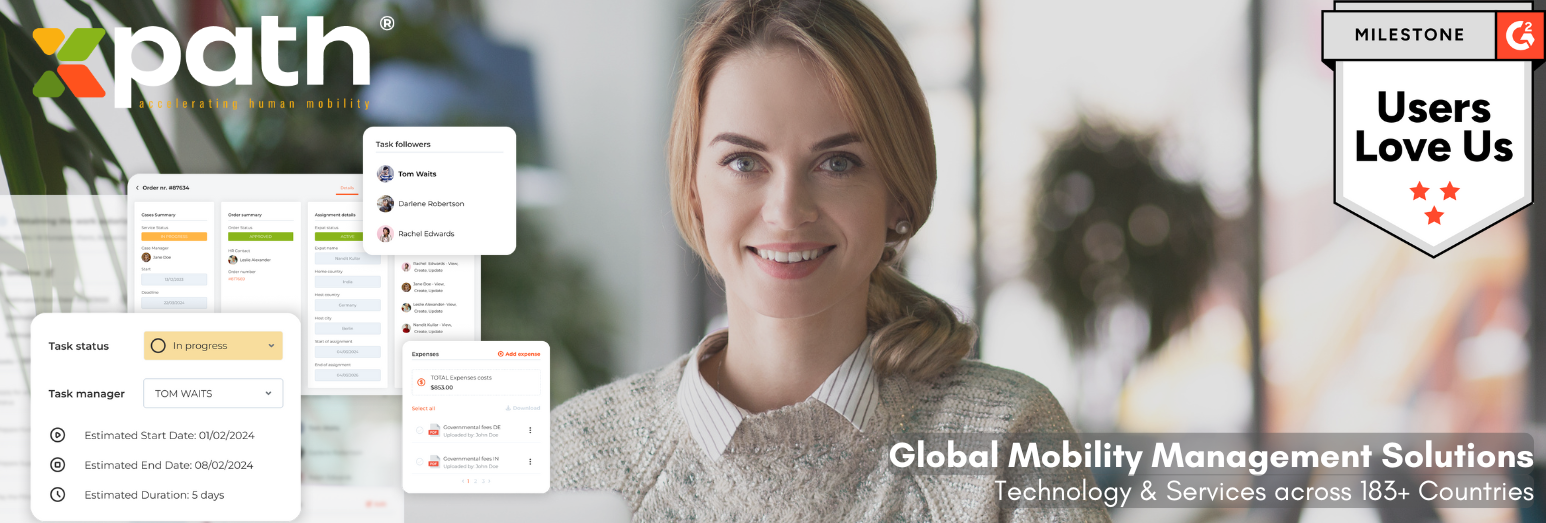
Our platform connects all aspects of international assignments in one unified system, from immigration tracking to vendor coordination to employee portals. Global mobility solutions that accommodate remote and hybrid workforces let you deploy talent flexibly while managing compliance obligations across multiple jurisdictions. Automated workflows reduce administrative burden, freeing your team to focus on strategic initiatives rather than manual coordination.
Whether you’re building a mobility program from scratch or optimizing an existing one, xpath.global’s expertise helps align your services with business objectives. Our marketplace connects you with vetted service providers across 183 countries, while our technology gives you visibility and control over your entire mobility portfolio. Explore how choosing the right global mobility technology and embracing remote work in your mobility program can elevate your program’s effectiveness and employee satisfaction.
Organizations manage five primary assignment types: short-term assignments lasting weeks to months, long-term assignments spanning one to three years, permanent transfers, remote work arrangements, and business travel that may trigger compliance obligations. Each type carries distinct logistical requirements, tax implications, immigration needs, and employee support considerations. Understanding these assignment types helps you design appropriate policies and support services for each scenario.
Technology platforms automate compliance workflows, vendor coordination, and assignment tracking that would otherwise require extensive manual effort. They provide centralized visibility into your mobility portfolio, enable data-driven decision-making through analytics and reporting, and improve employee experience through self-service portals and mobile access. Organizations using modern global mobility technology report significant time savings, reduced compliance risks, and better cost control compared to spreadsheet-based approaches.
The five major compliance risk areas are tax residency rules that create unexpected tax liabilities, permanent establishment exposure that triggers corporate tax obligations, immigration violations from improper work authorization, labor law non-compliance with host country employment standards, and social security coordination failures leading to double contributions. Remote and hybrid work arrangements amplify these risks by creating employee presence in countries without proper planning. Proactive compliance management through cross-functional coordination and expert guidance is essential to avoid penalties and legal issues.
Modern services incorporate flexible assignment policies that recognize remote and hybrid work realities while establishing clear compliance boundaries. This includes defining approved work locations, conducting tax and immigration assessments before approving remote work requests, implementing technology to track employee locations, and partnering with compliance experts to navigate complex scenarios. Unified platforms help manage telecommuting globally by centralizing approvals, tracking compliance obligations, and coordinating necessary registrations or work authorizations across multiple countries.
Previous article
Italy Checklist: Sponsoring Highly Skilled Migrant Visas
Grab a copy of a guide to international employee relocation
View E-book