






TL;DR:
- True end-to-end relocation involves coordinated management across all assignment phases, from planning to repatriation.
- Effective programs require integrated processes, cross-department collaboration, and technology that connects all services.
- Challenges stem from organizational silos, complex regulations, and individual employee needs, necessitating deliberate process design.
Most HR leaders managing international assignments have encountered the same frustrating pattern: a relocation that looks well-organized on paper begins to fracture the moment it crosses a border. Immigration timelines slip, tax filings get missed, and the employee’s family arrives in a new country without adequate settling-in support. The term “end-to-end relocation” is used widely in the industry, but it is frequently misunderstood, misapplied, or simply oversold. This article defines what end-to-end relocation actually means in a global context, identifies the critical components that make it work, exposes the hidden challenges that derail even well-funded programs, and provides a practical roadmap for HR professionals ready to build something that holds up under real-world conditions.
Key Takeaways
| Point | Details |
|---|---|
| Full-scope relocation | True end-to-end relocation addresses every phase, from planning to repatriation, for employees and HR. |
| Interdepartmental barriers | Success requires seamless collaboration among HR, Legal, Finance, and IT—not just good tools. |
| Hidden challenges | Immigration rules, tax issues, and family needs introduce surprising complications for global moves. |
| Process plus technology | Digital solutions are helpful, but strong processes and feedback loops are essential for effective mobility. |
| HR’s crucial role | HR professionals drive integration, communication, and practical improvements in relocation programs. |
Defining end-to-end relocation in a global context
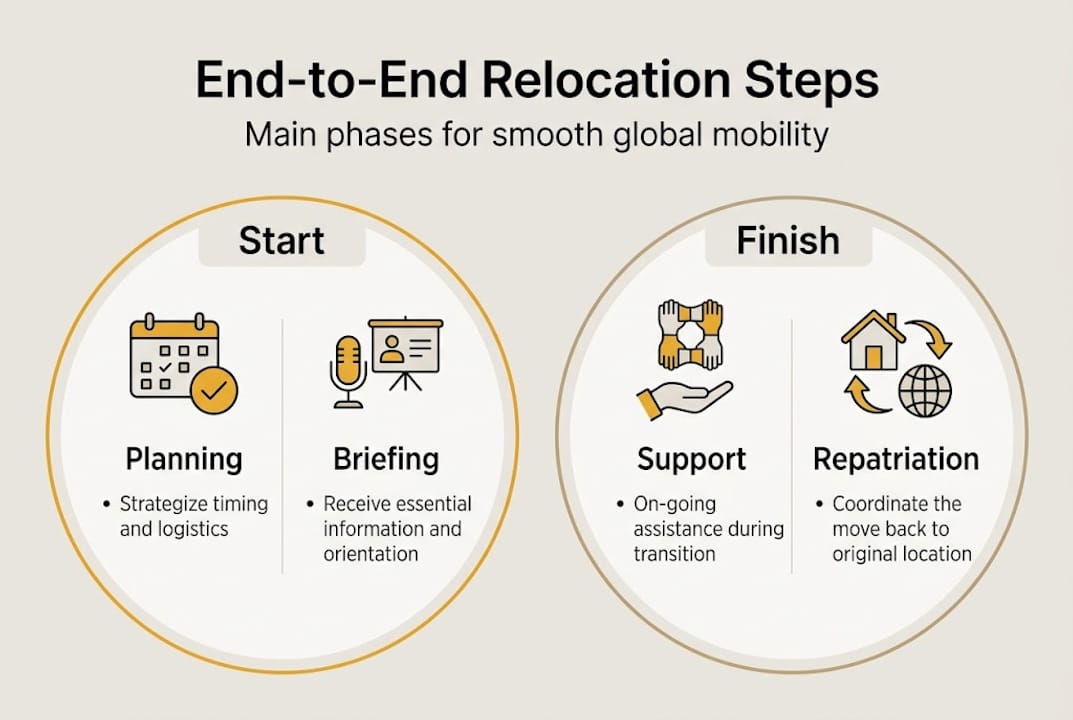
With the need for clarity established, let’s define what end-to-end relocation truly involves. In the simplest terms, end-to-end relocation refers to a managed process that covers every phase of an employee’s international move, from initial planning through final repatriation or localization. It is not a single service or a vendor relationship. It is an integrated program that connects people, processes, and technology across the full assignment lifecycle.
For HR and corporate mobility teams, this means coordinating across five broad stages:
| Stage | Key activities |
|---|---|
| Pre-move planning | Policy design, cost projections, employee briefing |
| Pre-departure | Immigration filing, home sale or lease termination, school search |
| On-assignment support | Housing, tax compliance, payroll coordination |
| Settling-in | Cultural orientation, banking, local registration |
| Repatriation or localization | Return logistics, tax equalization, career reintegration |
Each stage involves multiple departments. HR sets policy and manages the employee relationship. Legal and immigration counsel handle work permits and visa applications. Payroll and Finance manage compensation differentials, tax equalization, and cost tracking. Facilities or Procurement may oversee vendor contracts. Without deliberate coordination across all of these functions, gaps appear.
Typical services included in a genuine end-to-end program cover:
- Home search and temporary housing
- Immigration and work permit processing
- Destination services and settling-in support
- School search and family orientation
- International tax filing and compliance
- Household goods shipping
- Cultural and language training
- Ongoing assignment management
- Repatriation planning
The relocation services for HR that genuinely qualify as end-to-end are those where each of these elements is connected within a single process framework, not simply offered as optional add-ons.
As inter-departmental silos and personal employee factors make achieving true end-to-end relocation genuinely challenging, organizations must treat process integration as a design requirement, not an afterthought.
Pro Tip: A relocation checklist is a useful reference tool, but it is not a process. Checklists track tasks; integrated processes ensure that the right people act on the right tasks at the right time, with accountability built in.
Core components: What makes a relocation truly ‘end-to-end’?
Now that we know what end-to-end means, it’s important to pinpoint the essential ingredients. The distinction between a genuine end-to-end program and a fragmented approach is often invisible until something goes wrong. The table below illustrates how the two models differ in practice.
| Feature | End-to-end program | Traditional/fragmented approach |
|---|---|---|
| Single point of coordination | Yes | No, multiple contacts |
| Immigration integrated with HR workflow | Yes | Separate vendor, separate timeline |
| Tax compliance tracked throughout | Yes | Reactive, often post-assignment |
| Family support included | Yes | Optional or excluded |
| Real-time visibility for HR | Yes | Delayed or manual reporting |
| Policy compliance monitoring | Automated | Manual review |
The numbered sequence below reflects the order in which these components must be activated to avoid downstream failures.
- Immigration and work authorization must be initiated before any other logistics begin. Delays here cascade through every subsequent stage.
- Home search and temporary housing should be coordinated in parallel with immigration, not after it concludes.
- Financial and tax planning must begin pre-departure, covering tax residency determination, shadow payroll setup, and cost-of-living adjustments.
- Family integration support, including school search, spousal career assistance, and cultural orientation, directly affects assignment success rates.
- Ongoing compliance monitoring ensures that social security obligations, local registration requirements, and host-country tax filings remain current throughout the assignment.
- Repatriation planning should begin at least six months before the assignment end date to avoid knowledge loss and employee disengagement.
International moves introduce unique challenges including tax residency, immigration complexity, family support needs, and cultural adjustment, all of which must be addressed within a single coordinated framework. Following proven relocation steps helps HR teams avoid the most common sequencing errors and ensures that no critical phase is treated as optional.

Hidden challenges and complexities in end-to-end relocation
Understanding the essential components is only half the battle. Let’s address the obstacles that can derail even the best-laid plans. Many of the most damaging failures in international relocation are not caused by missing services. They are caused by the gaps between services, the moments where one department’s responsibility ends and another’s has not yet begun.
Consider some of the edge cases that routinely complicate international assignments:
- Employees holding multiple passports, which creates overlapping tax residency obligations
- Families with children requiring specialized educational placements not available through standard school search services
- Dual-income households where the trailing spouse requires work authorization in the host country
- Employees with pre-existing medical conditions that affect host-country insurance eligibility
- Assignments to countries with restricted immigration categories that require legislative exceptions
These situations expose the limits of even well-designed programs. The root cause is almost always structural. HR, Legal, Finance, and Payroll each operate within their own systems and timelines. When a tax issue surfaces mid-assignment, for example, the payroll tax challenges for HR that follow often require retroactive corrections that are expensive and time-consuming. Similarly, global mobility tax risks that go undetected during an assignment can create significant liability at repatriation.
Common pitfalls that HR teams encounter include:
- Delayed work permit approvals caused by incomplete documentation from multiple departments
- Miscommunication between the relocation vendor and the in-house HR team on policy entitlements
- Compliance gaps when employees move between host countries mid-assignment
- Inadequate handoffs between pre-departure and on-assignment service providers
“Digital tools help streamline international moves, but strong processes are still necessary for consistent, compliant outcomes.”
This is a critical insight. Technology can automate task routing and surface compliance alerts, but it cannot substitute for deliberate process design, trained personnel, and clear escalation paths when exceptions arise.
How HR can implement a truly end-to-end solution
So, how can HR take control and create a truly end-to-end process? Here’s a roadmap. Building an integrated relocation program requires more than selecting the right platform or signing a contract with a global relocation management company. It requires organizational alignment and a commitment to continuous improvement.
- Map the full assignment lifecycle across every department involved. Document who is responsible for each task, what triggers each handoff, and where accountability currently breaks down.
- Establish a cross-functional mobility committee that includes representatives from HR, Legal, Finance, Payroll, and IT. This group should meet regularly to review active cases, resolve escalations, and update policy.
- Select technology that connects, not just tracks. A platform that integrates case management, vendor coordination, and compliance monitoring within a single interface reduces the risk of inter-departmental miscommunication.
- Conduct regular program audits. Review completed assignments to identify recurring failure points. Use employee feedback surveys at 30, 90, and 180 days post-arrival to capture experience data.
- Build policy flexibility into the program design. Rigid one-size-fits-all policies create exceptions that overwhelm the process. Tiered policy structures allow HR to accommodate varying assignment types without abandoning consistency.
- Invest in change management. New processes and platforms fail when stakeholders are not trained or when internal champions are not identified to sustain adoption.
End-to-end relocation success requires breaking down inter-departmental silos and applying robust processes alongside technology. Reviewing global mobility best practices and following a structured relocation workflow guide gives HR teams a practical foundation to build from rather than starting from scratch.
Pro Tip: Before scaling a new relocation program across all business units, run a structured pilot with a small cohort of assignees. A pilot surfaces process gaps, technology limitations, and communication failures at a manageable scale, before they affect dozens of employees simultaneously.
A realist’s take: What most HR guides miss about end-to-end relocation
Beyond best practices, here’s what we’ve learned from years helping organizations tackle relocation challenges. The most persistent misconception in global mobility is that a sufficiently advanced platform will solve the coordination problem. It will not. Technology reduces friction and improves visibility, but it does not replace the human judgment required to navigate an employee’s unique circumstances.
Perfect end-to-end execution is rare. Organizations that aim for 95% program consistency and invest in resolving the remaining 5% through well-trained coordinators consistently outperform those that chase perfection through platform upgrades alone. The real differentiator is internal ownership. Programs that designate a named mobility lead, not just a department, tend to perform better because accountability is clear.
Another underappreciated factor is the cost of underinvesting in change management. HR teams frequently allocate budget to vendor contracts and technology licenses while neglecting the training and communication work required to make those investments function. Small, visible wins, such as a faster immigration approval or a smoother school placement, build internal confidence in the program far more effectively than a large-scale rollout announcement. Regularly soliciting feedback from recently relocated employees through brief structured surveys is one of the most reliable ways to identify where the process is breaking down before it becomes a retention issue. More practical guidance is available through mobility management articles that address real-world program challenges.
Ready to transform your mobility programs?
If you’re ready to address your organization’s biggest mobility gaps, here’s how to move forward. Building a genuinely integrated relocation program is achievable, but it requires the right combination of process design, technology, and expert support.
xpath.global supports HR teams and corporate mobility managers at every stage of the assignment lifecycle, from pre-departure planning through repatriation. With access to over 60,000 corporate relocation services across 183 countries and a unified platform that connects HR, vendors, and employees in a single environment, xpath.global eliminates the fragmentation that undermines most programs. Whether you are building a program from the ground up or auditing an existing one for gaps, connect with a relocation expert to discuss your specific requirements. You can also review the seamless employee mobility steps that leading organizations use to structure their programs.
Frequently asked questions
What does end-to-end relocation include?
End-to-end covers every phase of a move, from pre-departure planning and immigration through settling-in support and repatriation, including financial, tax, and compliance components throughout. It is a connected process, not a collection of individual services.
Why is it challenging to achieve a true end-to-end relocation process?
Relocation is difficult due to silos, cross-border tax and immigration regulations, and the highly individual needs of each employee and their family. No two assignments are identical, which means programs must be both structured and adaptable.
Can technology alone guarantee end-to-end relocation success?
No. Digital tools help streamline workflows and improve visibility, but strong cross-department processes, trained personnel, and clear accountability structures are equally essential for consistent outcomes.
How can HR evaluate if their program is truly end-to-end?
HR can use structured audits, employee feedback surveys at key post-arrival intervals, and gap checks at every stage to determine whether all relocation phases are integrated, compliant, and employee-centric rather than simply documented.
Recommended
- Global mobility best practices: streamline relocation & boost engagement
- 5 Strategic Steps to Simplify Global Mobility with xpath.global – xpath.global
- Master employee relocation: 4 proven global mobility steps
- Streamline your international relocation workflow: HR guide
- Guide to relocation logistics: smooth and stress-free moves
Previous article