






Managing international assignments has never been more demanding. Immigration regulations shift without warning, employee expectations around relocation support have risen sharply, and the cost of a failed assignment can reach three times an employee’s annual salary. HR professionals and corporate relocation managers who rely on informal processes or outdated playbooks face compounding risks: compliance gaps, disengaged assignees, and ballooning program costs. This article delivers a structured, evidence-based framework covering policy design, employee support, technology selection, contingency planning, and continuous improvement, giving your team the tools to run a mobility program that performs reliably at scale.
Key Takeaways
| Point | Details |
|---|---|
| Strategic alignment | Link mobility policies to business goals for maximum impact and compliance. |
| Employee support | Investing in relocation, healthcare, and cultural integration increases engagement and reduces failed assignments. |
| Technology leverage | Using integrated platforms ensures compliance, transparency, and program scalability. |
| Proactive planning | Mitigate risks by forecasting challenges and building effective contingency plans. |
| Continuous improvement | Regularly review and update your program by measuring outcomes and acting on feedback. |
Set clear mobility goals and policies
Every high-performing global mobility program starts with a clearly articulated strategy. Without measurable goals, mobility teams spend their time reacting to individual assignment requests rather than executing a coherent program aligned to business growth. Before moving a single employee, define what success looks like across three dimensions: compliance, employee engagement, and cost control.
A structured approach to policy design typically follows these steps:
- Define program objectives. Identify whether the program primarily supports talent development, fills critical skills gaps in new markets, or enables project-based international work. Each objective demands a different policy structure.
- Align policies with local labor law. Every destination country carries its own employment, tax, and immigration requirements. Policies that ignore local regulations create immediate compliance risk and potential financial penalties.
- Establish assignment parameters. Specify duration categories (short-term, long-term, permanent transfer), eligible benefits, compensation approaches such as tax equalization or tax protection, and repatriation terms.
- Set measurable success metrics. Track assignment completion rates, time-to-productivity, and post-assignment retention to evaluate program effectiveness over time.
- Communicate expectations clearly. Assignees who understand their benefits, obligations, and timelines before departure are significantly more likely to complete assignments successfully.
Focusing on enhancing employee satisfaction from the policy design stage reduces friction later. Policies that feel fair and transparent build trust with assignees and their families, which directly influences engagement and retention.
Pro Tip: Involve finance, legal, tax, and business unit leaders in the policy design process early. Their input surfaces practical constraints before they become costly mid-assignment surprises, and their early buy-in accelerates approval when new assignment types arise. Reviewing international workforce management tips can also help your team identify policy gaps before they surface in the field.
Prioritize employee experience and support
Once the policy framework is in place, the human element becomes the decisive factor in assignment success. Relocating an employee internationally is not simply a logistical exercise. It involves uprooting families, navigating unfamiliar healthcare systems, adapting to new cultural norms, and managing the psychological stress of operating in an unfamiliar environment.

Research consistently shows that supported employees are 10% more engaged than their unsupported peers, and engagement directly correlates with assignment completion and post-assignment retention. The support infrastructure your program provides is not a cost center. It is a performance driver.
Effective employee support during international assignments includes:
- Cultural integration training. Pre-departure and in-country cultural coaching reduces misunderstandings, accelerates professional effectiveness, and lowers the risk of early assignment termination.
- Healthcare access. Assignees need clear guidance on local healthcare systems, international health insurance coverage, and emergency medical protocols from day one.
- Housing and settling-in support. Temporary accommodation on arrival, followed by structured housing search assistance, removes one of the most stressful elements of relocation.
- Ongoing communication channels. Regular check-ins between HR, the assignee, and their manager identify emerging issues before they escalate into assignment failures.
- Family support services. Spousal career assistance and schooling support for children are frequently cited as top factors in assignment acceptance and completion.
“Employee support that includes cultural integration, healthcare, housing, and ongoing communication produces assignees who are measurably more engaged and productive throughout their international assignment.”
Investing in enhancing employee experience at every stage of the assignment lifecycle pays dividends in retention and employer brand. Strong global talent management practices recognize that the employee journey does not end at departure. It continues through every phase of the assignment and into repatriation.
Leverage technology for tracking and compliance
With people support structures established, the next priority is ensuring that operational processes are efficient, auditable, and scalable. Manual coordination through spreadsheets and email chains introduces errors, creates compliance blind spots, and consumes disproportionate HR bandwidth.
Modern mobility technology benefits include centralized case management, real-time immigration and tax compliance tracking, automated workflow triggers, and integrated reporting dashboards. The practical impact is significant: teams that adopt end-to-end platforms report faster assignment initiation, fewer compliance incidents, and better visibility into program costs.
| Feature | End-to-end platform | Point tools |
|---|---|---|
| Case management | Centralized, single view | Fragmented across systems |
| Compliance tracking | Real-time, automated alerts | Manual, periodic reviews |
| Vendor coordination | Integrated marketplace | Separate procurement process |
| Reporting and analytics | Unified dashboards | Siloed data exports |
| HRIS integration | Native or API-based | Often limited or custom-built |
| Scalability | Designed for volume growth | Requires additional tools |
End-to-end platforms consistently outperform point tools when mobility programs operate across multiple jurisdictions or manage more than a handful of concurrent assignments. The compliance tracking capability alone justifies the investment, particularly as immigration authorities in key markets increase enforcement activity.
Pro Tip: When evaluating technology, prioritize solutions that integrate natively with your existing HRIS and payroll systems. Disconnected platforms create duplicate data entry and reconciliation errors that undermine the efficiency gains you are trying to achieve. Programs supporting mobility for remote teams benefit especially from platforms with flexible workflow configuration.
Plan proactively for challenges and contingencies
Even well-designed mobility programs encounter unexpected disruptions. Immigration processing delays, family emergencies, political instability, and sudden regulatory changes can derail assignments that were tracking perfectly. The difference between a program that recovers quickly and one that suffers lasting damage is the presence of documented contingency plans.
Common risks that mobility teams must anticipate include:
- Immigration delays or denials. Work permit processing timelines vary widely and can extend unexpectedly, particularly in markets with high application volumes.
- Family adjustment challenges. A spouse or partner who struggles to adapt to the host country is one of the most frequently cited reasons for early assignment termination.
- Emergency scenarios. Medical emergencies, natural disasters, and civil unrest require pre-established evacuation and repatriation protocols.
- Assignment scope changes. Business priorities shift. Having a process for extending, modifying, or terminating assignments without compliance exposure is essential.
The following table provides a sample contingency planning framework that mobility teams can adapt:
| Challenge | Proactive action | Backup resource |
|---|---|---|
| Immigration delay | Begin applications 90 days early | Alternative visa category review |
| Family adjustment issues | Pre-departure family counseling | In-country support network referral |
| Medical emergency | International health insurance briefing | 24/7 emergency assistance provider |
| Regulatory change | Quarterly compliance review schedule | Local immigration counsel on retainer |
| Early assignment termination | Repatriation protocol in assignment letter | HR escalation process documented |
Building contingency thinking into your program design from the outset is a hallmark of mature mobility operations. Teams focused on finding global talent in competitive markets understand that protecting the assignment investment requires planning for what can go wrong, not just optimizing for what goes right. Smart HR strategies treat risk management as a core program competency rather than an afterthought.
Continuously measure, iterate, and improve mobility outcomes
The strongest mobility programs treat program assessment as an ongoing discipline rather than an annual review exercise. Data collected throughout the assignment lifecycle reveals patterns that inform policy adjustments, vendor decisions, and budget allocations.
A structured improvement cycle follows three steps:
- Collect data systematically. Track assignment completion rates, time-to-productivity, assignee satisfaction scores, compliance incident frequency, and post-assignment retention. Gather feedback at key milestones: pre-departure, mid-assignment, and repatriation.
- Act on trends, not isolated incidents. A single assignment failure may reflect individual circumstances. A pattern of failures in a specific destination or assignment type signals a systemic issue that requires policy or process adjustment.
- Communicate adjustments to stakeholders. When program changes are made in response to data, inform assignees, managers, and business unit leaders. Transparency about program evolution builds confidence and encourages ongoing feedback.
Key performance indicators (KPIs) worth tracking include assignment success rates, cost-per-assignment versus budget, immigration compliance incident rates, and assignee net promoter scores. Measuring mobility satisfaction through structured surveys provides qualitative data that quantitative metrics alone cannot capture.
Benchmarking against industry peers adds external context to internal data. Industry surveys and team collaboration with peer HR networks reveal whether your program’s performance metrics align with sector norms or indicate areas where investment is warranted. Programs that iterate regularly outperform static programs over a three-to-five year horizon, as policy adjustments compound into meaningful efficiency and engagement gains.
Why best practices aren’t enough: The power of adaptability in global mobility
There is a common mistake that even experienced mobility teams make: treating best practices as a fixed playbook. A policy framework that performed well in 2022 may create compliance exposure in 2026 because immigration regulations in key markets have changed, remote work expectations have shifted, or the company’s business strategy has evolved into new geographies with entirely different risk profiles.
The global economy does not pause for program reviews. Tax treaties are renegotiated. Social security totalization agreements are suspended. Host country governments introduce new work authorization categories with short implementation timelines. Mobility leaders who rely solely on documented processes without building a culture of continuous learning will find their programs drifting out of alignment with operational reality.
What separates high-performing mobility leaders is not the quality of their initial policy documents. It is their capacity to absorb new information quickly, adjust processes in real time, and communicate changes clearly to assignees and business stakeholders. Staying current on employee experience insights and actively engaging with global HR peer networks provides the external perspective that internal program reviews cannot replicate. Process discipline and rapid adaptability are not competing priorities. They are complementary capabilities that define mobility program maturity.
Streamline your global mobility with expert support
Building a mobility program that consistently delivers on compliance, cost control, and employee experience requires more than good intentions. It requires the right technology, the right vendor network, and access to expertise that spans immigration, tax, and relocation logistics across multiple jurisdictions.
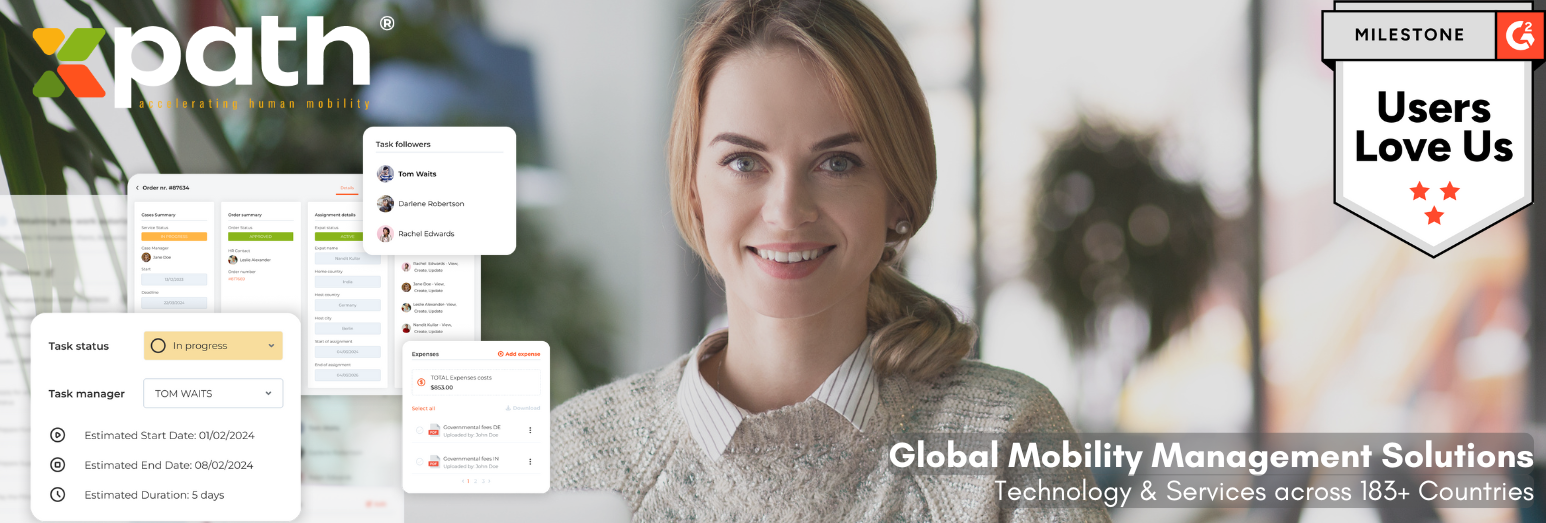
xpath.global provides HR leaders with a unified platform that centralizes case management, automates compliance workflows, and connects your team to a vetted marketplace of over 60,000 mobility services across 183 countries. Whether you are designing a new program or optimizing an existing one, our specialists are ready to help. Contact our HR experts to discuss your specific program needs, explore how to master employee relocation at scale, or get guidance on mobility technology that fits your organization’s growth trajectory.
Frequently asked questions
What is a global mobility best practice for policy creation?
A best practice is to align mobility policy with business goals while ensuring clear communication of assignment terms, compliance obligations, and benefit entitlements to assignees before departure.
How can HR teams support employees during international relocation?
Providing cultural integration training, healthcare guidance, housing support, and ongoing communication throughout the assignment lifecycle produces higher engagement and significantly reduces early termination rates.
What role does technology play in global mobility management?
Technology centralizes assignment data, automates compliance tracking across jurisdictions, and enables real-time decision-making, reducing administrative burden and minimizing the risk of costly compliance incidents.
How do you measure the success of a global mobility program?
Track KPIs including assignment completion rates, post-assignment retention, cost-per-assignment versus budget, and assignee satisfaction scores to identify trends and continuously optimize program performance.
Recommended
- 5 Strategic Steps to Simplify Global Mobility with xpath.global – xpath.global
- Master employee relocation: 4 proven global mobility steps
- Master employee relocation programs for global mobility
- Tired of High Global Mobility Costs? It’s Time to Rethink Your Strategy – xpath.global
- Employee Retention Solutions, Lower Turnover | OpenElevator