






TL;DR:
- Strategic global mobility providers deliver end-to-end support, analytics, and technology integration.
- Technology like AI and self-service portals improve efficiency, compliance, and program visibility.
- Measuring KPIs such as cost, compliance, and employee satisfaction optimizes provider relationships and program outcomes.
Most HR teams treat service providers as interchangeable vendors, selected on price and replaced when contracts expire. That assumption is costing organizations more than they realize, in compliance failures, assignment delays, and missed opportunities to move talent efficiently across borders. The global mobility landscape in 2026 demands a fundamentally different approach. This guide clarifies what service providers actually do, how their role has shifted from transactional to strategic, and how HR professionals and relocation managers can build provider relationships that deliver measurable results across every stage of the assignment lifecycle.
Key Takeaways
| Point | Details |
|---|---|
| Partners, not vendors | Modern service providers act as strategic partners with policy, tech, and ROI support. |
| Technology leads the way | AI, portals, and marketplaces are essential to efficient, compliant global mobility programs. |
| End-to-end wins | Integrated providers reduce risks and streamline complex international assignments. |
| Measure for growth | Track KPIs to ensure your provider delivers both compliance and business value. |
Why service providers matter in global mobility
In the global mobility context, a service provider is any external organization engaged to support the planning, execution, or compliance of an international employee assignment. That definition sounds straightforward, but the scope it covers is vast. A single assignment can require immigration attorneys, tax advisors, destination services firms, moving companies, temporary housing coordinators, and technology platforms, each operating in different jurisdictions with different regulatory obligations.
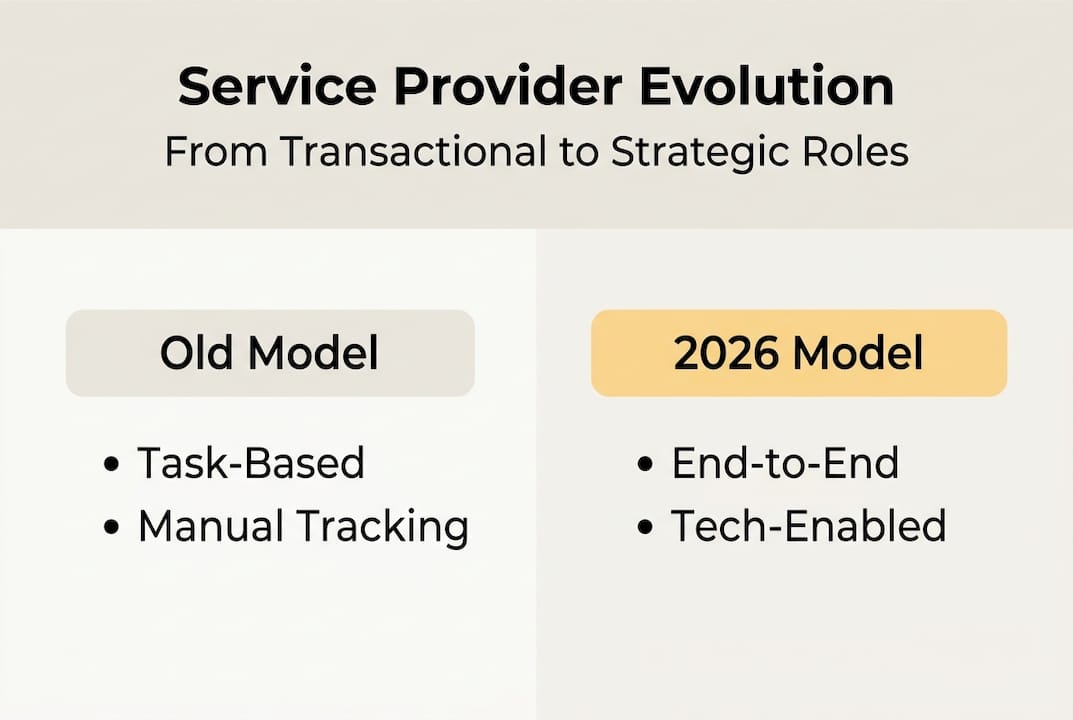
The traditional model treated each of these as a separate, task-based engagement. Immigration handled the visa. A moving company packed the boxes. A tax firm filed the return. These functions rarely communicated with each other, and the HR team absorbed the coordination burden. That model created fragmentation, compliance gaps, and significant administrative overhead.
What has changed is the expectation placed on providers. Providers are evolving from transactional coordinators to strategic partners offering policy benchmarking, ROI analytics, and technology integration. This shift reflects the growing complexity of international assignments and the pressure on HR teams to demonstrate program efficiency and cost control.
Core service categories in global mobility include:
- Immigration and work authorization: Visa applications, permit renewals, right-to-work compliance
- Tax advisory and equalization: Cross-border tax exposure, social security contributions, bilateral agreement analysis
- Relocation logistics: Household goods shipping, temporary accommodation, destination orientation
- Technology platforms: Assignment management systems, employee self-service portals, vendor marketplaces
- Policy and compensation consulting: Benchmarking, allowance structures, cost-of-living adjustments
Provider selection has a direct impact on assignment success rates. When providers operate as strategic partners in global mobility, they bring institutional knowledge that reduces errors, accelerates timelines, and protects the organization from regulatory exposure. Investing in internal process management alongside the right external partners is what separates high-performing mobility programs from reactive ones.
From transactional to strategic: Key evolutions in provider roles
The shift from transactional to strategic is not just a marketing phrase. It reflects a structural change in how the best providers operate and what they are expected to deliver. Understanding this distinction helps HR teams ask better questions during procurement and set more rigorous performance expectations.
| Dimension | Transactional provider | Strategic provider |
|---|---|---|
| Scope | Single-service delivery | End-to-end program support |
| Data sharing | Minimal, reactive | Proactive reporting and analytics |
| Policy input | None | Benchmarking and advisory |
| Technology | Basic or none | Integrated platforms and automation |
| Compliance role | Reactive filing | Proactive risk identification |
| Relationship model | Vendor | Partner |
Today’s providers offer end-to-end solutions, policy benchmarking, ROI analytics, and technology integration, shifting away from siloed, fragmented services. The journey from coordinator to partner typically follows a recognizable progression:
- Scope expansion: The provider moves beyond a single service category to cover adjacent functions.
- Data integration: The provider connects their systems with the HR team’s platforms for real-time visibility.
- Policy advisory: The provider contributes to assignment policy design, not just execution.
- Analytics delivery: Provider-driven analytics become a standard part of the engagement, informing decisions on cost control and program design.
- Continuous improvement: The provider proactively identifies inefficiencies and proposes solutions, rather than waiting to be directed.
End-to-end providers reduce the coordination burden on HR teams significantly. When immigration, tax, and relocation are managed within a single provider relationship or a tightly integrated ecosystem, information flows more reliably, handoffs are cleaner, and compliance risks are caught earlier. Piecemeal vendor arrangements, by contrast, require the HR team to act as the integration layer, a role most mobility teams are not resourced to perform well.

Understanding mobility ROI becomes far more achievable when a strategic provider is tracking program costs and outcomes across the full assignment lifecycle.
Pro Tip: During your next RFP process, ask providers to demonstrate how they have contributed to policy improvements or cost reductions for existing clients. A transactional vendor will describe service delivery. A strategic partner will show you data.
Technology as a game-changer: Self-service, AI, and marketplaces
Technology has become the clearest differentiator between providers that add genuine value and those that simply process transactions. Technology such as self-service portals, AI, and vendor marketplaces is essential for efficiency in mobility management. For HR teams evaluating providers, understanding the technology stack is no longer optional.
| Technology | Primary function | Benefit for HR teams |
|---|---|---|
| Self-service portals | Employee document management and tracking | Reduces HR administrative load |
| AI-powered tools | Compliance monitoring, cost modeling | Faster decisions, fewer manual errors |
| Vendor marketplaces | Access to vetted global service providers | Reduced procurement time, cost transparency |
| Automated workflows | Task sequencing and milestone tracking | Consistent process execution |
| Reporting dashboards | Real-time program analytics | Improved visibility and control |
“The mobility programs that perform best are those where technology removes the coordination burden from HR, not those where HR is expected to manage coordination manually across multiple disconnected systems.”
AI in HR business processes is accelerating compliance monitoring in particular. AI tools can flag regulatory changes in destination countries, identify employees approaching permit expiration, and model the tax impact of assignment extensions, all tasks that previously required significant manual effort.
When evaluating a provider’s technology capabilities, consider the following:
- Does the platform integrate with your existing HRIS or ERP systems?
- Can employees access assignment information and upload documents through a mobile interface?
- Does the provider offer real-time compliance alerts tied to specific jurisdictions?
- How does the system handle data security and cross-border privacy regulations?
- Are reporting outputs customizable to your internal KPI frameworks?
Providers that lack robust technology force HR teams to compensate with spreadsheets and manual follow-up. The compliance risk that creates is real. AI and compliance tools now allow organizations to maintain audit-ready records automatically, a capability that becomes critical during tax authority reviews or immigration audits.
Choosing and managing service providers for optimal results
Selecting the right provider is a structured decision, not an intuitive one. HR teams that approach provider selection with a clear framework consistently achieve better outcomes than those who rely on existing relationships or price alone.
A practical selection and management framework includes the following steps:
- Define program requirements: Identify the geographies, assignment types, and service categories your program requires before approaching any provider.
- Assess end-to-end capability: Determine whether the provider can cover multiple service categories or whether you will need to coordinate across multiple vendors.
- Evaluate technology integration: Confirm that the provider’s platform can connect with your internal systems and support streamlined process management.
- Review compliance credentials: Verify the provider’s track record in the jurisdictions where you operate, particularly for immigration and mobility tax compliance.
- Assess data transparency: Request sample reports and confirm that the provider can deliver the analytics your program needs.
- Establish performance benchmarks: Define KPIs at contract signature, not after service delivery begins.
- Schedule regular reviews: Build quarterly business reviews into the contract to assess performance, address gaps, and plan for program changes.
End-to-end solutions are preferred over siloed services for consistency and efficient compliance. When a single provider manages immigration, tax, and relocation within an integrated system, the risk of information falling between functions is substantially reduced.
Pro Tip: Watch for service agreements that define success in activity terms, such as applications filed or calls completed, rather than outcome terms such as compliance rates or time-to-deployment. Activity metrics protect the vendor. Outcome metrics protect your program.
Measuring ROI and continuous improvement with providers
A provider relationship that cannot be measured cannot be managed. The most effective global mobility programs treat provider performance as an ongoing data exercise, not an annual contract review.
Providers now offer ROI analytics as a core part of strategic partnership. That means HR teams should expect, and demand, structured reporting as a standard deliverable rather than an optional add-on.
Key metrics to track across your provider relationships include:
- Cost per assignment: Total spend by assignment type, destination, and service category
- Compliance rate: Percentage of assignments completed without regulatory violations or late filings
- Time to deployment: Average days from assignment initiation to employee start date in the destination country
- Employee satisfaction scores: Measured through structured feedback at key assignment milestones
- Vendor response times: Average time from request to action across service categories
- Exception rate: Frequency of non-standard requests that require manual intervention
Using analytics for mobility ROI enables HR teams to identify patterns that are not visible in individual case reviews. For example, if time-to-deployment consistently increases for a specific destination country, that signals either a provider capacity issue or a regulatory change requiring a process adjustment.
Reporting data also creates negotiating leverage. When you can demonstrate that a provider’s response times have increased or that exception rates have risen over a contract period, you have an objective basis for renegotiating terms or reallocating volume to better-performing vendors. Continuous improvement requires that feedback loop to be systematic, not episodic.
A new lens on service providers: What most overlook
Most provider evaluations focus on price and reputation. Both matter, but neither predicts strategic value. The organizations that consistently outperform their peers in global mobility are those that have learned to prioritize tech fluency and data transparency over brand recognition and historical relationships.
The uncomfortable reality is that long-standing provider relationships often mask performance problems. When a provider has been in place for several years, HR teams tend to normalize their limitations rather than benchmark them against current market standards. That normalization is expensive.
Building ROI business cases for provider investment requires data that many legacy providers simply cannot supply. If your current provider cannot tell you your average cost per assignment by destination, your compliance exception rate by service category, or your employee satisfaction score by assignment type, you are operating with significant blind spots.
The providers that will define the next decade of global mobility are those that treat data as a shared resource, not a proprietary asset. HR teams that internalize this standard and apply it consistently in procurement will build programs that are genuinely resilient, not just operationally adequate.
Unlocking smoother mobility with xpath.global
The principles outlined in this guide, strategic provider selection, technology integration, outcome-based performance measurement, are exactly what xpath.global is built to support.
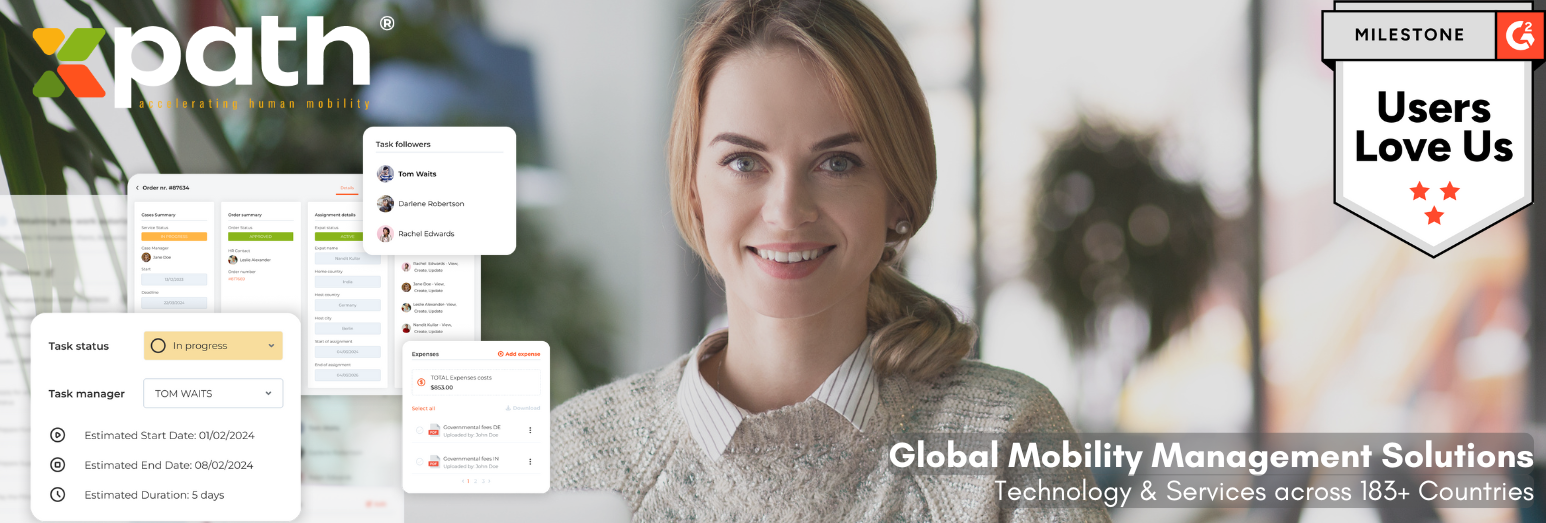
xpath.global combines a unified global mobility platform with a marketplace of over 60,000 services across 183 countries, giving HR teams direct access to vetted immigration, tax, relocation, and compliance providers within a single digital environment. The platform’s reporting and analytics capabilities make ROI measurement a standard part of program management, not an afterthought. To explore how xpath.global can strengthen your provider strategy, connect with global mobility experts or review the platform’s competitive advantage. For organizations embracing remote work alongside traditional assignments, xpath.global offers a scalable foundation for both.
Frequently asked questions
What are the main types of service providers in global mobility?
The main types include immigration specialists, tax advisors, relocation managers, and technology platform providers, each covering distinct but often overlapping compliance and logistics functions within an international assignment.
How does technology improve service provider efficiency?
Tech tools such as AI, self-service portals, and vendor marketplaces automate routine tasks, maintain compliance monitoring in real time, and give HR teams visibility into assignment progress without manual follow-up.
How can HR leaders benchmark provider performance?
HR leaders should track KPIs including cost per assignment, compliance rates, employee satisfaction scores, and time to deployment, using analytics and ROI tracking that top providers now deliver as standard.
Why is an end-to-end provider preferable to multiple siloed vendors?
End-to-end providers integrate immigration, tax, and relocation within a single workflow, reducing handoff errors and administrative burden while delivering consistent, efficient compliance across all assignment stages.