






TL;DR:
- Outdated mobility procurement practices cause compliance failures, delays, and poor employee experiences.
- Modern procurement emphasizes agility, strategic partnerships, compliance, and technology integration.
- Aligning procurement with organizational and employee needs improves costs, compliance, and talent retention.
Outdated mobility procurement practices are quietly draining resources from global mobility programs. When HR teams rely on fragmented vendor lists, manual spreadsheets, and cost-only selection criteria, they expose their organizations to compliance failures, assignment delays, and poor employee experiences. The stakes are significant: a single non-compliant relocation can trigger tax penalties, visa violations, and talent attrition. This guide clarifies what mobility procurement actually means, contrasts traditional and modern approaches, outlines the strategic factors HR professionals must prioritize, and shows how aligning procurement with organizational goals produces measurable results across cost, compliance, and employee satisfaction.
Key Takeaways
| Point | Details |
|---|---|
| Strategic partnerships matter | Agile, culturally aligned providers drive better results than cost-only approaches. |
| Compliance must be proactive | Technology and global expertise safeguard against costly compliance errors. |
| Employee experience is key | Satisfied relocating talent leads to smoother, more successful assignments. |
| Modern procurement boosts ROI | Moving beyond traditional RFPs increases efficiency and delivers measurable business value. |
Defining mobility procurement: The foundation of global relocation success
Mobility procurement is the structured process by which organizations identify, evaluate, contract, and manage the vendors and service providers that support international employee relocations. It spans a wide operational scope, including immigration counsel, relocation management companies (RMCs), tax advisors, destination services providers, temporary housing suppliers, and moving companies. Unlike general corporate procurement, which typically focuses on price-per-unit and contract standardization, mobility procurement must account for jurisdiction-specific compliance requirements, cultural nuances, and the direct impact on employee wellbeing.
The distinction matters because the consequences of poor vendor selection in global mobility extend far beyond budget overruns. A relocation management company that lacks compliance expertise in a target country can expose the assignee and the organization to immigration violations, payroll tax errors, and social security contribution failures. These are not theoretical risks. They are operational realities for HR teams managing cross-border assignments at scale.
Strategic mobility procurement involves several interconnected elements:
- Vendor selection and qualification: Assessing providers on global coverage, compliance track record, technology capabilities, and cultural competency
- Policy alignment: Ensuring vendor services map directly to the organization’s assignment policy tiers and benefit structures
- Contract management: Negotiating terms that include service-level agreements, compliance warranties, and transparent pricing
- Performance monitoring: Tracking vendor delivery against defined metrics, including compliance rates, employee satisfaction scores, and cost-per-move
- Continuous improvement: Using data from completed assignments to refine vendor relationships and policy frameworks
The contrast with traditional procurement is stark. As noted in research on global mobility RFP design, traditional RFPs are frequently criticized as slow and spreadsheet-heavy, while modern approaches emphasize agile, collaborative strategies that prioritize partnerships and cultural fit over pure cost reduction. The shift is from transactional to strategic, from cost-focus to ROI and strategy alignment.
“Mobility procurement is not a purchasing exercise. It is a risk management and talent enablement function that directly shapes assignment outcomes.”
For HR teams that want to manage international assignments effectively, treating procurement as a strategic discipline rather than an administrative task is the foundational step.
Traditional vs. modern mobility procurement: What’s changed?
For decades, global mobility procurement followed a predictable pattern. HR teams issued formal RFPs, collected bids from a pool of RMCs and vendors, scored responses primarily on cost, and awarded contracts on a multi-year cycle. The process was methodical but rigid. Vendor relationships were transactional. Mid-assignment adjustments were slow. Compliance gaps were often discovered after the fact.
Modern mobility procurement operates on fundamentally different principles. Agility replaces rigidity. Strategic partnerships replace transactional contracts. ROI alignment replaces cost-only evaluation. The following comparison illustrates the shift:

| Feature | Traditional procurement | Modern procurement |
|---|---|---|
| Selection criteria | Lowest cost | Value, compliance, cultural fit |
| Process speed | Slow, multi-month RFPs | Agile, iterative evaluation |
| Vendor relationship | Transactional | Strategic partnership |
| Technology use | Spreadsheets and email | Integrated platforms and dashboards |
| Compliance approach | Reactive | Proactive and real-time |
| Employee focus | Minimal | Central to procurement criteria |
| Performance measurement | Annual review | Continuous, data-driven |
The global mobility RFP research confirms this evolution, noting that agile, collaborative strategies now emphasize partnerships and cultural fit, representing a clear departure from the slow, spreadsheet-heavy models of the past.
For HR professionals managing relocation vendors, the practical implication is that the RFP itself should no longer serve as the primary evaluation mechanism. Instead, structured discovery conversations, pilot assignments, and technology demonstrations provide far richer insight into a provider’s actual capabilities.
The shift also changes what HR teams measure. Cost-per-move remains relevant, but it now sits alongside metrics like compliance incident rates, employee net promoter scores (NPS), and assignment completion rates. These indicators reveal whether a vendor is genuinely supporting business objectives or simply fulfilling contractual minimums.
Pro Tip: When evaluating mobility vendors, request references specifically from clients in your target assignment corridors. A provider with strong performance in Western Europe may have limited operational depth in Southeast Asia or Latin America. Geographic specificity in reference checks reveals capability gaps that broad portfolio claims will not.
Organizations that are streamlining relocation programs consistently report that the transition to modern procurement models reduces administrative overhead and improves assignment outcomes simultaneously.
Strategic factors in mobility procurement: What HR must prioritize
Understanding the transition sets the stage for making smarter choices. The following factors represent the criteria that distinguish high-performing mobility procurement programs from those that generate ongoing operational friction.
Global coverage and in-country depth: A vendor’s claimed geographic reach must be verified against actual in-country infrastructure. Providers with genuine local networks deliver faster permit processing, more accurate cost estimates, and better employee support on the ground. For efficient global relocations, prioritizing RMCs with 150+ countries of coverage, proven compliance expertise, and technology for real-time tracking ensures seamless compliance and employee satisfaction.
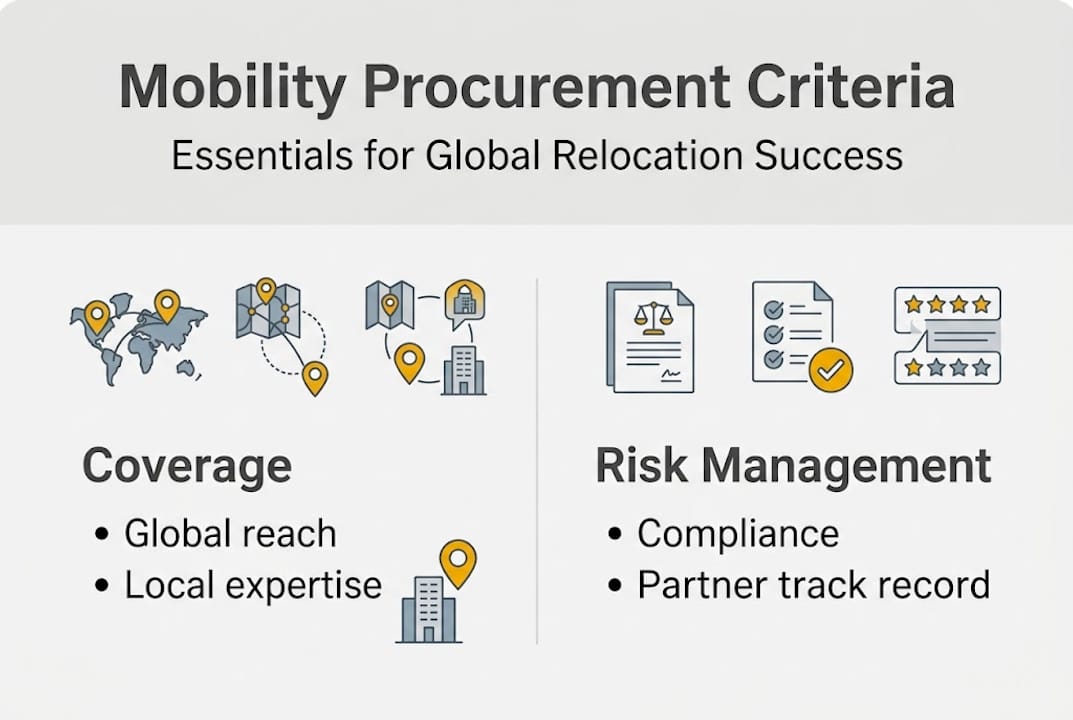
Compliance expertise: Immigration law, tax treaty application, and social security totalization agreements vary significantly across jurisdictions. Vendors must demonstrate not only awareness of these frameworks but active capability to apply them. Ask providers to walk through a recent compliance challenge and how they resolved it.
Technology integration: Modern relocation management software enables real-time case tracking, automated compliance alerts, and consolidated reporting. When evaluating vendors, assess whether their technology integrates with your HRIS and provides the visibility your team needs to manage assignments proactively.
A structured approach to building a more strategic procurement process involves the following steps:
- Define your mobility program requirements: Document assignment volumes, destination corridors, policy tiers, and compliance priorities before engaging any vendor.
- Develop a weighted evaluation framework: Assign scores to criteria including compliance expertise, technology, global coverage, employee experience, and cost transparency.
- Conduct structured discovery sessions: Replace generic RFP responses with live demonstrations and scenario-based discussions.
- Run pilot assignments: Test shortlisted vendors on lower-risk assignments before committing to full program contracts.
- Establish performance governance: Define service-level agreements, reporting cadences, and escalation protocols at contract execution.
- Review and optimize continuously: Use assignment data to refine vendor relationships and identify improvement opportunities on a quarterly basis.
Pro Tip: One of the most common pitfalls in partner selection is over-relying on global brand recognition. A well-known RMC with a large marketing presence may subcontract heavily in your key corridors, reducing both service quality and compliance accountability. Always ask who delivers the service on the ground, not just who manages the contract.
For HR teams seeking relocation services guidance, these steps provide a replicable framework that scales across assignment volumes and organizational complexity.
Aligning mobility procurement with organizational goals and employee experience
Having mastered strategic factors, it is time to scale the benefits for both business and talent. Mobility procurement does not operate in isolation. It sits at the intersection of talent strategy, operational efficiency, and employee experience, and the decisions made during vendor selection and contract design ripple through all three dimensions.
From a business perspective, well-structured procurement reduces the total cost of mobility programs by eliminating redundant vendors, negotiating volume-based pricing, and reducing compliance incident costs. From a talent perspective, it determines whether relocating employees feel supported or abandoned during one of the most stressful professional transitions they will face.
The following table illustrates measurable outcomes that organizations can expect from strategic procurement improvements:
| Outcome area | Baseline (traditional) | Improved (strategic procurement) |
|---|---|---|
| Cost per assignment | High, variable | Reduced by 15 to 25% |
| Compliance incident rate | 8 to 12% of assignments | Below 2% |
| Employee NPS (relocation) | 30 to 45 | 65 to 80 |
| Assignment completion rate | 78% | 90%+ |
| Vendor management time | 40% of team capacity | Below 20% |
For HR teams building step-by-step relocation programs, aligning procurement criteria with talent strategy means asking whether selected vendors can support not just logistics but also the cultural adjustment and professional continuity of relocating employees.
Practical ways HR can improve both efficiency and experience through procurement include:
- Incorporating employee feedback from previous relocations into vendor evaluation criteria
- Requiring vendors to provide dedicated employee-facing support contacts, not just HR-facing account managers
- Selecting providers with mobile-accessible employee portals for document management and status tracking
- Building service-level requirements around employee milestones, such as housing confirmation timelines and permit processing windows
- Using enhanced employee experience metrics as formal contract performance indicators
The dual value proposition is clear. Strategic procurement that accounts for real-time compliance tracking and employee satisfaction simultaneously produces better business outcomes and stronger talent retention.
Why most mobility procurement strategies miss the mark
Most mobility procurement strategies fail not because HR teams lack effort, but because the frameworks they inherit were designed for a different era. Rigid RFPs that prioritize price submissions over capability demonstrations systematically exclude the agile, culturally competent providers that modern assignments require. Excessive cost focus creates a race to the bottom that erodes service quality precisely when employees need it most.
The real frustration for HR professionals is that compliance surprises and employee complaints often emerge months after a vendor contract is signed, long after the procurement process has concluded. By then, the connection between a poor procurement decision and a failed assignment is difficult to trace.
What the field needs is a procurement model that balances process rigor with genuine empathy for relocating staff. Technology enables compliance visibility and reporting, but it cannot substitute for vendors who understand that behind every assignment is a person navigating an unfamiliar country, often with family in tow. The organizations that get this right treat mobility best practices not as a checklist but as a living operational standard, reviewed and refined with every assignment cycle.
Level up your global mobility procurement with expert support
Applying these strategies requires both the right framework and the right technology infrastructure. xpath.global combines enterprise mobility technology with hands-on consulting expertise to help HR teams build procurement programs that are efficient, compliant, and employee-centered.
The platform provides access to over 60,000 vetted mobility technology solutions across 183 countries, transparent vendor pricing, and automated compliance workflows, all within a single digital environment. Whether you are redesigning your vendor selection process or scaling an existing program, our relocation service guide offers practical frameworks to move forward with confidence. Ready to transform your mobility procurement approach? Contact mobility experts at xpath.global to explore solutions tailored to your program’s specific requirements.
Frequently asked questions
What are the main steps in mobility procurement for global relocation?
The main steps include assessing organizational needs, selecting providers with 150+ countries coverage and proven compliance expertise, ensuring cultural fit, and implementing technology for real-time tracking and reporting.
How does mobility procurement reduce compliance risks?
Structured procurement enforces rigorous vendor vetting, real-time compliance tracking, and policy-aligned service-level agreements, which collectively minimize immigration and tax errors during employee relocations. Proven compliance expertise embedded in vendor selection criteria is the most direct mechanism for reducing compliance incidents.
What is the key difference between traditional and modern mobility procurement?
Traditional methods rely on cost-focused, slow spreadsheet-heavy RFPs, while modern strategies prioritize agility, cultural fit, strategic partnerships, and ROI alignment over pure cost reduction.
Why do HR leaders need to consider employee experience in mobility procurement?
A positive relocation experience directly influences assignment completion rates and talent retention. Vendors selected with employee satisfaction criteria built into procurement frameworks consistently deliver higher employee NPS scores and lower attrition among relocated staff.
Recommended
- Relocation best practices: Optimize global mobility in 2026
- Global mobility best practices: streamline relocation & boost engagement
- Why use mobility platforms: 70% less admin, higher ROI
- 10 Powerful Ways Global Mobility Technology Is Changing Workforce Management – xpath.global
- Guide to relocation logistics: smooth and stress-free moves
Previous article