






TL;DR:
- Mobility case management centralizes all aspects of international employee relocation into a transparent, auditable workflow, reducing errors and increasing employee confidence. Its core features include document control, compliance tracking, assignment monitoring, and vendor coordination, all of which improve operational risk management. Effective programs leverage automation, data centralization, and employee support strategies to maximize process efficiency and compliance adherence.
Most HR managers and global mobility professionals have experienced the same frustrating scenario: an international assignment is underway, and suddenly no one can confirm whether the employee’s work permit has been approved, the tax advisor has received the correct documentation, or the housing provider has been formally engaged. The relocation process fragments across inboxes, spreadsheets, and disconnected vendor portals, creating confusion that costs time, money, and employee trust. A mobility case management system offers a structured solution to this problem, centralizing every element of the relocation lifecycle into one auditable, transparent environment. This guide explains what mobility case management is, how it works, and how HR teams can use it strategically to eliminate operational risk.
Key Takeaways
| Point | Details |
|---|---|
| Clarity on mobility case management | Understand the complete scope of mobility case management for international workforces. |
| Compliance made easier | Effective case management dramatically improves regulatory adherence and reduces risk. |
| Technology enables efficiency | Digital platforms automate workflows, centralize data, and support real-time decision-making. |
| Best practices drive results | Applying proven strategies ensures smoother, safer employee relocations for HR teams. |
Understanding mobility case management
With a clearer sense of the chaos mobility case management addresses, let’s unpack its foundational concepts.
Mobility case management is a structured operational framework that orchestrates all processes tied to international employee relocation. Rather than managing immigration, tax compliance, housing logistics, and assignment tracking in separate systems or through ad hoc communication, case management consolidates every activity into a single, trackable workflow. Each assignment becomes its own “case,” with defined milestones, responsible parties, deadlines, and documentation requirements.
This matters because the complexity of international relocation grows with every additional jurisdiction involved. A single assignment from the United States to Germany, for example, may require coordination across immigration attorneys, tax advisors, social security specialists, real estate providers, and the employee’s HR business partner. Without a centralized framework, critical tasks fall through the gaps.
The key components of a robust mobility case management approach include:
- Document management: Centralized storage and version control of passports, visas, tax filings, employment agreements, and relocation authorizations.
- Compliance tracking: Real-time monitoring of visa expiry dates, work permit renewals, and regulatory filing deadlines across multiple countries.
- Assignment monitoring: End-to-end visibility into assignment status, from initiation and approval through settlement and repatriation.
- Employee support workflows: Structured onboarding for relocating employees, including access to destination services, housing search support, and schooling assistance.
- Vendor coordination: Managed engagement with relocation service providers, moving companies, tax advisors, and immigration lawyers.
The benefits are measurable. Organizations that adopt structured case management report improved process transparency, significantly reduced administrative errors, and a notably better employee experience during relocations. When employees know their case is being managed with precision, their confidence in the organization increases, and attrition related to poor relocation experiences declines.
Core processes and features of mobility case management
Now that we’ve defined mobility case management, it’s time to explore its practical building blocks.
Effective mobility case management rests on several interconnected processes, each of which requires purpose-built tools to function at scale. Understanding these processes helps HR leaders evaluate platforms critically and make informed decisions about what their program truly needs.
1. Document management and workflow automation
Document management is the backbone of any case management system. In a global mobility context, this means not simply storing files, but actively tracking document status, expiry, and completeness. Workflow automation takes this further by triggering actions automatically. When a visa application is submitted, for example, the system can automatically notify the immigration attorney, update the assignment timeline, and alert the HR manager.

2. Assignment compliance and deadline tracking
Every international assignment carries a matrix of regulatory obligations. Work permits, tax registrations, social security filings, and host-country employment registrations all have specific deadlines. Platforms with strong mobility platform features allow teams to configure automated alerts and escalations so no deadline is missed.
3. Analytics and reporting for HR decision-making
Reporting is where case management shifts from operational to strategic. HR leaders can use analytics dashboards to monitor average assignment duration, cost per relocation, compliance breach frequency, and vendor performance. These data points inform budget forecasting, policy refinement, and workforce planning decisions.
| Feature | Manual management | Automated case management |
|---|---|---|
| Document tracking | Spreadsheets, email threads | Centralized digital repository with version control |
| Compliance monitoring | Calendar reminders, manual checks | Automated alerts and escalation workflows |
| Vendor coordination | Separate portals and emails | Unified vendor interface with performance tracking |
| Reporting | Manual data aggregation | Real-time dashboards and exportable analytics |
| Employee communication | Ad hoc emails and calls | Structured employee portal with task tracking |
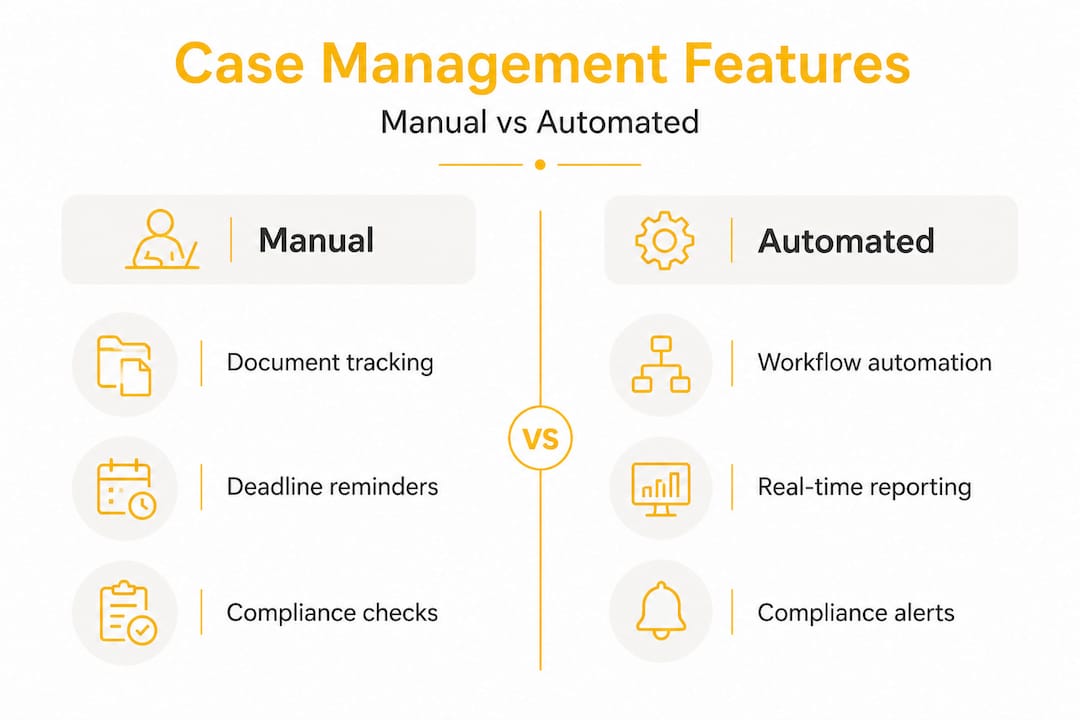
The contrast is stark. Manual processes create information asymmetry, where HR knows one part of the picture, the employee another, and the vendor a third. Automated case management creates a single shared view of reality.
Here is a sequence for building effective case management workflows in your organization:
- Audit your current mobility process to identify where data currently lives and where handoffs break down.
- Define standard case types for your most common assignment scenarios, such as short-term assignments, long-term assignments, and permanent transfers.
- Map the tasks, owners, and deadlines for each case type.
- Select a platform with case management tools that supports configurable workflows and vendor integrations.
- Train HR, assignees, and vendors on the platform before the first live case goes through it.
Pro Tip: Pilot your case management system with a small cohort of five to ten assignments before a full rollout. This allows you to identify configuration gaps and refine workflows without disrupting your entire mobility program.
Compliance in international assignments
A closer look at core features reveals compliance as a linchpin. Let’s examine it in detail.
Compliance is not a peripheral concern in global mobility. It is the single greatest source of financial and reputational risk for organizations managing international assignments. Regulatory environments shift frequently, and the consequences of non-compliance, including fines, visa cancellations, and in severe cases criminal liability for company officers, can be severe.
The regulatory landscape for international assignments typically spans three domains:
- Immigration compliance: Work permits, visa categories, right-to-work verifications, and entry conditions. Each country has specific rules about which nationalities require permits, how long they take to process, and what conditions apply.
- Tax compliance: International assignees often trigger tax obligations in both their home and host countries. Concepts like tax equalization (a policy that ensures the assignee pays no more or less tax than they would at home) and permanent establishment risk require careful management. Meeting global immigration compliance challenges head-on requires systematic tracking, not reactive problem-solving.
- Social security compliance: Bilateral social security agreements between countries determine where contributions are paid. Without proper certificates of coverage, employees may face double contributions, and the organization may bear that cost.
Common compliance risks in international assignments include:
- Missed work permit renewal deadlines resulting in illegal work situations.
- Incorrect tax filings arising from incomplete assignment data provided to tax advisors.
- Failure to register the assignee for host-country payroll or social security contributions.
- Non-standard documentation that does not meet immigration authority requirements.
- Overlooked permanent establishment risk when an employee’s activities in the host country create a taxable corporate presence.
| Compliance area | Consequence of failure | Mitigation strategy |
|---|---|---|
| Work permit expiry | Illegal employment, fines, deportation | Automated renewal alerts 90 days in advance |
| Tax filing errors | Back taxes, penalties, reputational risk | Integrated tax advisor workflows with document sharing |
| Social security | Double contributions, employee disputes | Certificate of coverage tracking within the case |
| Permanent establishment | Corporate tax exposure in host country | Legal review triggered at assignment initiation |
Organizations that treat international assignment compliance as a systematic discipline rather than a reactive task consistently demonstrate lower rates of regulatory breach and lower average compliance costs per assignment.
Statistic callout: Research in the global mobility sector consistently indicates that more than 40% of organizations identify compliance management as their single greatest mobility program challenge, reflecting the scale and urgency of this issue for HR and mobility teams worldwide.
A well-configured case management platform addresses this by embedding compliance checkpoints directly into every assignment workflow, making adherence structural rather than aspirational.
Best practices and strategies for effective mobility case management
With compliance addressed, the final step is bringing best practices into everyday management.
Optimizing mobility case management requires more than technology. It demands deliberate process design, cross-functional collaboration, and a genuine commitment to the employee experience throughout the relocation lifecycle.
Centralize case data and communication
The most persistent barrier to effective mobility management is fragmented data. When immigration documentation sits in one system, tax records in another, and vendor invoices in a third, no single person has the full picture. Centralizing all case data within a single platform eliminates this fragmentation and creates an authoritative record for every assignment. Following established mobility best practices means building this centralization into program design from the start, not retrofitting it later.
Set measurable KPIs for relocation success
You cannot improve what you do not measure. HR and mobility leaders should define key performance indicators for each dimension of the relocation process. Useful metrics include average time to visa approval, percentage of assignments completed without compliance breaches, employee satisfaction scores at 30 and 90 days post-relocation, cost variance against forecast, and vendor response times. Reviewing these KPIs quarterly allows program managers to identify deteriorating performance before it becomes a crisis.
Leverage technology for process automation
Automation is not a convenience in mobility case management. It is a risk control mechanism. Automated task triggers ensure that when one step completes, the next begins without requiring a human to remember to initiate it. This is particularly valuable for compliance-critical tasks. Applying workforce mobility tips around automation can dramatically reduce the cognitive load on mobility teams while simultaneously improving reliability.
Prioritize employee wellbeing and communication
Relocation is a significant life event for the employee and their family. How an organization manages this experience directly affects assignment success rates. Employees who feel informed, supported, and heard during a relocation are far more likely to settle into their new role quickly and remain engaged through the assignment. A structured communication cadence, including regular check-ins at assignment initiation, mid-assignment, and repatriation stages, gives employees confidence that the organization is managing their case proactively.
- Create a welcome package for assignees that outlines every step of the relocation process and who to contact at each stage.
- Assign a dedicated mobility coordinator as the primary point of contact for each assignee throughout the process.
- Schedule structured check-ins at 30, 60, and 90 days post-arrival to identify and address settlement challenges early.
- Share compliance obligations with employees in plain language, so they understand what is required of them and why.
Pro Tip: Build the employee communication plan before the first task in the case is initiated. Reactive communication during a relocation signals disorganization and erodes the employee’s confidence in the program, even when the logistics are sound.
“Effective mobility case management is not about technology alone. It is about designing processes that are transparent, measurable, and centered on the experience of the person being relocated.”
Why most organizations underutilize mobility case management
Stepping back, let’s consider what most organizations miss and how to recover untapped value.
Most corporations invest in some form of mobility case management, yet very few extract its full potential. The root cause is almost never the technology. It is the mindset with which the technology is deployed. Organizations frequently replicate their existing fragmented processes inside a new platform, carrying the same siloed workflows, the same lack of cross-departmental coordination, and the same reactive approach to compliance into a system that was built to eliminate those very problems.
The most common mistakes we observe in underperforming mobility programs include rigid, unconfigured workflows that do not reflect how assignments actually flow in practice; lack of coordination between HR, finance, legal, and the mobility team, meaning the case management system only captures part of the assignment picture; and overreliance on the platform as a record-keeping tool rather than an active management instrument.
The ROI of a truly integrated platform, one where the case management lessons learned across hundreds of assignments are codified into intelligent workflows, is substantial. Organizations report reductions in administrative processing time, lower rates of compliance breach, and significantly higher employee satisfaction when case management is genuinely embedded into the operational model rather than used as a filing system with automation features.
The uncomfortable truth is that many organizations treat case management as a tool for HR efficiency and miss its strategic value entirely. When case management data is connected to workforce planning, assignment cost analysis, and talent retention metrics, it becomes a source of competitive intelligence. Adaptability is the defining quality of a future-proof mobility function, and that adaptability depends entirely on the quality of data and process discipline that good case management provides.
Unlock your mobility potential with xpath.global
To put these insights into action, consider how xpath.global can accelerate your mobility strategy.
Managing international assignments with confidence requires more than good intentions. It requires a platform built specifically for the complexity of global mobility. xpath.global provides HR managers and mobility professionals with a unified ecosystem that connects case management, compliance tracking, vendor coordination, and employee experience in a single interface.
Whether you are managing fifty assignments per year or five hundred, xpath.global scales with your program. The platform’s structured workflows, integrated vendor marketplace across 183 countries, and real-time compliance monitoring eliminate the administrative noise that prevents mobility teams from focusing on strategic priorities. For teams ready to take the next step, the corporate relocation guide provides a practical starting point for program design, and the platform’s mobility case management system page outlines exactly how the technology works in practice. To speak directly with specialists who understand your industry’s specific mobility challenges, contact HR experts at xpath.global today.
Frequently asked questions
What challenges does mobility case management solve for HR teams?
It streamlines relocation tracking, compliance checks, and employee support into a single workflow, significantly reducing administrative errors and the operational burden on HR teams managing multiple simultaneous assignments.
How does mobility case management improve compliance for international assignments?
It centralizes all assignment documentation, automates deadline tracking, and flags emerging compliance risks, helping organizations prevent regulatory breaches before they occur rather than responding to them after the fact.
Can mobility case management tools integrate with existing HR platforms?
Yes, most modern mobility case management solutions are built with integration capabilities that allow them to connect with HRIS, payroll, and workforce management platforms, creating a unified data environment.
What features should HR look for in a mobility case management platform?
Prioritize workflow automation, real-time compliance tracking, configurable analytics dashboards, intuitive employee-facing interfaces, and robust vendor management capabilities that support end-to-end assignment coordination.
Are mobility case management systems suitable for medium-sized companies?
Absolutely. Scalable platforms are available that accommodate the budget and volume realities of medium-sized organizations, delivering the same compliance rigor and process discipline that large enterprises require, without the enterprise price tag.