






TL;DR:
- Effective HR document management involves the secure, organized lifecycle handling of employment records across multiple jurisdictions. It reduces compliance risks, speeds up retrieval, and streamlines workflows, transforming HR from a back-office function into a strategic enabler. Investing in purpose-built digital systems enhances agility, employee experience, and overall program efficiency in global mobility.
When an international assignment unravels because a work permit expired unnoticed, or a tax filing was delayed due to a missing employment contract buried in someone’s inbox, the root cause is rarely a lack of expertise. It is almost always a failure of document management. For HR teams managing cross-border relocations, the stakes of poor record-keeping are exceptionally high: regulatory penalties, assignment failures, and damaged employee trust can all result from fragmented or manual document processes. This article defines document management for HR, outlines the full lifecycle of employment records, and presents structured solutions for global mobility programs.
Key Takeaways
| Point | Details |
|---|---|
| Full document lifecycle | HR document management covers every step from creation to secure disposal, not just storage. |
| Global mobility complexity | Managing documents for international assignments requires special attention to compliance, security, and cross-border data flows. |
| Digital systems boost efficiency | Centralizing HR records and automating processes reduces errors and improves mobility program success. |
| Strategic asset for HR | Treating document management as a strategic tool enhances both compliance and employee experience in relocation. |
Defining document management for HR: What it really means
With the stakes established, it is time to get precise about what document management for HR actually entails. The term is frequently misunderstood as simple file storage, but the reality is considerably broader and more demanding.
Document management for HR is the lifecycle process of creating, capturing, organizing, securing, retrieving, retaining, and disposing of employment-related records, both digital and paper. That definition encompasses every document an employee generates or requires from their first day of hire through the end of an international assignment and beyond.
For global mobility specifically, this scope expands further. HR teams must manage records across multiple jurisdictions, in different languages, and subject to differing national retention laws. The document footprint for a single international assignee typically includes:
- Employment contract and assignment letter
- Work permit and visa documentation
- Tax equalization agreements and shadow payroll records
- Social security totalization certificates
- Housing and relocation agreements
- Benefit enrollment and medical records
- Home and host country pension documentation
- Exit and repatriation paperwork
“Effective HR document management is not just about where files are stored. It is about ensuring every record is accurate, accessible, secure, and compliant at every stage of its existence.”
Applying document management best practices from the outset of an assignment prevents cascading compliance failures later. When document processes are clear and consistent, HR teams can respond to audit requests, government inquiries, or employee disputes without scrambling through disorganized archives.
Key challenges HR faces in global mobility document management
Now that we have defined document management for HR, let us explore the specific roadblocks HR teams encounter when dealing with international assignments. These challenges are not theoretical. They appear in day-to-day operations and carry real financial and legal consequences.
Compliance complexity across jurisdictions
Each country imposes its own rules on employment records, including what must be kept, for how long, and in what format. The European Union’s General Data Protection Regulation (GDPR), for example, restricts cross-border data transfers and mandates specific consent and retention protocols. Meanwhile, other jurisdictions maintain entirely different data localization rules. A single assignee working across three countries may trigger compliance obligations in all three simultaneously.
Security risks and data privacy exposure
Sensitive employee information, including salary details, medical records, tax identification numbers, and immigration status, is a high-value target for data breaches. When documents are shared via email or stored in generic cloud folders without access controls, the risk of unauthorized exposure increases substantially. Document management for HR relocation requires encryption, role-based access, and audit trails to maintain data integrity across borders.
Version control and retention tracking
International assignment documents are rarely static. Employment contracts are amended, visa statuses are updated, and tax filings are revised. Without a formal version control system, HR teams risk acting on outdated records. Retention timelines add further complexity: some jurisdictions require employment records to be kept for five years, others for ten, and some distinctions exist between document categories within the same country.

Fragmented tools and disconnected workflows
Many HR teams still rely on a combination of email threads, shared network drives, and spreadsheets to manage assignment records. This approach introduces significant risk: documents are duplicated, mislabeled, or lost entirely. There is no single source of truth, which creates confusion for HR staff, employees, and external service providers alike.
Pro Tip: Conduct a document inventory audit before launching a new international assignment program. Identify where records currently live, who has access, and which retention timelines apply. This baseline assessment will reveal gaps that need to be addressed before the first assignee is placed.
According to research in the expat document management guide, the absence of a structured document system is one of the leading contributors to assignment delays and compliance failures in mid-sized global mobility programs. Organizations that invest in systematic document management frameworks report measurably fewer compliance incidents and faster assignment initiation timelines.
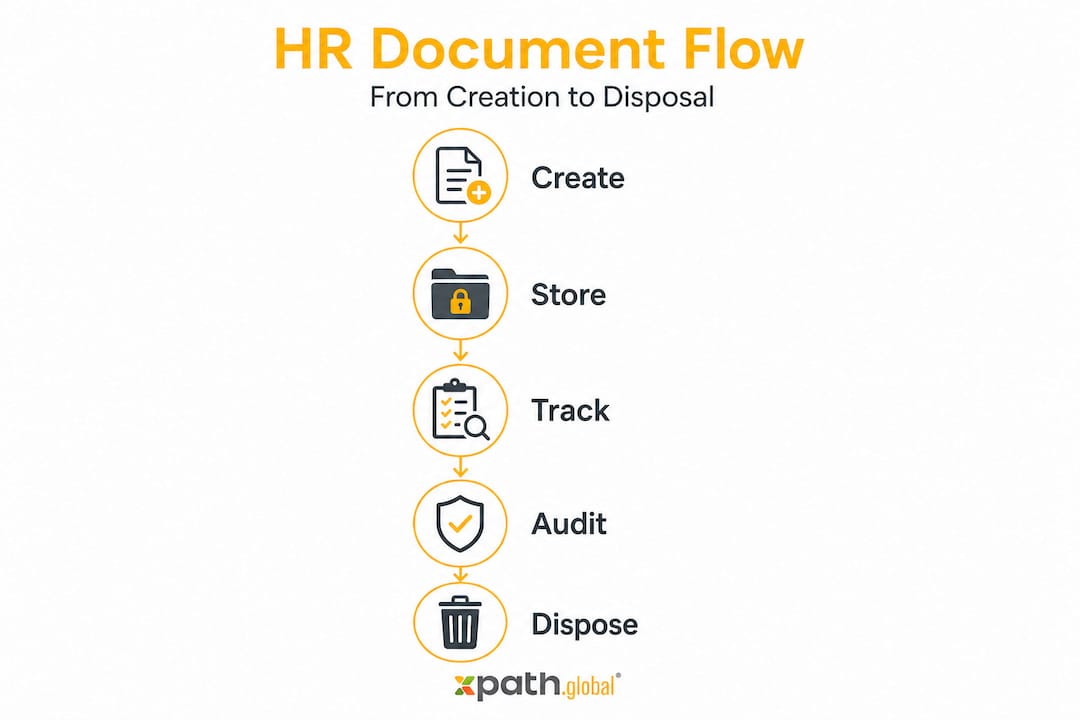
The lifecycle of HR documents: From creation to disposal
Understanding the pain points, let us see how a structured approach covers every stage of the document journey. The HR document lifecycle follows a predictable sequence, and each stage carries specific risks if left unmanaged.
- Creation: Documents are generated at assignment initiation, including contracts, letters of assignment, immigration applications, and tax agreements. Errors at this stage propagate through the entire assignment.
- Capture: Records from external parties, such as government-issued permits, housing contracts, and tax filings, must be collected, labeled, and stored systematically.
- Organization: Documents are classified by type, employee, assignment, jurisdiction, and date. Consistent naming conventions and folder structures are essential.
- Security: Access permissions are assigned based on role and need. Encryption is applied to sensitive files, and audit logs track who accessed what and when.
- Retrieval: Documents must be locatable quickly, whether for an internal audit, an employee inquiry, or a government compliance check.
- Retention: Records are held for the legally required period in each relevant jurisdiction. Retention schedules must reflect the laws of both home and host countries.
- Disposal: After the retention period expires, records are securely deleted or destroyed in a documented and auditable manner.
A core definition across sources emphasizes organizing and accessing records plus secure, compliant handling throughout creation to disposal. Digital platforms can automate steps three through seven, dramatically reducing manual effort and the probability of human error.
The table below summarizes the risk profile and automation potential at each lifecycle stage:
| Lifecycle stage | Primary risk | Automation potential |
|---|---|---|
| Creation | Inaccurate or incomplete records | Template-based document generation |
| Capture | Missing or mislabeled external documents | OCR and automated intake workflows |
| Organization | Inconsistent classification | Auto-tagging and folder rules |
| Security | Unauthorized access or data breach | Role-based permissions and encryption |
| Retrieval | Time lost searching for records | Full-text search and metadata filters |
| Retention | Non-compliance with national rules | Automated retention scheduling |
| Disposal | Improper destruction or premature deletion | Scheduled, documented disposal workflows |
Pro Tip: Map retention requirements for every country in your active assignment portfolio before configuring a digital document system. Retention rules for immigration records often differ from those for payroll records in the same jurisdiction, so category-level mapping is essential for global HR document management.
Building a structured lifecycle framework is not a one-time project. As assignment volumes grow and new host countries are added, the framework must be reviewed and updated to reflect new international document strategies and evolving regulatory requirements. HR teams that treat the lifecycle as a living process, rather than a static setup, consistently outperform those that configure a system once and leave it unchanged. The investment in streamlining document management pays dividends every time an audit request is fulfilled quickly and accurately.
Best practices and solutions for modern HR document management
With the lifecycle mapped, what does it look like to manage HR documents truly well? Here is what works and how to avoid classic mistakes.
Centralize records in a purpose-built platform
The single most impactful change an HR team can make is consolidating document storage into one system with controlled access, structured workflows, and audit capabilities. Generic enterprise file storage tools were not designed for the compliance demands of global mobility. Purpose-built platforms accommodate jurisdiction-specific retention rules, document category hierarchies, and integration with immigration and tax case management systems.
Automate retention and disposal schedules
Manual retention tracking is a compliance liability. When HR staff are responsible for remembering which documents expire when, records are inevitably retained too long or deleted too soon. Automated retention scheduling eliminates this risk by flagging records for review or disposal based on pre-configured rules aligned to national legislation.
Establish clear document protocols and naming conventions
Even the best platform fails without consistent human input. HR teams need documented protocols covering how records are named, where they are stored, who is responsible for upload, and how updates are tracked. Protocols should be reviewed annually and updated when assignment policies or host country regulations change.
Conduct regular document audits
Scheduled audits, quarterly or semi-annually, verify that all active assignment records are complete, current, and correctly classified. Audits also reveal whether access permissions remain appropriate as personnel change roles.
Apply role-based access controls
Not every member of an HR team needs access to every document category. Secure document storage requires that access be limited to those with a legitimate need, reducing both internal data exposure and the attack surface for external breaches.
The following comparison illustrates the practical difference between managing HR documents manually versus using a centralized digital system:
| Capability | Manual or fragmented approach | Centralized digital system |
|---|---|---|
| Document retrieval time | Minutes to hours | Seconds |
| Retention compliance | Dependent on staff memory | Automated and auditable |
| Version control | Inconsistent, error-prone | Tracked and enforced |
| Cross-border access | Difficult, often delayed | Immediate with controls |
| Audit readiness | Time-consuming preparation | On-demand reporting |
| Data security | Variable, often inadequate | Encrypted, role-controlled |
Document management for HR must include secure and compliant handling throughout the lifecycle, and modern digital systems are now capable of delivering this at scale without requiring large increases in administrative headcount. The efficiency gains from HR cloud mobility benefits are well documented, and the compliance advantages are equally significant.
Pro Tip: Require digital signatures on all assignment-critical documents from the start. This eliminates delays caused by physical signature collection across time zones and creates an automatic audit trail within your document management system.
The overlooked opportunity: Document management as a strategic global mobility tool
Beyond compliance and efficiency, there is a larger opportunity for HR teams willing to approach document management as a strategic function rather than an administrative necessity.
Most global mobility teams think of document management as back-office work. It is the task that happens after a decision is made, the filing that occurs once a permit is issued. This perspective significantly underestimates the strategic value of well-organized, immediately accessible assignment records.
Consider what happens when a senior business leader asks the mobility team whether a specific engineer can be deployed to a new project in Singapore within three weeks. The answer depends entirely on the team’s ability to quickly retrieve current visa status, review tax treaty positions, confirm existing employment terms, and identify any outstanding compliance obligations. If that information is scattered across email chains and shared drives, the answer takes days. If it lives in a structured, searchable system, the answer takes minutes. That speed difference directly affects the organization’s ability to respond to business opportunities.
Well-structured global mobility document strategies also improve the employee experience. Assignees who receive timely, accurate document processing report higher satisfaction with their relocation experience. Conversely, delays caused by missing paperwork or administrative errors create anxiety and erode trust in the mobility program. When employees see that their records are managed professionally and their assignments proceed without document-related disruptions, confidence in the HR function increases measurably.
There is also a workforce agility argument. Organizations that can relocate employees faster and with fewer administrative obstacles develop a genuine competitive advantage in talent deployment. Document management is one of the foundational enablers of that agility. It is not a cost center to be minimized; it is an operational capability to be invested in and optimized continuously.
HR leaders who champion document management as a strategic function, rather than tolerating it as a compliance obligation, position their mobility programs to deliver faster assignment initiation, cleaner audits, better employee outcomes, and ultimately greater value to the business.
Power your global mobility program with smarter document management
If you are ready to put these ideas into practice, the right technology partner can accelerate the transformation considerably.
xpath.global provides a unified global mobility platform designed specifically for HR teams managing international assignments at scale. Whether you are evaluating choosing mobility technology options or looking to redesign your current approach to document workflows, xpath.global offers the tools and expertise to build a compliant, efficient, and employee-friendly mobility program. Explore the full range of relocation service options available through the platform, and contact global HR experts to discuss how a structured document management framework can be integrated into your existing mobility operations.
Frequently asked questions
How does HR document management differ for international assignments?
International assignments involve greater compliance demands, cross-border data handling, and security requirements compared to domestic HR records, because records must comply with multiple national regulations simultaneously.
What documents are most critical for HR to manage during relocation?
Employment contracts, visas, tax forms, housing agreements, and benefit enrollments are among the most important, as these records form the core employment documentation required for compliance and assignment success across jurisdictions.
Why is secure disposal of HR documents important?
Proper disposal ensures privacy and legal compliance after the required retention period, since retaining sensitive HR records beyond their mandated period constitutes a data compliance risk under most national privacy frameworks.
What benefits does digital document management bring to HR mobility programs?
Digital systems automate retention scheduling, improve document retrieval speed, enforce access security, and provide audit-ready reporting, which together ensure that record handling stays compliant throughout every phase of an international assignment.
Recommended
Previous article