






TL;DR:
- Managing international assignment portfolios without centralization increases compliance risks and administrative costs. Digital case management centralizes data, automates workflows, and enhances transparency across global mobility processes, significantly improving efficiency and regulatory adherence. It transforms manual, fragmented tasks into a proactive, data-driven program that supports strategic decision-making and seamless collaboration among stakeholders.
Managing an international assignment portfolio without a centralized system is a high-stakes balancing act. HR teams and global mobility managers face an unrelenting stream of immigration deadlines, tax compliance requirements, work permit renewals, and relocation logistics, all tracked across email chains, shared drives, and fragmented spreadsheets. The resulting exposure to compliance risk is substantial, and the administrative cost is significant. Digital case management resolves this complexity by replacing disconnected manual processes with structured, automated workflows that deliver transparency, audit-readiness, and measurable efficiency gains across every phase of a global assignment.
Key Takeaways
| Point | Details |
|---|---|
| Centralized case control | Digital platforms organize all mobility cases and documents in one secure location. |
| Enhanced compliance | Automated workflows and audit trails help HR teams minimize risk and meet legal requirements. |
| Workflow efficiency | Digitized processes speed up global assignments and reduce manual work for busy HR teams. |
| Actionable analytics | Real-time dashboards offer insights for improving and scaling mobility programs. |
What is digital case management?
Digital case management, in the context of global mobility and HR, refers to a technology-driven approach to organizing, tracking, and resolving complex employee cases within a unified platform. Rather than relying on ad hoc email threads or manually updated spreadsheets, digital case management centralizes all case-related data, tasks, documentation, and communications into a single, structured environment accessible to every relevant stakeholder.
For HR case management in global mobility, this means consolidating immigration applications, tax compliance timelines, relocation logistics, and vendor interactions into one coherent system. Each case, whether it involves a long-term international assignment, a short-term business trip requiring work authorization, or a permanent cross-border transfer, can be tracked from initiation through closure with complete visibility.
The core capabilities of a mature digital case management system typically include:
- Centralized digital records for all employee and assignment documentation
- Automated workflow triggers that initiate tasks when predefined conditions are met
- Role-based access controls that ensure sensitive data is visible only to authorized parties
- Audit trails that log every action, change, and communication within a case
- Compliance calendars that track regulatory deadlines across multiple jurisdictions
- Analytics dashboards that surface case status, bottlenecks, and program-wide performance
It is worth distinguishing mobility-focused digital case management from traditional HR case management. Traditional HR systems focus primarily on employee relations matters such as grievances, performance investigations, or accommodation requests. Mobility-focused platforms, by contrast, are designed to handle cross-border complexity, including immigration law, bilateral tax treaties, and social security contribution tracking. As enterprise case management capabilities have expanded, digital HR case management now broadly encompasses analytics and automation that were simply not possible with earlier generation systems.
“A well-designed digital case management platform does not just track what happened, it enables mobility teams to anticipate what needs to happen next, and to demonstrate to regulators that the organization has consistently met its obligations.”
The practical difference for global mobility teams is significant. Case management for service providers within a digital ecosystem allows immigration attorneys, relocation companies, and tax advisors to collaborate within the same platform, updating case records in real time and eliminating the latency associated with back-and-forth email communication.
Key features and workflows in digital case management solutions
Understanding what digital case management does at a conceptual level is useful, but the real value becomes apparent when examining specific features and the workflows they support in practice.
A robust digital case management solution for global mobility typically includes the following capabilities:
| Feature | Function | Compliance benefit |
|---|---|---|
| Document management | Centralized storage with version control | Reduces expired or lost documents |
| Automated workflow triggers | Task assignment based on case milestones | Ensures no step is missed |
| Real-time alerts | Notifications for upcoming deadlines | Prevents permit expiries |
| Role-based access controls | Data segmented by user permissions | Maintains data privacy compliance |
| Analytics dashboards | Case progress and program metrics | Supports strategic decision-making |
| Audit trails | Full activity log per case | Enables regulatory audit-readiness |
Digital case management for HR emphasizes workflow automation and compliance tracking, directly reducing the manual errors that are endemic to spreadsheet-based processes. When a mobility manager initiates an assignment in the system, the platform can automatically generate a checklist of required documents, assign tasks to the relevant parties, set deadline reminders, and escalate overdue items without any manual intervention.
A typical assignment workflow in a digital case management solution proceeds through several structured stages:
- Case initiation: HR or the mobility manager creates a new assignment case, entering employee details, destination country, assignment type, and start date.
- Document gathering: The system automatically requests required documentation from the employee and relevant internal stakeholders, with automated reminders for outstanding items.
- Compliance checks: The platform cross-references jurisdictional requirements, flagging necessary work permits, visa categories, tax registrations, and social security filings.
- Approval routing: Relevant approvals, from legal, finance, or senior HR, are routed automatically according to the organization’s predefined authorization matrix.
- Service provider coordination: Vendors such as immigration attorneys and relocation companies receive task assignments directly within the platform.
- Case monitoring and closure: The system tracks outstanding tasks, compliance milestones, and assignment end dates, providing a clear picture of case status until formal closure.
This structure, enabled by the Xpath digital platform, eliminates the coordination overhead that typically burdens mobility teams managing high-volume assignment portfolios.
Pro Tip: Before selecting a digital case management platform, map your organization’s most common assignment types end to end. Identifying where manual handoffs currently occur helps you configure automation rules that directly address your highest-risk compliance gaps when you go live.
Streamlining immigration workflows is one of the most immediate and measurable benefits organizations report after implementing digital case management. When permit renewal deadlines are tracked automatically and escalated when at risk, the compliance exposure associated with inadvertent overstays or unauthorized work is substantially reduced.

Comparing traditional vs. digital case management for global mobility
It is instructive to examine the concrete differences between traditional manual approaches and digital case management, particularly given the compliance stakes involved in international assignments.
Traditional mobility management typically relies on email communication for task delegation, shared drives for document storage, spreadsheets for assignment tracking, and calendar reminders set by individual team members. Each of these tools functions adequately in isolation, but together they create systemic vulnerabilities. Documents stored in separate folders become version-controlled inconsistently. Compliance deadlines tracked in individual calendars are missed when team members are unavailable. Vendor communications distributed across email inboxes create information gaps that prevent effective oversight.
Mobility-focused digital case management prioritizes immigration and compliance requirements rather than the employee relations focus that characterizes traditional HR case management tools. This distinction matters because the regulatory consequences of a missed immigration deadline are fundamentally different from a delayed performance review. Work permit violations can result in employee removal from country, significant financial penalties for the organization, and reputational damage with host country authorities.
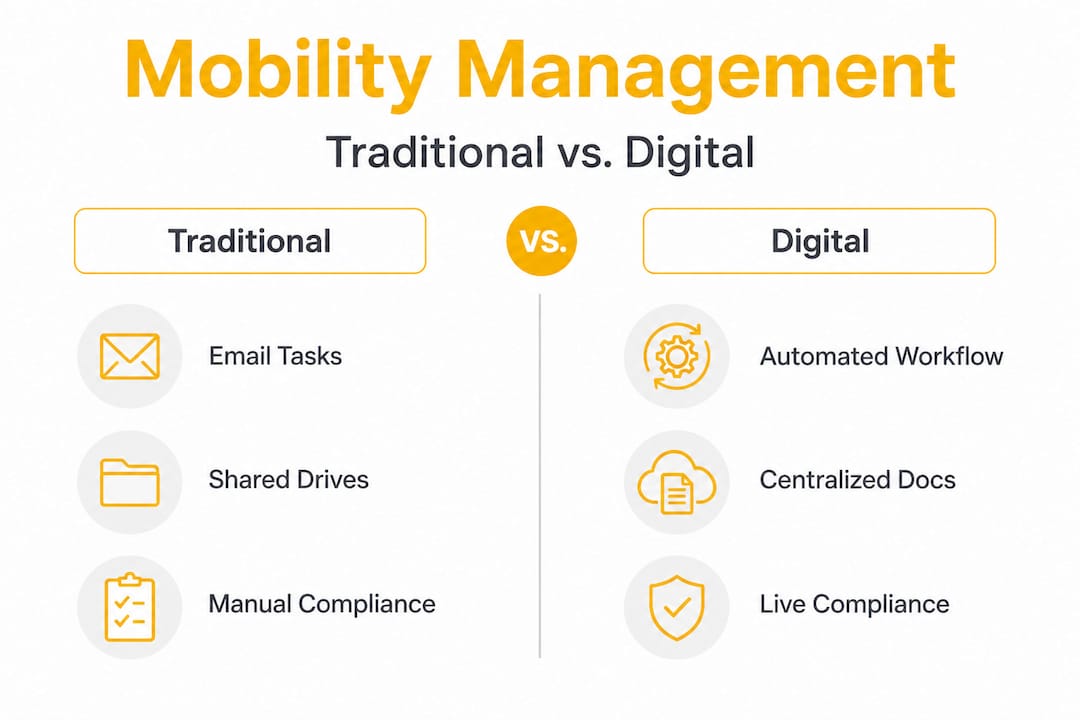
| Dimension | Traditional approach | Digital case management |
|---|---|---|
| Document storage | Shared drives with inconsistent naming | Centralized with version control |
| Deadline tracking | Individual calendars and email reminders | Automated alerts and compliance calendars |
| Compliance oversight | Manual review by team members | Real-time dashboards and audit trails |
| Vendor coordination | Email and phone calls | In-platform task assignment and tracking |
| Reporting | Manual spreadsheet compilation | Automated analytics and configurable reports |
| Audit readiness | Retroactive document retrieval | Continuous, time-stamped activity logs |
The efficiency differential is substantial. Organizations managing more than a few dozen active international assignments typically find that manual processes require disproportionate administrative effort to maintain. Each new assignment multiplies the coordination load across HR, legal, finance, and vendor teams.
Key compliance risks associated with traditional approaches include:
- Missed work permit renewal deadlines resulting in unauthorized employment
- Incomplete tax registration in host countries creating personal and corporate tax exposure
- Inconsistent application of assignment policies leading to equity disputes and cost overruns
- Inability to produce documentation in regulatory audits due to fragmented record-keeping
A reliable global mobility case management system addresses each of these risks systematically rather than relying on individual vigilance. When organizations transition to a mobility digital ecosystem, they typically report faster case resolution times, reduced compliance incidents, and improved employee satisfaction with the relocation experience.
Applying digital case management: Best practices for international HR teams
Knowing that digital case management delivers material improvements in compliance and efficiency is one thing; implementing it successfully is another. Organizations that achieve the greatest benefit follow a structured implementation approach that addresses both technical configuration and organizational adoption.
The following steps provide a practical framework for HR and mobility teams preparing to implement or optimize digital case management:
- Define standard processes before configuring the platform. Document your most common assignment types and the specific steps, approvals, and compliance requirements each involves. A platform configured to reflect real workflows from day one delivers immediate value.
- Select a platform designed for global mobility complexity. General-purpose HR case management tools often lack the jurisdictional compliance libraries, immigration workflow templates, and vendor coordination features that mobility teams require. Evaluate platforms against your actual assignment mix, not just generic feature lists.
- Onboard all stakeholders systematically. HR administrators, immigration counsel, tax advisors, and relocation vendors all interact with case data. Structured onboarding that explains role-specific responsibilities within the platform prevents the adoption gaps that undermine system integrity.
- Configure compliance monitoring proactively. Set automated alerts for permit expiries, tax filing deadlines, and assignment end dates at meaningful lead times, typically 90, 60, and 30 days in advance. This gives teams sufficient runway to take corrective action.
- Leverage analytics dashboards for continuous oversight. Weekly or monthly review of case status reports, bottleneck analysis, and compliance metrics helps mobility leaders identify systemic issues before they become critical incidents.
Digital platforms transform global mobility by adding transparency, speed, and audit-readiness that manual processes cannot replicate at scale. Organizations that treat implementation as a one-time technology deployment, however, often underperform. The teams that sustain results build feedback loops into their operating model, reviewing case outcomes regularly and updating workflow configurations based on observed patterns.
Common pitfalls to avoid include under-defining workflows before go-live, which results in teams reverting to email workarounds for edge cases; failing to engage vendor partners in the platform, which limits the coordination benefits; and neglecting to maintain documentation standards, which erodes audit-readiness over time.
Pro Tip: Establish a quarterly review process where the mobility team evaluates completed cases for recurring delays or compliance near-misses. These patterns often reveal workflow gaps that can be resolved through additional automation rules or clearer task ownership assignments within the platform.
Applying document management best practices within the case management environment is also essential. Consistent naming conventions, mandatory metadata fields, and defined document retention policies ensure that case records remain retrievable and compliant with both internal governance standards and host country data regulations.
Why true global mobility digitalization requires more than just automation
Most organizations, when they first adopt digital case management, focus primarily on task automation. Workflow triggers replace manual reminders. Document requests go out automatically. Permit expiry alerts fire without human initiation. These are meaningful improvements, and they deliver real compliance risk reduction. But they represent only the first layer of what digital transformation in global mobility can achieve.
The deeper opportunity lies in what aggregated case data reveals about the mobility program as a whole. When every assignment is managed within the same platform, the resulting dataset contains actionable intelligence that no spreadsheet-based approach could surface. Which assignment types consistently experience compliance delays? Which host country jurisdictions generate disproportionate documentation complexity? Which vendors consistently deliver within agreed timelines, and which introduce lag at critical case milestones?
Digital HR case management is not just about operational efficiency but about unlocking predictive insights and centralized compliance visibility that enable genuinely strategic mobility management. HR leaders who treat their case management platform purely as an administrative tool miss the strategic layer entirely.
Compliance in international mobility is not a box-ticking exercise. Tax equalization miscalculations, work authorization gaps, and social security contribution errors carry real financial and legal consequences for both the organization and the assigned employee. A platform that tracks these obligations across multiple jurisdictions in real time, and that surfaces risk indicators before they materialize into violations, functions as a strategic compliance asset rather than a record-keeping tool.
The organizations that lead in global mobility outcomes are those that have structured their digital environments to support collaboration across HR, legal, finance, and external service providers. Streamlined workflows for mobility eliminate the information silos that prevent these functions from operating as a coherent program. When immigration counsel, tax advisors, and HR business partners all work within the same case management environment, the quality of decisions improves because each party has access to complete, current information.
The shift from reactive administration to proactive, data-informed mobility management is what genuine digitalization enables. Automation is the foundation, but integrated analytics and compliance intelligence are what separate well-run mobility programs from the rest.
Transform your global mobility operations with digital case management
Managing international assignments at scale demands technology that matches the complexity of the task. xpath.global was built specifically to meet this need, combining enterprise case management, automated compliance tracking, and a global vendor marketplace into a single, unified platform designed for mobility professionals.
Whether your organization manages a handful of cross-border assignments or a global portfolio spanning dozens of jurisdictions, xpath.global provides the structured workflows, real-time compliance monitoring, and analytics capabilities that mobility teams need to operate with confidence. Choosing global mobility technology is a decision with long-term implications for compliance posture, operational efficiency, and employee experience. Speak with the team at xpath.global to explore how the platform addresses your specific assignment mix and compliance requirements. Contact xpath.global’s HR professionals to request a personalized demo and see how digital case management works in practice.
Frequently asked questions
What is the main benefit of digital case management for global mobility?
The main benefit is streamlined compliance, faster relocation processes, and reduced manual errors for HR teams managing international assignments, as workflow automation and compliance tracking directly address the risks inherent in manual processes.
How does digital case management support compliance in international assignments?
It provides automated tracking, workflow reminders, and real-time document management to keep organizations compliant with immigration, tax, and mobility-focused compliance requirements across multiple jurisdictions simultaneously.
Can small HR teams benefit from digital case management tools?
Yes, even small teams gain meaningful reductions in error rates and substantially greater transparency when managing cross-border employees, because digital case management transforms mobility by removing the administrative overhead that scales poorly with manual methods.
What makes digital case management different from basic HR case management?
Digital case management for global mobility emphasizes integration, analytics, and compliance for complex international programs rather than the employee relations focus of traditional HR case management, making it purpose-built for the jurisdictional and regulatory complexity of cross-border work.