






Managing expatriate expenses across borders presents HR professionals with a maze of categories, currencies, and compliance requirements that can quickly spiral into budget overruns and audit risks. Without structured tracking methods and the right tools, global mobility teams face mounting administrative burdens, frustrated employees awaiting reimbursements, and finance departments demanding visibility into escalating costs. This guide walks you through practical expense tracking methodologies, essential technology platforms, and proven best practices that transform chaotic expatriate expense management into streamlined, compliant workflows that protect your budget while supporting your international workforce.
Understanding expatriate expense categories and budgeting basics
Effective expense tracking starts with knowing exactly what costs to monitor throughout an expatriate assignment lifecycle. Key expense categories to track include relocation costs, housing allowances, tax equalization payments, travel expenses, and daily living allowances, each contributing significantly to total assignment budgets. International relocations average between $75,000 and $150,000 per employee depending on destination and assignment length, making precise categorization essential for preventing budget surprises.
Building a structured budget requires cross-functional collaboration from the outset. HR teams must partner with finance and tax specialists early in the assignment planning phase to establish realistic cost projections and monitoring frameworks. This collaborative approach ensures all stakeholders understand budgeting, taxes, and compensation implications before commitments are made.
The primary expense categories you should track include:
🔸Relocation services covering household goods shipment, temporary storage, and moving company fees
🔸Housing costs including rent deposits, utilities setup, and ongoing accommodation allowances
🔸Tax equalization and gross-up payments to maintain employee take-home pay parity
🔸Business and familiarization travel for pre-assignment visits and ongoing work requirements
🔸Daily living allowances compensating for cost-of-living differences between home and host locations
🔸Immigration and work permit fees for employees and accompanying family members
🔸Destination services supporting school search, spousal career assistance, and cultural training
Beyond these direct costs, hidden expenses often catch mobility teams off guard. Currency fluctuations can add 5% to 15% to projected budgets when assignments span multiple years. Emergency trips home for family situations, extended temporary housing due to delayed permanent accommodation, and duplicate housing costs during transition periods all represent budget risks that structured tracking helps identify early. Administrative costs for program management, vendor coordination, and compliance monitoring also accumulate quickly without centralized visibility.

Choosing the right expense tracking methodologies for expatriates
Your choice of expense tracking methodology fundamentally shapes administrative workload, employee experience, and cost control effectiveness. Three primary approaches dominate global mobility programs, each suited to different organizational priorities and risk tolerances.
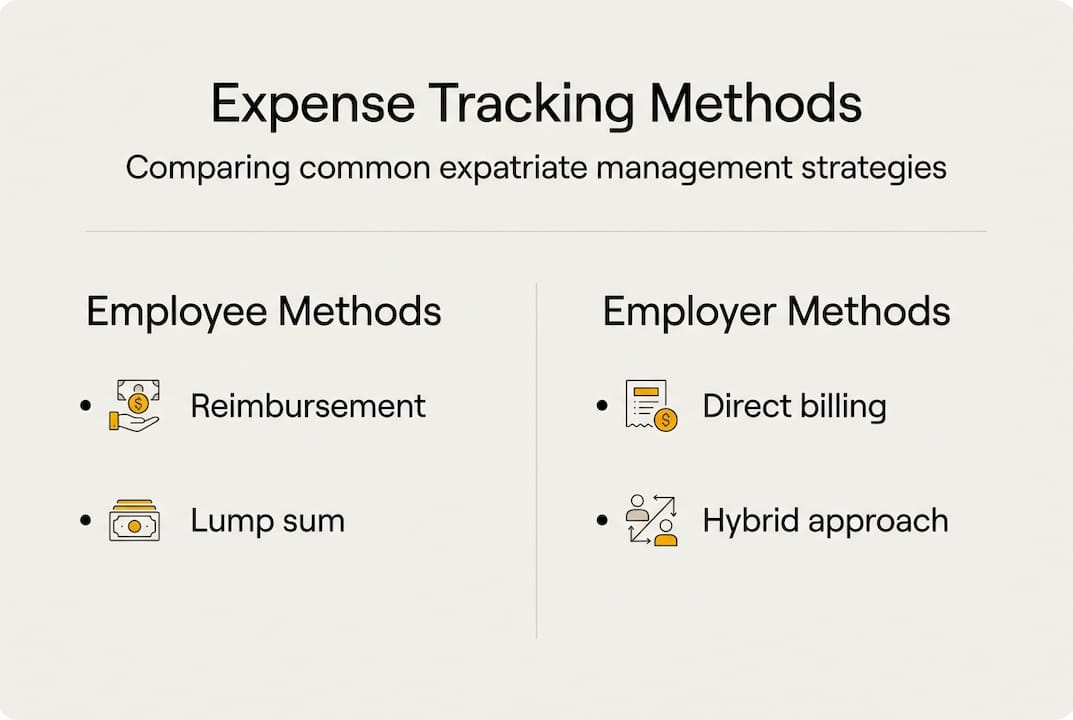
Reimbursement methodology requires employees to pay expenses upfront and submit receipts for repayment. This approach provides maximum visibility and control since every expense requires documentation and approval before reimbursement. Finance teams gain detailed audit trails and can enforce policy compliance at the transaction level. However, this method creates significant administrative burden for both employees managing cash flow and HR teams processing claims. Reimbursement cycles averaging 10 to 15 days can frustrate relocating employees already managing assignment stress.
Direct billing shifts payment responsibility to the employer by having vendors invoice the company directly. Housing landlords, relocation service providers, and immigration lawyers bill your organization rather than the employee. This methodology dramatically reduces employee financial burden and eliminates reimbursement delays. The trade-off comes in vendor management complexity, as your team must coordinate payment terms, verify invoices, and maintain relationships with multiple service providers across different countries. Direct billing works best for predictable, high-value expenses like housing and core relocation services.
Lump sum allowances provide employees with fixed cash amounts to manage certain expense categories independently. You might offer $10,000 for miscellaneous settling-in costs or $2,500 monthly for housing with minimal documentation requirements. This flexible approach minimizes administrative overhead and empowers employees to make spending decisions based on personal priorities. The risk lies in reduced oversight and potential for inadequate coverage if employees underestimate costs or make poor spending choices. Avoiding policy mistakes in global mobility requires clear guidelines on what lump sums should cover.
| Methodology | Oversight level | Administrative burden | Employee flexibility | Cost control |
|---|---|---|---|---|
| Reimbursement | High – every expense reviewed | High – claim processing intensive | Low – policy restrictions | Excellent – transaction-level visibility |
| Direct billing | Medium – invoice verification | Medium – vendor coordination | Medium – provider choice limited | Good – contracted rates |
| Lump sum | Low – minimal documentation | Low – simple payments | High – spending discretion | Fair – fixed budgets with variable outcomes |
Pro Tip: Hybrid approaches combining methodologies often deliver optimal results. Use direct billing for major predictable costs like housing and relocation services, reimbursement for policy-controlled expenses like travel, and lump sums for personal settling-in costs where employee choice adds value without significant risk.
Leveraging technology and automation for efficient expense tracking
Cloud-based global mobility platforms purpose-built for expatriate expense management transform tracking from spreadsheet chaos into streamlined digital workflows. Unlike generic expense tools designed for business travel, specialized platforms understand the unique requirements of international assignments including multi-year tracking, complex tax implications, and coordination across immigration, relocation, and compensation processes.
Cloud-based platforms specialized for global mobility reduce expense approval times by 40%, improve compliance 25%, and cut manual processes by 30% with AI automation. These efficiency gains stem from intelligent features that handle currency conversions automatically, flag policy violations before submission, and route approvals based on expense type and amount thresholds. Real-time dashboards give finance teams instant visibility into spending patterns and budget consumption across all active assignments.
The most impactful platform capabilities for expense tracking include:
🔸Seamless integration with HR information systems and payroll platforms ensuring assignment data flows automatically without manual data entry
🔸Multi-currency support with automatic conversion at current or locked exchange rates depending on policy requirements
🔸Configurable approval workflows routing expenses through appropriate stakeholders based on category, amount, and assignment type
🔸Mobile apps enabling employees to photograph receipts, submit expenses, and track reimbursement status from anywhere
🔸Audit trail documentation capturing every transaction, approval, and policy exception for compliance verification
🔸Customizable reporting delivering insights on spending by category, location, employee, or any dimension relevant to your program
🔸Vendor marketplace integration connecting directly to pre-approved service providers with transparent pricing
Artificial intelligence features elevate these platforms beyond digital filing systems into proactive compliance tools. AI algorithms learn your policy rules and automatically flag suspicious patterns like duplicate submissions, expenses exceeding daily limits, or claims missing required documentation. Machine learning models predict budget overruns by analyzing spending velocity against remaining assignment duration, alerting mobility managers to intervene before costs spiral.
Choosing global mobility technology requires evaluating vendor support quality and scalability alongside feature sets. Your platform must handle current assignment volumes while accommodating growth as your mobility program expands. Look for providers offering dedicated implementation support, ongoing training resources, and responsive technical assistance when issues arise. The best technology becomes worthless if your team cannot use it effectively or vendor support disappears when you need help.
Pro Tip: Prioritize platforms offering open APIs that connect with your existing technology stack. The ability to integrate with your HRIS, payroll system, and financial planning tools eliminates data silos and ensures expense information flows seamlessly across all systems requiring visibility into mobility costs.
AI and automation in HR extends beyond expense tracking to transform entire mobility workflows, but expense management delivers some of the most immediate and measurable returns on technology investment.
Common challenges and best practices to ensure accurate tracking and compliance
Even with solid methodologies and advanced technology, expatriate expense management fails when execution stumbles over predictable obstacles. Understanding where programs typically break down helps you build resilience into your processes from the start.
Common mistakes include insufficient training causing errors and delays, generic tools lacking compliance features, and lack of stakeholder buy-in. When employees do not understand expense policies or how to use tracking systems properly, submission errors multiply and reimbursement cycles stretch from days into weeks. Generic expense tools built for domestic business travel cannot handle the complexity of international assignments, leading to workarounds that undermine compliance and create audit vulnerabilities. Without finance, tax, and business unit support, mobility teams struggle to enforce policies and secure budget approvals.
Frequent pitfalls that derail expense tracking accuracy include:
🔸Inconsistent policy application across different assignment types, locations, or employee levels creating perceived unfairness
🔸Delayed expense submissions when employees wait weeks or months to file claims, making verification difficult
🔸Inadequate receipt documentation with missing invoices, unclear vendor names, or expenses lacking business justification
🔸Poor communication between mobility, finance, and tax teams leading to duplicate payments or missed tax implications
🔸Failure to monitor spending patterns until budget exhaustion forces reactive cost cutting
Implementing these best practices systematically addresses common challenges:
- Deliver comprehensive training to all stakeholders including employees, managers, finance staff, and mobility coordinators covering policies, procedures, and technology use
- Select compliance-ready tools specifically designed for global mobility with built-in policy enforcement, tax consideration flags, and audit trail capabilities
- Secure executive sponsorship and cross-functional buy-in by demonstrating how effective expense tracking supports business objectives and controls costs
- Establish clear escalation paths for policy exceptions ensuring consistency while allowing flexibility for legitimate special circumstances
- Conduct regular audits sampling expense submissions to identify patterns, verify compliance, and catch issues before they become systemic
- Create feedback loops soliciting input from employees and mobility coordinators on process pain points and improvement opportunities
Effective expatriate expense tracking requires more than tools and policies. Success depends on building a culture where all stakeholders understand their roles, communicate proactively, and prioritize accuracy and compliance as shared responsibilities rather than administrative burdens.
Strategic collaboration among HR, finance, tax, and business unit leaders ensures expense tracking serves broader mobility program goals. Regular steering committee meetings reviewing spending trends, policy effectiveness, and process efficiency keep all parties aligned and engaged. When stakeholders view expense management as a strategic capability rather than a compliance checkbox, you gain the organizational support needed to continuously improve processes and outcomes.
Tools to optimize global mobility programs extend beyond expense tracking to encompass assignment planning, vendor coordination, and employee experience management, but expense visibility remains foundational to program success.
Continuous monitoring through monthly reviews of spending against budgets, policy compliance rates, and processing cycle times helps identify improvement opportunities before small issues become major problems. Benchmark your performance against industry standards and peer organizations to understand where your program excels and where gaps exist. Most importantly, act on insights by adjusting policies, enhancing training, or upgrading technology when data reveals systematic challenges.
Explore global mobility solutions to simplify expatriate expense management
Transforming expatriate expense tracking from administrative burden into strategic advantage requires the right combination of methodology, technology, and expertise. Global mobility solutions streamlining your workforce provide the integrated platforms and professional support that enable HR teams to manage international assignments with confidence and efficiency.
Advanced global mobility platforms centralize expense tracking alongside immigration case management, assignment planning, and vendor coordination in unified digital ecosystems. When you can monitor relocation costs, housing allowances, and tax implications within the same system tracking work permits and assignment milestones, you gain the holistic visibility essential for effective program management. Choosing the right global mobility technology means evaluating how well platforms integrate expense management with broader mobility workflows.
For organizations building or refining mobility programs in flexible work environments, crafting a global mobility program embracing remote work introduces additional expense tracking considerations as traditional assignment models evolve. Whether managing traditional expatriate relocations or supporting distributed international teams, the principles of structured expense categorization, appropriate methodology selection, and technology-enabled automation remain foundational to program success.
FAQ
What are the most important expense categories to monitor for expatriates?
Relocation costs, housing allowances, tax equalization payments, travel expenses, and daily living allowances represent the core categories requiring consistent tracking throughout assignment lifecycles. Each category significantly impacts both budget planning and compliance obligations, with housing and tax costs typically consuming the largest portions of total assignment budgets. Monitoring these categories systematically prevents cost overruns and ensures employees receive appropriate support.
Which expense tracking method offers the best balance of control and flexibility?
Hybrid approaches combining multiple methodologies typically deliver optimal results by matching tracking rigor to expense characteristics. Use direct billing for high-value predictable costs like housing where vendor relationships provide cost control, reimbursement for policy-sensitive expenses requiring documentation like business travel, and lump sum allowances for personal settling costs where employee choice adds value. This combination maximizes efficiency while maintaining appropriate oversight levels for different expense types.
How does technology improve expatriate expense tracking accuracy?
Automated compliance checks built into specialized global mobility platforms flag policy violations, missing documentation, and suspicious patterns before expenses reach approval stages, dramatically reducing error rates. Multi-currency handling eliminates manual conversion mistakes while integration with HR and payroll systems ensures assignment data accuracy across all platforms. AI-driven automation cuts manual processing time by 30% while improving compliance by 25%, allowing mobility teams to focus on strategic program management rather than administrative tasks.
What are common mistakes to avoid in managing expatriate expenses?
Insufficient training creates submission errors and delays when employees and coordinators lack clear understanding of policies and system functionality. Using generic expense tools designed for domestic business travel rather than specialized global mobility platforms introduces compliance gaps and workflow inefficiencies. Failing to secure stakeholder buy-in from finance, tax, and business unit leaders undermines policy enforcement and budget management. Address these pitfalls through comprehensive training programs, purpose-built technology selection, and executive sponsorship that positions expense tracking as a strategic capability.