- 🔸A unified global HR strategy aligned with business goals is essential for compliance and efficiency.
- 🔸Leveraging technology and outsourcing carefully enhances scalability, compliance, and workforce management.
- 🔸Continuous monitoring, analytics, and local expertise are critical for compliance, ROI measurement, and long-term success.
Managing a global workforce without a clear operational framework is one of the fastest ways to accumulate compliance fines, lose top talent, and watch relocation costs spiral out of control. Policy gaps, fragmented vendor relationships, and inconsistent local law interpretation create friction at every stage of the employee lifecycle. The good news is that multinational organizations willing to invest in the right strategy, technology, and governance model can convert that friction into a genuine competitive advantage. This guide walks HR executives and global mobility managers through the exact steps needed to streamline operations, reduce risk, and demonstrate measurable ROI.
Set a unified global HR strategy
With risks and opportunities clear, the first step is creating a robust, flexible HR strategy that serves as the operational backbone for every market you operate in. Without this foundation, even the best technology investments will underperform. A strong global HR strategy starts with alignment to business objectives. Every mobility policy, benefits structure, and workforce planning decision should trace back to a specific business goal, whether that is accelerating market entry, retaining critical talent, or managing total compensation costs. Smart global HR requires you to standardize core policies while building in deliberate flexibility for local adaptation. According to 9 Proven Strategies for Successful Global HR Management , organizations should align HR strategy with business objectives early, standardizing core policies while localizing for compliance and culture. This is not optional. Failing to localize exposes your organization to legal liability and signals to local employees that their context is an afterthought. Here is what a well-structured global HR strategy should address:
- 🔸Core mobility policy: Define assignment types, eligibility criteria, and benefit tiers that apply universally
- 🔸Local legal compliance: Map each jurisdiction’s labor law requirements, mandatory benefits, and termination rules
- 🔸Cultural integration: Identify cultural norms that affect performance management, communication styles, and team dynamics
- 🔸Local talent engagement: Involve regional HR leads and local legal counsel from the outset, not after a problem surfaces
- 🔸Policy governance: Establish a clear process for updating policies as regulations change
"“The organizations that scale global HR successfully are those that treat local expertise as a strategic asset, not a compliance checkbox.”"
Engaging local experts early is particularly important for regions with complex labor law environments, such as the European Union, Brazil, or the Gulf Cooperation Council countries. Local counsel can identify risks that a centralized HR team will simply miss. Pro Tip: Before launching operations in a new country, conduct a formal policy gap analysis comparing your standard global framework against that jurisdiction’s mandatory employment law requirements. This single step prevents the majority of onboarding compliance errors.
Leverage technology and platforms for efficiency
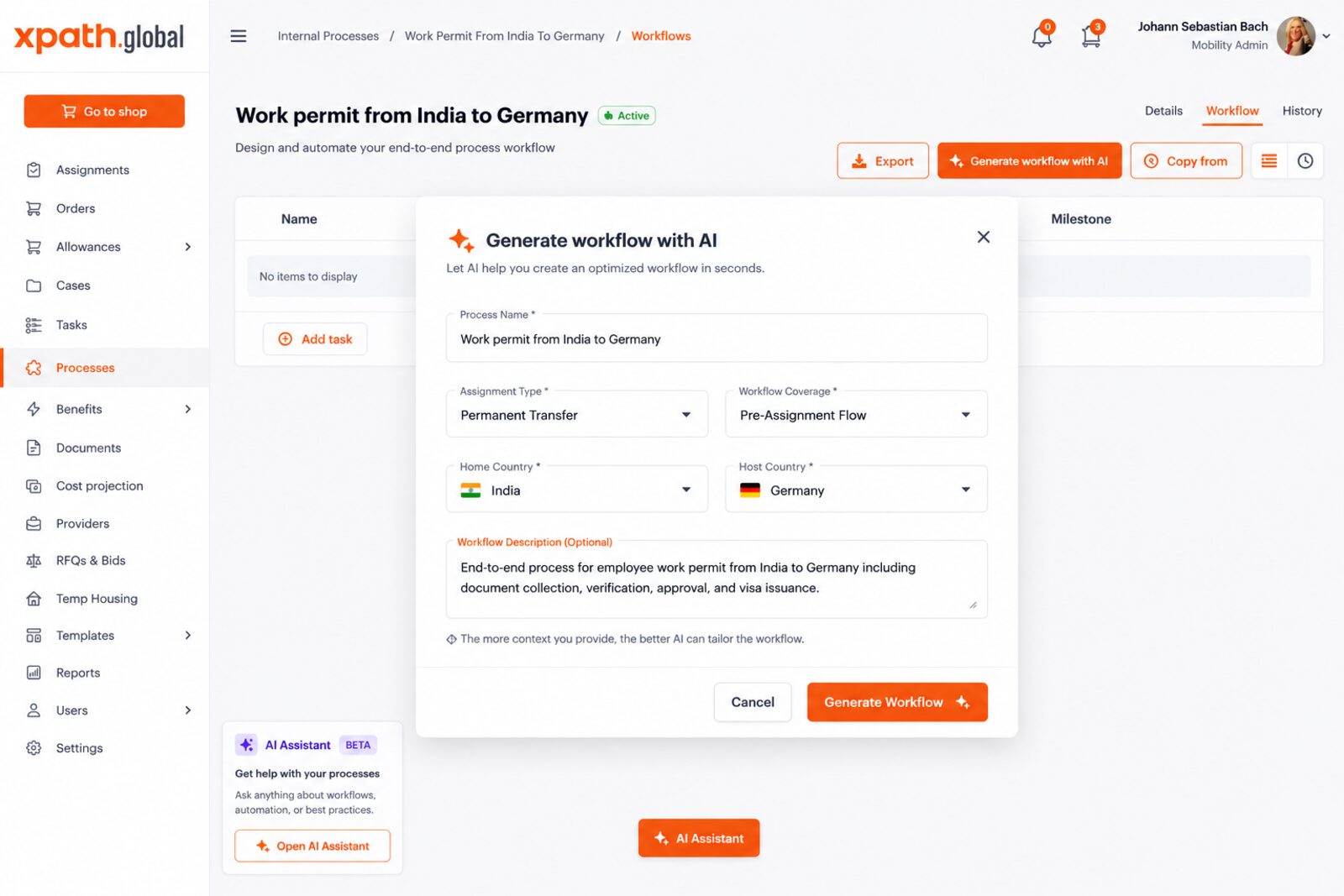
Once the strategy is set, the right technology becomes the lever for operational scalability. Modern human capital management (HCM) platforms do far more than store employee records. They automate administrative workflows, support multi-currency payroll processing, and provide real-time compliance alerts that keep your team ahead of regulatory changes. The KPMG Global Mobility Benchmark Report recommends that organizations adopt HCM platforms supporting multi-country operations, multi-currency payroll, AI-driven admin task handling, and real-time compliance alerts. The AI impact on HR is already measurable: organizations using AI for administrative tasks report significant reductions in processing time and improved data accuracy across global programs. Understanding the mobility technology ROI is essential before committing to a platform investment. When evaluating platforms, prioritize these capabilities in order: Multi-country and multi-currency payroll support to eliminate manual reconciliation errors Integrated compliance tracking with jurisdiction-specific rule sets that update automatically Workflow automation for assignment initiation, document collection, and vendor coordination Analytics and reporting dashboards that surface cost trends, compliance incidents, and assignment outcomes Employee self-service portals that reduce HR administrative burden while improving the assignee experience Pro Tip: Before selecting a platform, audit your current tech stack for redundancies. Many organizations pay for overlapping tools that could be consolidated into a single global mobility platform, reducing both cost and integration complexity.
Outsource compliance and local operations smartly
Even with strong technology in place, outsourcing remains a critical lever for modern global workforce operations. Employer of Record (EOR) services allow organizations to hire employees in new markets without establishing a local legal entity, which can take months and significant capital investment. EOR providers handle local payroll, tax withholding, statutory benefits, and employment contracts on your behalf. As noted in research on global HR challenges , companies can leverage EOR services to manage local compliance, payroll, taxes, and benefits without establishing local entities. This is particularly valuable for pilot market entries or project-based assignments where long-term commitment is uncertain. Knowing what to outsource and what to retain internally is the real skill: 🔸Outsource: Payroll processing, local tax filings, statutory benefit administration, employment contract drafting, and local onboarding logistics 🔸Retain internally: Strategic workforce planning, compensation philosophy, performance management, and vendor relationship oversight 🔸Monitor closely: Data privacy compliance, intellectual property protections, and employee classification status The primary risk in outsourcing is visibility loss. When a third party manages payroll and compliance, errors can accumulate before your team detects them. Mitigate this by establishing monthly compliance reporting requirements in every EOR or outsourcing contract, and by conducting quarterly audits of vendor outputs. The decision between EOR and internal infrastructure is rarely permanent. Many organizations begin with an EOR to validate a market, then transition to a direct entity once volume justifies the investment.
Master compliance and mitigate workforce risks
Outsourcing can help, but rigorous compliance oversight remains your responsibility regardless of which partners you engage. The regulatory environment for global workforces is evolving rapidly in 2026, with new EU pay transparency requirements, updated GDPR enforcement priorities, and shifting tax treaty interpretations creating fresh exposure for multinational employers. Prioritizing HR compliance best practices means building structured governance, not just reacting to regulatory changes. To secure assignment compliance across jurisdictions, organizations need a repeatable audit process and cross-functional ownership. Here are the action steps that reduce compliance exposure most effectively: 🔸Establish a quarterly audit cadence covering payroll accuracy, worker classification, and benefits compliance in every active jurisdiction 🔸Form a cross-functional compliance team that includes HR, legal, finance, and IT to address issues from multiple angles 🔸Deploy local legal advisors in high-risk or high-volume markets to monitor regulatory changes in real time 🔸Conduct annual compliance training for HR staff and line managers operating across borders 🔸Document all policy exceptions with formal approval records to protect the organization during audits As highlighted in research on global hiring compliance , worker misclassification risks fines and back pay liability, while dual employment arrangements for expatriates create tax exposure and permanent establishment risk. Digital nomad compliance risks and immigration compliance challenges add further layers of complexity that demand proactive management.
"“Compliance is not a one-time project. It is an ongoing operational discipline that requires dedicated resources, clear ownership, and executive sponsorship to sustain.”"
The organizations that manage compliance best treat it as a continuous process rather than an annual review. They invest in monitoring tools, build relationships with local counsel, and create clear escalation paths when new risks emerge.
Measure ROI and continuously optimize your strategy
Operational improvement is only sustainable if you measure and refine for long-term value. The KPMG 2025 benchmarking data from 456 multinationals shows that demonstrating ROI is the number one challenge in global mobility, with 72% of organizations struggling to scale analytics and only 43% using AI for administrative tasks. Separately, 70% of businesses reviewed their mobility policies in the past year, signaling that quantifying global mobility ROI has become a board-level priority. Track these key metrics to build a credible ROI case: 🔸Cost per relocation broken down by assignment type and destination 🔸Compliance incident rate and associated remediation costs 🔸Time-to-productivity for relocated employees 🔸Assignment completion and retention rates 🔸Employee satisfaction scores at 30, 90, and 180 days post-relocation Pro Tip: Conduct a formal annual policy review that benchmarks your mobility program against industry peers. This keeps your policies competitive, compliant, and aligned with evolving business priorities.
What truly moves the needle in global workforce operations
With a repeatable framework in hand, here is where our experience diverges from the typical playbook. Most organizations invest heavily in technology and assume that platform adoption will solve their operational problems. It rarely does on its own. The organizations that achieve lasting efficiency gains are those that balance standardization with genuine local ownership. They embed HR and IT as partners from day one of any new market entry, rather than treating technology as a post-implementation fix. They also invest in cross-cultural training at every level, recognizing that payroll accuracy means little if a relocated employee cannot function effectively in a new cultural environment. Employee experience and sustainability are emerging as the real long-term ROI drivers. Assignees who feel supported, informed, and culturally prepared perform better and stay longer. Understanding AI’s role in HR is valuable, but it should augment human judgment, not replace the relationship-building that drives genuine workforce engagement. The organizations winning in global mobility right now are not the ones with the most sophisticated tech stack. They are the ones that combine smart systems with deep local knowledge and a genuine commitment to the employee experience.
Take the next step: Power your workforce with advanced solutions
The strategies outlined in this guide represent the operational standard for high-performing global mobility programs. Executing them at scale requires both the right technology and the right partners. xpath.global brings together a unified platform, a vetted global services marketplace, and experienced mobility consultants to help you deploy compliant, tech-enabled workforce operations across any market. Whether you need to choose mobility technology that fits your organization’s complexity, master relocation programs at scale, or simply speak to an HR expert about your specific challenges, xpath.global provides the infrastructure and expertise to accelerate your success without the operational friction that holds most programs back.
Frequently asked questions
What are the most common compliance risks in global workforce management?
Worker misclassification, dual employment tax exposure, and gaps in local benefits compliance are the most frequent compliance risks for multinational employers managing cross-border workforces.
Is using an Employer of Record (EOR) always better than an internal global HR platform?
EORs offer faster setup and reduced local administrative burden, while internal HR platforms provide greater process control. The right choice depends on your speed requirements, risk tolerance, and long-term market commitment, as noted in research on global HR challenges.
How can analytics improve global workforce operations?
Analytics surface ROI, highlight process inefficiencies, and support better strategic decisions. Given that 72% of organizations struggle to scale analytics, investing in this capability early creates a meaningful competitive advantage.
How often should workforce policies be reviewed for international teams?
Annual policy reviews are the recommended standard, with 70% of businesses having reviewed their policies in the past year to stay aligned with evolving regulations and best practices.
Recommended
- Smart Global HR: Work Less, Achieve More - xpath.global
- Streamline your international relocation workflow: HR guide
- International workforce management: 5 strategies for 2026
- Case Management to Simplify Complexity | Xpath Pro for HRs