






The Rise of AI in Global Mobility Compliance is not just a technology trend. It is a response to a very real operational problem: global mobility teams are managing more countries, more visa categories, more tax risks, more remote-work patterns, and more employee expectations than ever before. Spreadsheets, inboxes, manual trackers, and disconnected vendor updates simply cannot keep pace.
AI is now transforming compliance workflows across immigration, tax, social security, relocation, posted-worker rules, business travel, permanent establishment risk, and assignment cost control. Instead of waiting for a manager to search a tracker, calculate a projected date, or manually compare documents, AI can surface the answer in seconds, provided the data is accurate, permissioned, and properly governed.
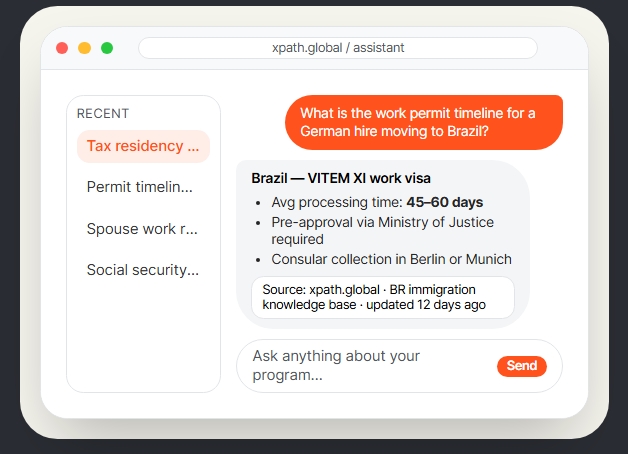
The opportunity is significant. AI can help mobility teams verify documents, flag missing information, summarize case status, detect overdue tasks, calculate projected start dates, produce audit-ready reports, and identify cases that may become risky before they actually fail. Platforms such as xpath.global are already applying this model to mobility operations through AI reporting, AI-generated workflows, and a 24/7 Mobility Assistant grounded in live case, policy, and country data. xpath.global describes its agentic AI as supporting intelligent reporting, automated form filling, and self-building workflows for international assignments across more than 183 countries.
Still, AI should not be treated as a magic wand. In global mobility, the consequences of a wrong answer can be serious: a missed visa deadline, an incorrect work authorization assumption, an avoidable tax exposure, or an employee stranded between jurisdictions. The strongest AI strategy is therefore not “replace the mobility team.” It is “equip the mobility team with faster, better-controlled decision support.”
AI-Powered Document Verification
Document verification is one of the clearest use cases for AI in global mobility compliance. A single international assignment can involve passports, visas, employment contracts, salary letters, marriage certificates, birth certificates, lease agreements, tax forms, social security certificates, diploma evidence, apostilles, translations, immigration questionnaires, and medical or police certificates.
Traditionally, HR and mobility teams check these documents manually. That process is slow and error-prone. AI can help by identifying missing pages, checking expiry dates, extracting key fields, comparing names across documents, flagging mismatched dates, and routing documents to the right stakeholder for review.
For example, AI can support checks such as:
| Document Task | How AI Helps |
|---|---|
| Passport validity | Flags expiry risks before visa filing |
| Work permit evidence | Extracts permit type, validity dates, and restrictions |
| Immigration forms | Pre-fills standard fields from case data |
| Employer letters | Checks whether role, salary, and location match the case record |
| Dependent documents | Identifies missing marriage, birth, or custody evidence |
| Translation status | Flags documents that may require certified translation |
| Renewal tracking | Alerts HR before permits or documents expire |
The key benefit is not just speed. It is consistency. When AI is connected to structured workflows, every case can be checked against the same baseline instead of relying on one person’s memory or an outdated checklist.
xpath.global’s Mobility Assistant is built around this practical need. It can pre-fill immigration intakes, supplier briefs, and handover forms from live case data, while HR reviews and signs off rather than re-typing the same information across systems. Its AI-generated workflows can also convert existing checklists, SOPs, or process descriptions into structured tasks, subtasks, owners, durations, dependencies, and milestones.
Predictive Analytics for Risk Management
Predictive analytics is where AI becomes truly strategic. Rather than telling mobility teams what already happened, AI can help estimate what is likely to happen next.
In global mobility compliance, predictive analytics can support:
| Risk Area | Predictive Use Case |
|---|---|
| Immigration timelines | Forecast likely permit approval or start-date risk |
| Tax residency | Flag employees approaching day-count thresholds |
| Social security | Identify cases needing certificate-of-coverage review |
| Cost control | Compare projected spend against policy or budget |
| Vendor performance | Highlight suppliers with recurring SLA delays |
| Assignment lifecycle | Detect cases approaching renewal, extension, or repatriation milestones |
| Business travel | Flag repeated trips that may trigger work authorization or tax review |
For example, a mobility manager might ask: “Show active assignments in Germany, the United States, and the United Kingdom with permits expiring in the next 90 days and total spend above budget.” In a traditional setup, that request might require spreadsheet exports, manual filters, pivot tables, and email follow-ups. In an AI-supported platform, the same question can be asked in plain language and returned as a chart, table, dashboard, or export.
This is exactly the problem xpath.global’s AI reporting is designed to solve. The platform allows users to ask for slices of live mobility data in any language and receive the result as a chart, table, map, KPI view, summary, or export. Examples include active assignments by country, cases in progress, visa pipeline, upcoming appointments, supplier activity, services spent, cost per case, lump-sum drawn versus remaining, and projected start dates calculated automatically from immigration task outputs.
The strongest compliance value is early warning. A case marked “in progress” may look fine until AI reveals that the immigration appointment is late, the supplier SLA is slipping, the start date depends on an unrealistic permit timeline, and the employee’s lease start date is already confirmed. That is the moment AI moves from reporting to risk prevention.
Plain-Language Reporting for Mobility Teams
One of the biggest barriers in global mobility is not lack of data. It is lack of usable data.
Mobility teams often have the information they need, but it lives across case notes, emails, vendor portals, HRIS records, payroll files, spreadsheets, relocation trackers, and finance reports. By the time someone manually consolidates the information, it may already be outdated.
Plain-language AI reporting changes that. Instead of building a report manually, users can ask questions such as:
| Plain-Language Query | Possible Output |
|---|---|
| “Show active assignments by destination country for the last 90 days.” | Bar chart and country table |
| “Which cases are at risk this month?” | Risk dashboard with owner and reason |
| “Show permits in progress by supplier.” | Table with SLA status |
| “Calculate projected start dates after immigration appointment completion.” | Start-date forecast |
| “Show services spent by vendor and country.” | Finance-ready export |
| “Which assignees have documents expiring before the assignment end date?” | Compliance exception report |
xpath.global’s AI reporting feature is designed for this exact use case. It runs on live platform data, supports charts including pie, bar, line, and table outputs, and can export results to Excel or PDF for finance, audit, or leadership review. Because the assistant is built into the reporting environment, HR teams can ask for the data slice they need instead of waiting for a specialist to build a dashboard.
This matters because mobility decisions are often time-sensitive. A delayed work permit, a missed relocation milestone, or a cost overrun cannot wait for a monthly reporting cycle. AI gives HR and mobility leaders a way to ask better questions more often.
AI-Generated Workflows and Process Consistency
Global mobility compliance often breaks down because teams do not follow the same process every time. That is not always laziness or poor training. It is usually because mobility work is complex, country-specific, and full of exceptions.
A long-term assignment from Germany to Brazil may require different immigration, tax, relocation, payroll, and vendor steps than a local hire moving from India to the UK. A senior executive transfer may need approvals that a graduate relocation does not. A family move may involve school search, dependent visas, spouse work authorization, and extra tax planning.
AI-generated workflows can help by turning policies, checklists, SOPs, and sample cases into structured process templates. In xpath.global, AI can draft workflows inside the Processes module, including tasks and subtasks, duration in days, owner assignment, start dependency, and milestone tagging. HR can review, adjust, and publish the workflow so every matching case runs consistently.
That creates several compliance benefits:
| Workflow Benefit | Compliance Impact |
|---|---|
| Standardized task order | Reduces skipped steps |
| Clear ownership | Prevents “I thought someone else handled it” failures |
| Dependency logic | Stops later tasks from starting too early |
| Milestone visibility | Shows HR, assignees, and suppliers where the case stands |
| Version history | Supports auditability |
| Reuse across countries | Speeds rollout while preserving consistency |
This is especially valuable when mobility teams scale quickly. New team members can follow approved workflows instead of learning through trial and error. Suppliers can see what they own. Assignees can see what they need to do next. HR can monitor exceptions rather than chasing every task manually.
Ethical Considerations in AI Mobility Compliance
AI in global mobility must be handled carefully because it touches sensitive personal data and employment-related decisions. Mobility files can contain passport data, family information, salary, health-related documents, immigration history, tax residency facts, dependents’ details, and sometimes special-category data.
The ethical risks include:
| Ethical Risk | What It Means in Mobility |
|---|---|
| Bias | AI may treat employees differently if trained on skewed historical data |
| Over-automation | Teams may rely on AI outputs without human review |
| Lack of transparency | Employees may not know how AI is used in their case |
| Data minimization failures | Too much personal data may be processed unnecessarily |
| Hallucinated answers | AI may produce confident but incorrect immigration or tax guidance |
| Unequal access | Employees in some languages or countries may receive better support than others |
| Surveillance creep | Case tracking may become intrusive if not properly limited |
Legal frameworks are also tightening. In the EU, many AI systems used in employment contexts can be treated as high-risk under the EU AI Act, triggering obligations around transparency, human oversight, data quality, and risk management. Recent legal analysis notes that HR-related AI tools may fall into high-risk categories and require stricter employer controls.
The GDPR is also relevant. Article 22 gives individuals rights in relation to decisions based solely on automated processing, including profiling, where those decisions produce legal or similarly significant effects. In mobility, this means organizations should be cautious about using AI to make final decisions on eligibility, assignment approval, risk classification, or employee treatment without meaningful human oversight.
The right principle is simple: AI can recommend, summarize, calculate, and flag. Humans should decide when the outcome affects employment, immigration status, compensation, relocation eligibility, or legal rights.
Robust Data Governance Is Non-Negotiable
AI is only as reliable as the data and governance around it. In global mobility, poor data governance can quickly turn a useful AI tool into a compliance liability.
A strong AI governance model should include:
| Governance Control | Why It Matters |
|---|---|
| Role-based access | Users only see data they are authorized to view |
| Audit trails | Every action, change, and recommendation can be reviewed |
| Data quality checks | AI outputs are based on accurate, complete case data |
| Human approval gates | Sensitive decisions remain under HR, legal, or tax review |
| Data minimization | The platform processes only what is necessary |
| Retention rules | Old documents and case data are not kept indefinitely |
| Vendor governance | Third-party AI and mobility providers meet security standards |
| Explainability | Users understand the source and limits of AI-generated outputs |
| Incident response | Errors, leaks, or model failures are escalated quickly |
xpath.global’s AI model is especially relevant here because the platform emphasizes role-based scope, secure in-portal chat, live case grounding, full activity history, and HR review before AI-drafted replies are sent. That design matters. A mobility AI assistant should not operate like an ungoverned public chatbot. It should work inside a controlled environment, use permissioned data, and keep activity visible for audit purposes.
Opportunities and Challenges at a Glance
| AI Opportunity | Compliance Benefit | Key Challenge |
|---|---|---|
| Document verification | Fewer missing or expired documents | Requires high data accuracy |
| AI reporting | Faster leadership, finance, and audit views | Must control who sees what |
| Predictive analytics | Earlier risk detection | Predictions must not become blind decisions |
| AI workflows | More consistent case execution | Workflows still need expert review |
| AI assistant | 24/7 support for HR and assignees | Must avoid hallucinated legal guidance |
| Form auto-fill | Less duplicate data entry | Needs human sign-off |
| Vendor spend analytics | Better cost and SLA control | Supplier data must be standardized |
| Multi-language support | Better employee experience | Translations need quality control |
| Case-grounded answers | Faster operational decisions | Source data must be current |
The best AI deployments in global mobility will not be the flashiest. They will be the most controlled, explainable, and operationally useful.
How xpath.global Fits the AI Mobility Compliance Shift
xpath.global’s AI features align closely with where global mobility teams feel the most pressure: reporting, workflow consistency, case questions, document handling, supplier coordination, and employee support.
Its AI reporting allows mobility users to ask questions in plain language and receive live data outputs as charts, tables, dashboards, maps, summaries, or exports. This helps teams move away from spreadsheet manipulation, offline trackers, and separate reporting tools.
Its AI-generated workflows help convert checklists, SOPs, and process descriptions into reusable workflows with tasks, subtasks, owners, durations, dependencies, and milestones. This supports process consistency across immigration, tax, relocation, moving, HR approvals, assignee onboarding, departure confirmation, arrival confirmation, repatriation, and assignment extensions.
Its 24/7 Mobility Assistant gives HR teams and assignees an in-portal AI assistant grounded in live case, policy, and country data. HR can ask about case status, next steps, document expiry, projected dates, overdue tasks, and pending approvals. Assignees can ask about their own case within scope. Suppliers can receive scoped help on the orders they are working on.
A particularly valuable feature is form auto-fill. Immigration intakes, supplier briefs, and internal handovers can be pre-populated from the case record, reducing re-keying and lowering the risk of inconsistent data. xpath.global’s public materials describe AI capabilities including intelligent reporting, automated form filling, self-building workflows, and an operating network across 183+ countries with vetted providers and services.
FAQs
How is AI changing global mobility compliance?
AI is helping mobility teams automate document checks, generate reports, summarize case status, forecast risks, calculate projected start dates, pre-fill forms, and standardize workflows. The biggest value is faster visibility into compliance issues before they become urgent.
Can AI replace global mobility professionals?
No. AI can reduce manual work, but mobility still requires human judgment, legal interpretation, employee sensitivity, and escalation management. AI should support HR, immigration, tax, and relocation specialists rather than replace them.
What are the biggest risks of AI in mobility compliance?
The biggest risks are inaccurate outputs, biased recommendations, over-reliance on automation, weak access controls, excessive data processing, poor audit trails, and unclear accountability.
Why does data governance matter for AI in mobility?
Mobility data is highly sensitive. It can include immigration documents, salary, family details, tax information, and assignment records. Without strong governance, AI can expose personal data, produce unreliable insights, or create compliance risk.
How does xpath.global use AI for mobility reporting?
xpath.global’s AI reporting lets users ask plain-language questions about live platform data and receive charts, tables, summaries, dashboards, or exports. Teams can ask about active assignments, visa pipeline, supplier spend, appointments, projected start dates, and case risk.
What makes xpath.global’s Mobility Assistant useful?
The assistant is embedded inside the HR and assignee portal, grounded in live case, policy, and country data, and supports role-based visibility. It can answer case questions, surface overdue tasks, calculate projected dates, and pre-fill standard forms for HR review.
Conclusion
The Rise of AI in Global Mobility Compliance is changing how HR and mobility teams manage risk. AI can verify documents faster, produce live reports, predict delays, calculate projected dates, standardize workflows, support assignees in multiple languages, and give leaders the data they need without spreadsheet gymnastics.
But the future of AI in mobility is not automation at any cost. It is governed automation. The winning model combines AI speed with human oversight, clear accountability, secure data practices, transparent reporting, and carefully designed workflows.
xpath.global’s AI features fit that direction well: plain-language reporting, live platform data, charts and exports, AI-generated workflows, form auto-fill, role-based visibility, and a 24/7 Mobility Assistant for HR, assignees, and suppliers. For companies managing international assignments at scale, that combination can turn mobility data from a static archive into a live compliance engine.