






- 🔸HR case management is a structured process centralizing international assignment workflows to reduce compliance risks.
- 🔸Modern platforms increase efficiency by automating routing, documentation, and real-time compliance monitoring.
- 🔸Effective case management builds program credibility, prevents issues, and supports strategic global growth.
Managing an international assignment involves far more than booking flights and filing paperwork. When a work permit stalls in a host country, a tax deadline is missed because no one owns the task, or a relocating family arrives without confirmed housing, the consequences ripple across compliance, cost, and employee trust. These are not edge cases. They are the daily reality for HR teams running global mobility programs without structured processes. This article defines HR case management in the context of international assignments, explains how it works, compares legacy and modern approaches, and shows how structured workflows protect organizations from costly, preventable failures.
Defining HR case management in global mobility
With this context in mind, let’s break down what HR case management truly means, especially in the world of international assignments.
HR case management is the structured process of intake, tracking, documentation, workflow automation, collaboration, and resolution of employee issues, requests, and investigations using centralized systems. That definition covers a wide range, from a domestic employee raising a payroll question to a globally mobile engineer navigating visa renewals, tax equalization, and cross-border social security contributions simultaneously.
For HR generalists, case management often means handling routine requests. For global mobility professionals, the stakes are categorically different. A single international assignment can involve immigration counsel in the host country, a destination services provider, a tax advisor managing shadow payroll, and a relocation management company, all working in parallel across multiple time zones. Without a centralized system, coordination depends on email threads and spreadsheets, which creates serious compliance risk.
Global mobility case management centralizes coordination of immigration, visas, relocation logistics, vendor management, expense tracking, compliance monitoring, and multi-stakeholder workflows across time zones. That level of centralization is not a convenience. It is a structural requirement for programs operating at scale.
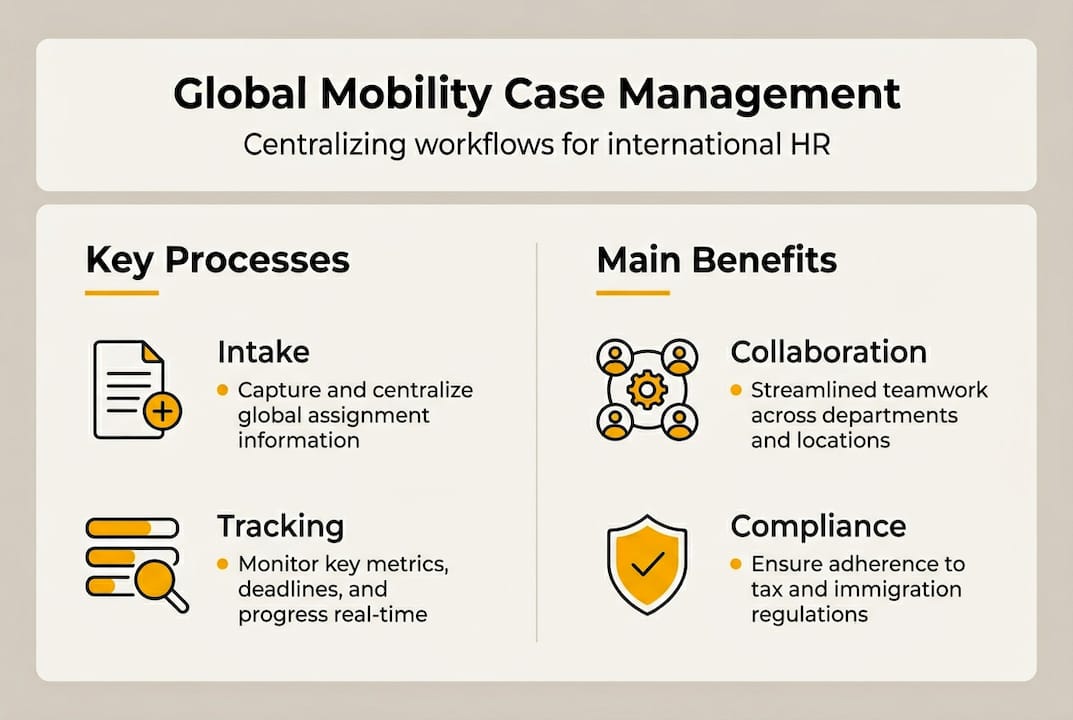
The table below maps core case management functions to specific international HR needs:
| Case management function | International HR application |
|---|---|
| Centralized intake | Work permit requests, relocation approvals, tax filings |
| Workflow routing | Assigning tasks to immigration counsel, tax advisors, vendors |
| Documentation | Visa copies, assignment letters, cost projections |
| Audit trails | Compliance evidence for host-country authorities |
| Collaboration tools | Multi-stakeholder coordination across time zones |
| Reporting and analytics | Assignment cost tracking, compliance status dashboards |
The risk is real. Organizations managing international assignments without centralized case management frequently encounter compliance failures, missed deadlines, and fragmented vendor relationships, each of which carries financial and legal exposure that far exceeds the cost of the technology required to prevent them.
Building effective global mobility compliance strategies starts with accepting that international HR case management is a discipline in its own right, not a scaled-up version of domestic HR administration.
Core mechanics: How HR case management works
Now that you have a high-level view, it’s crucial to unpack each component of the case management process and see how they fit together.
A well-designed case management workflow follows a consistent sequence regardless of the complexity of the assignment. The core mechanics include six stages:
Intake via forms, portals, or email, capturing the initial request with all relevant employee and assignment data
Categorization and prioritization, determining whether the case involves immigration, tax, relocation, or a combination of services
Assignment and workflow routing, directing tasks to the appropriate internal owner or external vendor
Documentation and audit trails, recording every action, decision, and communication within the case record
Collaboration tools, enabling real-time coordination between HR, legal counsel, tax advisors, and destination service providers
Reporting and analytics, generating visibility into case status, timelines, costs, and compliance indicators
This sequence sounds straightforward, but the failure points are subtle. Most HR teams manage intake reasonably well. Where programs break down is in steps three through five, particularly when a case crosses functional boundaries and no single owner has full visibility.
Automation addresses this directly. Standardized workflows with automation for reminders and escalations, role-based access, integration with HRIS and payroll systems, and AI-assisted routing ensure consistency and defensibility across every case. When a visa expiration date triggers an automatic renewal workflow three months in advance, the risk of a lapse drops significantly.
Compliance in complex scenarios, including global telecommuting arrangements, depends on exactly this kind of automated oversight. The same logic applies to tax deadlines, social security registration windows, and assignment extension approvals.
Pro Tip: Never treat documentation as an afterthought. Every decision made during an international assignment, from cost approval to vendor selection, should be recorded within the case file. Audit trails are your primary defense in the event of a host-country tax authority inquiry or an immigration compliance review.
The impact of global mobility technology on program efficiency is most visible at this operational level, where automation replaces manual follow-up and structured workflows replace ad hoc coordination.

Traditional vs. modern case management: What’s at stake?
Understanding the steps is one piece. Making the right technology choice is where the most serious gains or losses can occur.
The contrast between legacy and modern approaches is not simply a matter of convenience. It is a question of program viability.
| Dimension | Traditional approach | Modern platform approach |
|---|---|---|
| Data storage | Spreadsheets, email, shared drives | Centralized cloud database |
| Workflow management | Manual follow-up, calendar reminders | Automated routing and escalation |
| Vendor coordination | Phone, email, separate portals | Unified vendor marketplace |
| Compliance tracking | Periodic manual review | Real-time dashboards and alerts |
| Audit trail | Inconsistent, often incomplete | Automated, timestamped records |
| Reporting | Ad hoc, time-intensive | Configurable, on-demand analytics |
| Employee experience | Fragmented, reactive | Self-service portal with full visibility |
The efficiency gap is measurable. Modern centralized platforms reduce processing time by 30 to 40 percent compared to spreadsheet and email-based systems, while also improving ROI visibility. Manual approaches, by contrast, create fragmentation and legal exposure that compound over time.
30 to 40% reduction in case processing time when organizations move from manual tracking to centralized, AI-assisted platforms.
Consider a practical scenario. An HR team managing 50 active international assignments using shared spreadsheets and email chains has no reliable way to flag that a work permit in Germany expires in 45 days. The responsible manager is on leave. The immigration attorney has not been briefed. The employee continues working, unknowingly out of status, until an audit surfaces the lapse. The resulting fine, legal fees, and reputational damage far exceed any savings from avoiding a technology investment.
This is not a hypothetical. It is a pattern that smart HR management professionals encounter regularly when inheriting programs built on manual infrastructure. Modern platforms eliminate this category of risk by design.
Practical applications: Solving mobility HR challenges with case management
Seeing the differences is useful, but HR needs to know how case management delivers value right now, especially with international assignments.
International assignments generate a predictable set of complex scenarios, and case management determines how well an HR team responds to each one. Common challenges include:
🔸Immigration delays that stall start dates and trigger downstream costs in temporary housing and project timelines
🔸Overbudget assignments where cost projections were not tracked against actuals in real time
🔸Non-compliant documentation, such as expired certificates of coverage or missing assignment letters
🔸Family relocations, which involve families of four or more in 31% of cases and require schooling, spousal support, and housing coordination running in parallel
🔸Remote-to-relocation hybrids, where employees working remotely across borders create permanent establishment (PE) risk and social security ambiguity
🔸Tax and social security complexities, particularly when bilateral agreements between countries do not cover the employee’s specific situation
Case management addresses each of these by creating a structured record, assigning ownership, and triggering escalation when deadlines approach or thresholds are exceeded. High-performing mobility programs use case management for proactive risk detection, identifying delay signals before they become compliance events, and for data-driven policy evolution as geopolitical and economic conditions shift.
Avoiding global mobility compliance pitfalls requires more than awareness. It requires systems that surface risk automatically and route it to the right person before it becomes a problem. Similarly, policy changes such as U.S. visa interview waiver updates can affect dozens of active cases simultaneously, and only a centralized case management system can identify and respond to that exposure at scale.
Pro Tip: Use your case management data as a policy development tool. When you track outcomes across hundreds of cases, patterns emerge. Which assignment types consistently overrun budget? Which immigration routes generate the most delays? That data should drive your next policy review cycle, not anecdotal feedback from managers.
Why case management is HR’s secret weapon for global growth
Most organizations still treat HR case management as an operational necessity rather than a strategic asset. That framing is costly.
The most effective global mobility programs we observe share a common characteristic: they use case management data not just to resolve issues, but to prevent them. Workflow discipline creates institutional memory. When every immigration delay, every vendor failure, and every cost overrun is documented and categorized, the program learns. Policy improves. Vendor relationships are rationalized. Budget accuracy increases.
The hidden cost of poor case management is not the compliance fine or the missed deadline. It is the erosion of program credibility with business stakeholders who stop trusting HR to execute international moves reliably. Once that trust is lost, the mobility function loses its seat at the workforce planning table.
Integrating compliance and relocation into a unified management framework is the structural change that separates reactive programs from resilient ones. Case management is the foundation that makes that integration possible.
How xpath.global can support your HR case management
If you’re looking for a turnkey way to modernize your case management and improve your global mobility results, xpath.global stands ready to help.
xpath.global provides a purpose-built global mobility platform that centralizes every dimension of HR case management for international assignments. From immigration tracking and vendor coordination to compliance monitoring and employee self-service, the platform replaces fragmented tools with a single, structured environment.
HR teams can connect workflow automation, compliance oversight, and a marketplace of 60,000 vetted services across 183 countries, all within one system. Whether you are building a robust global mobility program from the ground up or modernizing an existing one, xpath.global provides the technology and expertise to do it at scale. Explore mobility technology options or contact global mobility experts to discuss your program’s specific needs.
Frequently asked questions
What are the main features of HR case management systems?
The main features include centralized intake, workflow automation, audit trails, secure documentation, collaboration tools, reporting, and integration with HR systems such as HRIS and payroll platforms.
Why is case management critical for international assignments?
It centralizes complex workflows including immigration, relocation, compliance, and expense tracking, reducing risk and enabling coordinated communication across multiple time zones and stakeholders.
How does automation improve HR case management?
Automation standardizes workflows, ensures timely responses through reminders and escalations, reduces manual errors, and produces auditable records that support compliance defensibility.
What are common pitfalls in global HR case management?
Relying on manual tracking through spreadsheets and email risks fragmentation and legal exposure, particularly when multi-stakeholder cases span jurisdictions and no single owner has full visibility into status or deadlines.