






TL;DR:
- Manual mobility management drains HR resources through manual checks and fragmented data.
- Mobility platforms centralize data, automate workflows, and reduce errors and costs significantly.
- These platforms improve employee satisfaction, ensure compliance, and enable strategic talent decisions.
Manual global mobility management is quietly draining resources from HR teams that can least afford the loss. Disconnected spreadsheets, fragmented vendor relationships, and manual compliance checks create conditions where errors are not occasional—they are predictable. Invoice processing alone drops by 70% when automation replaces manual workflows, which signals just how much operational capacity is being lost to repetitive tasks. For HR professionals and global mobility managers overseeing international assignments at scale, this article outlines the concrete operational, financial, and employee experience benefits that mobility platforms deliver, and why the shift from manual to technology-driven relocation management is no longer optional.
Key Takeaways
| Point | Details |
|---|---|
| Save time & reduce errors | Mobility platforms automate workflows and eliminate manual bottlenecks in relocation. |
| Cut relocation costs | Firms can save 20-30% on global assignments through automation and cost control. |
| Boost employee satisfaction | Enhanced employee support and self-service increase assignment success rates. |
| Ensure compliance | Automated compliance checks and audit trails safeguard against regulatory risks. |
| Strategic workforce agility | Mobility platforms help HR teams proactively adapt to a changing global landscape. |
The challenges of traditional global mobility management
Understanding why current relocation processes often underperform requires an honest look at the operational reality most HR teams face daily. Global mobility programs involve simultaneous coordination across immigration, tax, social security, housing, vendor management, and employee support. Without a centralized system, each of these workstreams operates in isolation, and the consequences compound quickly.
The most common pain points include:
- Siloed data that prevents HR teams from seeing the full picture of an assignment’s status
- Manual compliance checks that rely on individual memory rather than automated alerts
- Missed deadlines on visa renewals, tax filings, and work permit applications
- Cost overruns caused by untracked vendor spend and policy exceptions
- Employee frustration stemming from poor communication and lack of visibility into their own relocation progress
As assignment volumes grow and regulatory environments become more complex, these problems scale proportionally. A team that managed ten annual assignments with spreadsheets will find that same approach unworkable at fifty or one hundred assignments.
“Assignment setup is error-prone and administration-heavy without automation,” a reality that global mobility software investment directly addresses by replacing manual touchpoints with structured, auditable workflows.
Improving assignment tracking best practices is one of the first areas where technology delivers visible returns. For organizations with smaller HR teams, small team strategies built around platform automation can make the difference between a program that scales and one that collapses under its own weight.
How mobility platforms transform global relocation operations
Given these limitations, mobility platforms present a higher standard for efficiency and accuracy. At their core, these platforms centralize all assignment data into a single environment, giving HR teams, employees, and service providers real-time visibility into every stage of the relocation process.
Centralized mobility systems eliminate the information gaps that cause coordination failures. When a visa deadline is approaching, the platform sends an automated alert. When a vendor invoice is submitted, it routes through a predefined approval workflow rather than sitting in someone’s inbox.
The operational improvements follow a clear sequence:
- Data centralization removes silos between HR, compliance, and vendor teams
- Automated workflows replace manual task management with milestone-driven processes
- Compliance alerts ensure regulatory deadlines are never missed
- Vendor integrations allow real-time service tracking and invoice management
- Reporting dashboards surface assignment progress and cost data instantly
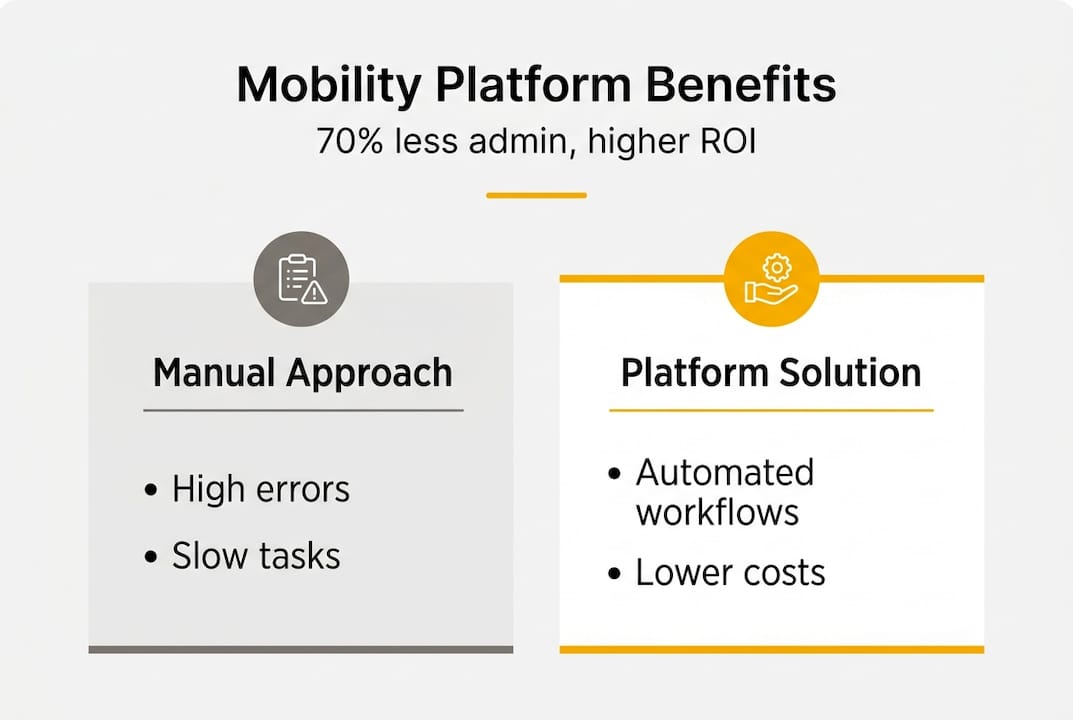
The measurable impact is significant. Automation reduces invoice processing by 70%, cuts assignment setup errors, and eliminates large volumes of repetitive administrative work that previously consumed HR capacity.
| Process area | Manual approach | Platform-enabled approach |
|---|---|---|
| Invoice processing | High error rate, slow approval | Automated routing, 70% faster |
| Compliance tracking | Calendar reminders, manual checks | Automated alerts, audit trail |
| Vendor management | Email coordination, no visibility | Centralized portal, real-time status |
| Assignment reporting | Manual spreadsheet compilation | Live dashboards, instant export |
Pro Tip: When evaluating mobility platforms, prioritize those with native cost management features and built-in vendor collaboration tools. These two capabilities alone account for the majority of measurable efficiency gains in the first year of platform adoption.
Driving cost savings and ROI through automation and policy enforcement
The operational changes mobility platforms create are clear, but the financial outcomes are equally compelling. Relocation costs per assignee typically range from $15,000 to $100,000 depending on assignment type, destination, and benefit structure. Without automated policy enforcement, exceptions accumulate and spend drifts well beyond approved budgets.

Mobility platforms address this directly by embedding relocation policy rules into the workflow itself. When an employee requests a benefit that exceeds policy limits, the system flags it before approval rather than after payment. This shift from reactive to proactive cost control is where the financial case for platforms becomes undeniable.
Cost comparison: manual vs. platform-enabled management
| Cost driver | Manual management | Platform-enabled management |
|---|---|---|
| Policy exception rate | High, often undocumented | Low, automated enforcement |
| Vendor spend visibility | Limited, delayed | Real-time, centralized |
| Reporting time | Hours per report | Minutes, automated |
| Compliance penalty risk | Elevated | Significantly reduced |
The numbers reflect this reality. Organizations cut relocation costs by 20 to 30% through platform adoption, and at least one enterprise saved $3 million in its first year alone. These are not marginal improvements. They represent structural changes in how mobility spend is governed.
Key financial benefits include:
- Automated budget tracking against approved assignment packages
- Vendor rate benchmarking and transparent pricing comparisons
- Real-time spend visibility across all active assignments
- Faster invoice reconciliation, reducing payment cycle times
- Policy-driven approval workflows that prevent unauthorized spend
For HR leaders building the business case for platform investment, these figures provide a credible foundation. Exploring cost-saving strategies in the context of your organization’s current assignment volume and vendor spend will help quantify the expected return with precision.
Boosting employee experience and assignment success
Beyond the bottom line, the effects on employee satisfaction and assignment success are significant. A relocation that feels disorganized or opaque from the employee’s perspective creates stress that directly affects productivity and retention. Mobility platforms address this by giving employees direct access to their own assignment information.
Self-service portals allow relocating employees to:
- Track the status of visa applications, housing searches, and moving logistics in real time
- Upload and manage personal documents without relying on HR as an intermediary
- Access destination guides, tax calendars, and compliance checklists tailored to their assignment
- Communicate directly with service providers and HR through a single interface
- Receive automated updates at key assignment milestones
Self-service portals and personalized support drive a 35% increase in employee satisfaction scores and measurably lower assignment failure rates. Assignment failure, which occurs when an employee returns early or underperforms due to relocation-related stress, carries costs that far exceed the technology investment required to prevent it.
Pro Tip: Use platform analytics to identify which assignment stages generate the most employee support requests. These friction points often reveal policy gaps or communication delays that can be resolved with targeted workflow adjustments, improving satisfaction without increasing HR headcount.
HR teams benefit equally. Real-time feedback data and assignment progress dashboards allow managers to intervene early when an assignment is at risk, rather than discovering problems after they have escalated. Reviewing employee experience technology options and understanding the top platform benefits will help HR leaders align platform selection with their employee experience goals.
Enabling proactive compliance and risk management
Alongside efficiency and satisfaction, compliance is a defining concern for enterprise HR teams managing cross-border assignments. Immigration violations, missed tax filings, and social security contribution errors carry financial penalties and reputational risks that can significantly exceed the cost of prevention.
Mobility platforms automate compliance management through a structured, multi-layered approach:
- Data entry and validation at assignment initiation ensures complete and accurate employee records
- Automated compliance alerts notify HR and employees of upcoming visa expirations, tax deadlines, and permit renewals
- Document management centralizes all assignment-related records in a secure, accessible repository
- Status dashboards provide a real-time view of compliance across all active assignments
- Audit trail generation creates a complete, timestamped record of every action taken within the system
- Reporting and audit closure simplifies regulatory reviews by producing structured compliance reports on demand
Mobility platforms automate compliance checks and reduce manual errors, replacing a process that historically depended on individual vigilance with one governed by system logic.
Early intervention enabled by automated alerts prevents the kind of compliance failures that result in assignment terminations, financial penalties, and strained relationships with host-country authorities.
For organizations operating across multiple jurisdictions, international compliance automation is not a convenience—it is a risk management necessity. The audit trail functionality alone simplifies regulatory reviews that would otherwise require weeks of manual document retrieval and reconciliation.
Why mobility platforms are a strategic must—beyond just technology
Stepping back, it is clear that mobility platforms are more than operational tools. Most HR teams adopt them to solve immediate problems: too many emails, too many spreadsheets, too many missed deadlines. That is a legitimate starting point. But the organizations that extract the most value from these platforms are those that treat them as strategic infrastructure rather than tactical fixes.
The real competitive advantage lies in what platforms enable at scale. When assignment data is centralized and workflows are automated, HR leaders gain the visibility to make proactive talent decisions. Which locations are generating the highest assignment costs? Which employee profiles are most likely to succeed in long-term international roles? These are strategic questions that manual processes cannot answer.
There is also a workforce agility dimension that is frequently underestimated. Organizations that can move talent across borders quickly and compliantly are better positioned to respond to market opportunities than those constrained by slow, error-prone mobility programs. Reviewing proven relocation steps through a strategic lens reveals how platform-enabled mobility supports broader business objectives, not just HR efficiency metrics. The platforms that will define tomorrow’s best employers are those already being adopted today.
Explore leading mobility platform solutions for HR
If you are ready to modernize mobility in your organization, the next step is understanding which platform capabilities align with your program’s specific needs.
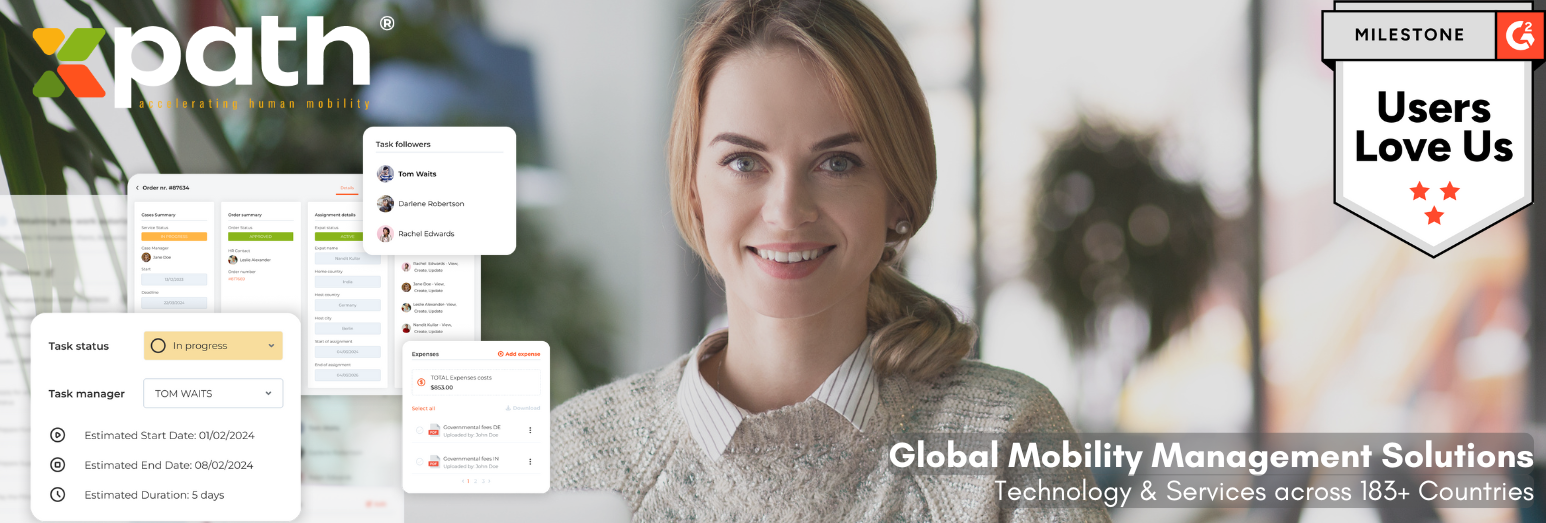
xpath.global provides a unified global mobility ecosystem that connects HR teams, employees, and service providers in a single digital environment. From automated compliance tracking to transparent vendor management and self-service employee portals, the platform is built to address the full complexity of international workforce relocation. To understand how the right technology fits your program, choose the right mobility solution with guidance tailored to your organization’s scale and structure. For deeper relocation process insights, or to discuss your program’s specific challenges, speak with HR mobility experts who can help you build a business case and implementation plan.
Frequently asked questions
How much time can mobility platforms save HR teams?
Mobility platforms reduce manual work by up to 70% through automation and centralized workflows, freeing HR teams to focus on strategic program management rather than administrative coordination.
What cost savings can be expected from using a mobility platform?
Organizations typically cut relocation costs by 20 to 30% through platform adoption, with some enterprises reporting savings of $3 million or more in the first year through policy enforcement and spend visibility.
How do mobility platforms enhance employee experience during relocation?
These platforms offer self-service portals and real-time assignment updates, producing a 35% improvement in satisfaction scores and measurably lower assignment failure rates compared to manual relocation management.
How do mobility platforms help manage compliance risks?
They automate compliance checks and reduce manual errors by generating automated alerts, maintaining complete audit trails, and centralizing all regulatory documentation in a single accessible system.
Recommended
- Internal Process Management of Global Mobility – xpath.global
- Contact xpath – Human Resource Professionals – xpath.global
- Reasons Smaller Employee Mobility Team Needs Technology – xpath.global
- Global Mobility HRs are Switching to Affordable Technology – xpath.global
- Modern Insurance Platform Benefits – Digital Insurance Platform | IBSuite Insurance Software | Modern Insurance System
- Enhance nonprofit benefits with tech: cut costs by 25%