






International employee relocations involve juggling passports, visas, work permits, tax records, and immigration documents across multiple jurisdictions. When organizations fail to manage these mobility documents systematically, non-compliance can cost up to 4% of annual revenue. For HR professionals and relocation managers, understanding mobility document management is essential to protecting your organization from costly penalties while ensuring smooth international assignments. This guide explains what mobility document management entails, which documents you need to track, and how modern systems transform compliance and efficiency.
Table of Contents
- Understanding Mobility Document Management And Its Critical Role
- Core Documents Required For International Employee Relocation
- How Mobility Systems Optimize Employee Relocation Processes
- Best Practices And Expert Insights For Effective Mobility Document Management
- Explore Xpath.Global For Streamlined Global Mobility Solutions
Key takeaways
| Point | Details |
|---|---|
| Definition and scope | Mobility document management systematically organizes and automates all employee relocation paperwork across borders |
| Essential documents | Passports, visas, work permits, financial statements, immigration history, and employment credentials must be tracked |
| Automation benefits | Technology platforms reduce errors by 70% and compress approval timelines through workflow automation |
| Compliance risks | Unmanaged documents create regulatory violations, costly delays, and potential assignment failures |
| Implementation strategy | Start early, centralize digitally, integrate with HRIS, and collaborate closely with immigration counsel |
Understanding mobility document management and its critical role
Mobility document management is the systematic process of organizing, tracking, and automating all paperwork required for international employee relocations. This includes everything from initial passport verification to final work permit approval. Unlike domestic HR processes, international mobility demands coordination across multiple legal systems, each with distinct documentation requirements and compliance deadlines.
The complexity multiplies when you consider that a single relocation might involve:
- Immigration documents for the employee and dependents
- Tax compliance paperwork across home and host countries
- Social security coordination records
- Housing and lease agreements
- Employment contract modifications
- Educational records for accompanying children
Global mobility technology systems automate and optimize workforce relocation, international assignments, and compliance management by creating centralized workflows that track every document from request to approval. These platforms eliminate the fragmented spreadsheets and email chains that plague traditional mobility programs.
Without systematic document management, your team faces serious operational risks. Missing a single visa renewal deadline can strand an employee abroad or force premature repatriation. Incomplete financial documentation can trigger customs delays that add weeks to assignment timelines. Untracked immigration history creates audit vulnerabilities that expose your organization to regulatory penalties.
Modern mobility systems address these challenges through real-time compliance tracking, automated deadline alerts, and integrated approval workflows. When every stakeholder from HR to immigration counsel to the relocating employee can access the same document repository, coordination becomes seamless. You gain visibility into bottlenecks before they cause delays, and compliance becomes proactive rather than reactive.
“Strategic document management is not just about compliance. It is about creating competitive advantage through faster deployments, reduced administrative costs, and improved employee experience during international assignments.”
The return on investment becomes clear when you compare manual document tracking against automated systems. Manual processes require constant email follow-ups, duplicate data entry, and reactive problem solving. Automated platforms handle routine tasks invisibly while flagging exceptions that need human attention. This shift allows your mobility team to focus on strategic program design rather than administrative firefighting.
Implementing effective mobility compliance strategies starts with recognizing that document management is the foundation of every successful international assignment. Without it, even the most generous relocation packages and supportive policies will fail.
Core documents required for international employee relocation
Successful mobility document management requires understanding exactly which documents you must collect, verify, and maintain throughout the relocation lifecycle. Documents needed for international relocation fall into four primary categories, each serving distinct compliance and operational purposes.
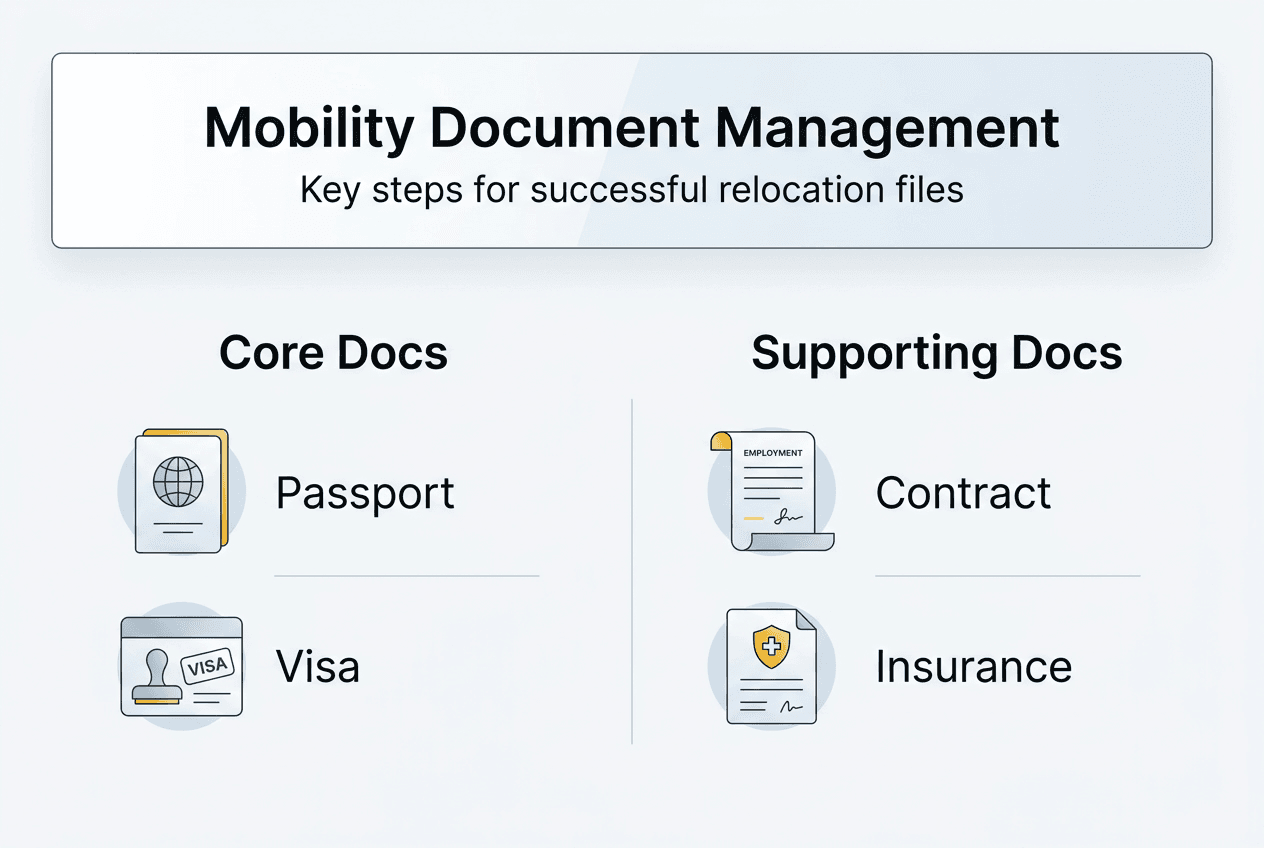
Identification and travel documents form the foundation. Passports must have 6-12 months validity beyond entry dates, a non-negotiable requirement across most jurisdictions. Birth certificates, marriage certificates, and dependent identification documents establish family unit composition for visa applications. National identity cards serve as secondary identification in many countries.

Immigration and residency documents include current and historical visas, work permits, residence cards, and biometric receipts. Immigration authorities increasingly require complete travel history, so maintaining copies of previous visas and entry/exit stamps becomes critical. Visa refusal letters, if any exist, must be disclosed upfront to avoid complications. For employees with specialized skills or executive roles, professional licenses and educational credentials often require authentication or apostille certification.
Employment and financial records demonstrate the legitimacy and financial viability of the international assignment. Employment contracts, job offer letters, and assignment letters establish the purpose of relocation. Recent pay stubs and bank statements, typically covering 3-6 months of financial history, prove financial self-sufficiency to immigration authorities. Tax returns from the previous two years may be required for certain visa categories.
Supporting documentation varies by destination but commonly includes health insurance certificates, medical examination results, police clearance certificates, and housing arrangements. Some countries require proof of language proficiency, particularly for permanent residence applications. For families, school enrollment confirmations and vaccination records become essential.
The following table organizes these documents by priority and typical collection timeline:
| Document Category | Examples | Collection Timeline |
|---|---|---|
| Foundational | Passports, birth certificates, marriage certificates | 6-8 weeks before application |
| Immigration | Current visas, work permits, travel history | 4-6 weeks before application |
| Employment | Contracts, offer letters, assignment terms | 3-4 weeks before application |
| Financial | Bank statements, pay stubs, tax returns | 2-3 weeks before application |
| Supporting | Medical exams, police clearances, housing proof | 1-2 weeks before application |
Pro Tip: Start assembling foundational documents immediately upon assignment approval, even before final destination confirmation. Passport renewals alone can take 8-12 weeks, and obtaining historical immigration records from previous host countries may require months of lead time.
Special consideration applies to executives and technical specialists who may need credential evaluations, professional association memberships, or specialized certifications. These documents often require third-party verification services that add 4-6 weeks to preparation timelines. Your expat document management guide should account for these extended timelines in project planning.
The complexity of document requirements explains why systematic management is non-negotiable. Missing even a single secondary document can trigger application rejections that delay assignments by months and damage employee confidence in your mobility program.
How mobility systems optimize employee relocation processes
Modern mobility platforms transform document management from a manual coordination nightmare into a streamlined, automated workflow. The xpath.global platform streamlines workflow automation for visa workflows, payroll adjustments, assignment preparation, and relocation approvals through integrated case management and task delegation.
Key automation features include:
- Automated task assignment routes document requests to appropriate stakeholders based on assignment type, destination country, and employee profile
- Smart checklists dynamically adjust required documents based on visa category, family composition, and destination-specific regulations
- Case creation workflows automatically generate immigration cases when assignments are approved in your HRIS
- Approval routing sends documents through predefined review chains with automatic escalation for overdue items
- Deadline tracking monitors expiration dates for passports, visas, and permits with configurable alert thresholds
The efficiency gains become dramatic when you compare manual versus automated approaches:
| Process Step | Manual Approach | Automated Platform |
|---|---|---|
| Document request | Individual emails to 5-8 stakeholders | Single automated notification to all parties |
| Status tracking | Spreadsheet updates, follow-up emails | Real-time dashboard visibility |
| Approval routing | Sequential email chains over days | Parallel workflows completed in hours |
| Compliance verification | Manual checklist review | Automated validation against requirements |
| Reporting | Manual data compilation | Instant analytics and SLA tracking |
Integration with HRIS platforms like Workday, SuccessFactors, and Oracle HCM eliminates duplicate data entry and ensures assignment data flows seamlessly into mobility workflows. When an assignment is approved in your HRIS, the mobility platform automatically creates the immigration case, assigns tasks, and notifies relevant stakeholders. This integration reduces case setup time from hours to minutes while eliminating transcription errors.
The step-by-step benefits compound throughout the assignment lifecycle. Fewer errors mean fewer visa rejections and resubmissions. Faster approvals compress time-to-deployment, allowing critical talent to start contributing sooner. Real-time analytics reveal process bottlenecks before they impact deadlines. Compliance tracking provides audit-ready documentation that satisfies regulatory requirements and internal controls.
Pro Tip: Prioritize platforms offering SLA tracking and live dashboards that show exactly where each case stands in the approval pipeline. This visibility allows proactive intervention when cases risk missing deadlines, rather than discovering problems after damage is done.
Advanced platforms go beyond basic document storage by incorporating intelligent features like optical character recognition that extracts data from uploaded documents, automatic deadline calculation based on visa validity periods, and predictive analytics that forecast future document needs based on assignment patterns. These capabilities transform mobility teams from reactive administrators into strategic workforce planning partners.
To simplify global mobility steps, focus on platforms that integrate document management with broader case workflows. When document collection, immigration case management, and vendor coordination operate within a single system, your team gains unprecedented efficiency. The immigration case workflow becomes a competitive advantage rather than an operational burden.
Best practices and expert insights for effective mobility document management
Implementing robust mobility document management requires more than just technology. It demands strategic planning, clear processes, and organizational discipline. The following best practices emerge from successful global mobility programs across industries.
Start document collection early and communicate clearly. As soon as an assignment receives preliminary approval, begin gathering foundational documents. Employees often underestimate how long it takes to locate birth certificates, obtain police clearances, or renew expired passports. Providing a detailed checklist with specific instructions and deadlines sets clear expectations and prevents last-minute scrambles.
Maintain a centralized digital repository with version control. Scattered documents across email attachments, local drives, and physical files create chaos and compliance risk. A single source of truth ensures everyone works from current, approved versions. Version control tracks document updates and maintains audit trails that prove compliance during regulatory reviews.
Collaborate proactively with immigration counsel. When you can provide immigration lawyers with a complete package, you compress approval timelines significantly. Incomplete submissions trigger multiple rounds of requests for additional evidence, each adding weeks to processing. Establishing document standards with your legal partners upfront eliminates ambiguity and reduces back-and-forth.
Implement quality checks before submission. Common errors like expired documents, missing signatures, or incorrect translations cause preventable rejections. Build verification steps into your workflow where a second reviewer confirms completeness and accuracy before submission. This investment of 15-20 minutes per case prevents delays measured in weeks.
Avoid these frequent mobility compliance mistakes:
- Assuming passport validity requirements are uniform across countries
- Failing to track dependent documents separately from primary assignee paperwork
- Overlooking destination-specific document legalization requirements
- Neglecting to maintain copies of submitted documents for audit purposes
- Underestimating processing times for credential evaluations and translations
Expert perspectives reinforce these operational practices. Global mobility consultants emphasize that document management excellence directly impacts talent retention and program scalability. When employees experience smooth, well-coordinated relocations, they develop confidence in your organization’s ability to support international careers. This confidence translates into higher acceptance rates for future assignments and positive word-of-mouth that attracts top talent.
“Organizations that treat document management as strategic infrastructure rather than administrative overhead gain measurable advantages in deployment speed, compliance outcomes, and employee satisfaction. The difference between good and great mobility programs often comes down to operational excellence in seemingly mundane processes like document tracking.”
Strategic document management also enables better workforce planning. When you maintain comprehensive records of visa types, validity periods, and renewal timelines across your mobile population, you can forecast future immigration needs and budget accordingly. This visibility prevents surprises and allows proactive renewal management that avoids gaps in work authorization.
Finally, recognize that document management requirements evolve constantly as countries update immigration policies, add biometric requirements, or change application procedures. Building relationships with immigration counsel in key destinations ensures you stay informed of regulatory changes that impact document requirements. Regular training for your mobility team on current requirements prevents outdated practices from compromising compliance.
Explore xpath.global for streamlined global mobility solutions
If the complexity of mobility document management feels overwhelming, you are not alone. Most HR teams struggle with fragmented systems, manual processes, and limited visibility into their international assignment pipelines. xpath.global was built specifically to solve these challenges through integrated technology and expert services that transform how organizations manage global talent mobility.
The xpath.global platform centralizes every aspect of document management within comprehensive global mobility solutions that automate workflows, track compliance, and integrate seamlessly with your existing HRIS. You gain real-time visibility into every assignment, automated alerts for approaching deadlines, and audit-ready documentation that satisfies regulatory requirements across 183 countries.
Beyond technology, xpath.global provides access to 600+ vetted service providers including immigration attorneys, relocation specialists, and tax advisors through a transparent marketplace. This combination of platform capabilities and expert services means you are never managing mobility challenges alone. When choosing the right global mobility technology, prioritize solutions that combine automation with human expertise.
Whether you are crafting a global mobility program embracing remote work or scaling an existing international assignment program, xpath.global provides the infrastructure and support you need. Explore how xpath.global can transform your mobility document management from a compliance burden into a strategic advantage.
Frequently asked questions
What exactly does mobility document management involve?
Mobility document management encompasses the systematic collection, organization, verification, and tracking of all paperwork required for international employee relocations. This includes immigration documents, employment records, financial statements, and supporting materials needed for visa applications and compliance across multiple jurisdictions.
How does technology improve international employee document management?
Technology platforms automate document requests, track submission status in real time, route approvals through predefined workflows, and maintain centralized repositories accessible to all stakeholders. This automation reduces errors by up to 70%, compresses approval timelines, and provides audit-ready compliance documentation that manual processes cannot match.
Which documents are absolutely essential for employee relocation?
Core documents include valid passports with sufficient validity, current and historical visas, employment contracts and offer letters, recent financial statements covering 3-6 months, birth and marriage certificates for family members, and destination-specific items like medical examinations or police clearances. Requirements vary significantly by country and visa category.
How can we ensure compliance with global mobility regulations?
Implement centralized document management systems that track regulatory requirements by destination country, maintain complete audit trails of all submissions, set automated alerts for expiration dates and renewal deadlines, collaborate closely with immigration counsel using complete document packages, and conduct regular compliance reviews to identify gaps before they become violations. For detailed strategies, review comprehensive expat document management FAQ resources.
What steps should HR teams take to implement effective document management?
Start by auditing current processes to identify gaps and inefficiencies. Select a mobility platform that integrates with your HRIS and provides workflow automation. Establish clear document standards and checklists for each assignment type and destination. Train mobility coordinators and hiring managers on requirements and timelines. Build relationships with immigration counsel in key destinations. Finally, implement quality checks and version control to ensure accuracy before submission.