






Managing expatriate documents across borders presents critical challenges for HR and global mobility teams. Manual methods like spreadsheets create compliance gaps and security risks, while organizations risk costly fines and audit problems when overlooking international document retention laws. Cloud-based platforms transform this complexity into streamlined, secure systems that protect both your organization and your assignees.
Table of Contents
- 🔸Understanding Document Management In Global Mobility
- 🔸Key Compliance Challenges In Expat Document Management
- 🔸How Cloud-Based Technologies Transform Expat Document Management
- 🔸Common Misconceptions About Document Management For Expats
- 🔸Comparison Framework For Selecting Expat Document Management Solutions
- 🔸Practical Impacts: How Efficient Document Management Benefits Expat Assignments
- 🔸Explore Our Global Mobility Technology Solutions
Understanding document management in global mobility
Document management for expatriate assignments means systematically handling every piece of critical paperwork throughout an international assignment lifecycle. This process includes secure storage, intelligent organization, proactive lifecycle tracking, and continuous compliance verification for documents like visas, work permits, tax forms, employment contracts, and relocation approvals.
The scope extends far beyond simple file storage. Your team must ensure documents remain accessible to authorized stakeholders across time zones, track expiration dates to prevent lapses in legal status, maintain audit trails for compliance verification, and protect sensitive personal information against unauthorized access. Using cloud-based global mobility software consolidates employee data and strengthens compliance, preventing costly tax and visa breaches.
Effective document management directly impacts assignment success and organizational risk. Poor practices create compliance violations that trigger audits and fines, damage employee satisfaction when documents go missing at critical moments, and expose your organization to data breaches involving confidential personal information. Multi-jurisdictional regulatory requirements and the sheer volume of documents per assignment magnify these challenges.
Key documents requiring systematic management include:
- 🔸Visa and work permit applications with supporting documentation
- 🔸Tax equalization agreements and jurisdiction-specific filings
- 🔸Employment contracts and assignment letters
- 🔸Immigration status tracking and renewal schedules
- 🔸Relocation expense receipts and approval workflows
- 🔸Dependent documentation for family relocations
Key compliance challenges in expat document management
Navigating compliance in expatriate document management demands understanding vastly different legal frameworks across assignment locations. Document retention requirements illustrate this complexity: European GDPR mandates strict data minimization and limited retention periods, while US regulations often require longer retention for tax and employment records. Your compliance strategy must adapt to each jurisdiction where assignees work.
Secure storage and controlled access represent legal requirements, not optional best practices. Many countries mandate encryption for personal data, role-based access controls to limit exposure, audit logs tracking who accessed which documents, and geographic data residency restrictions. These requirements intensify when managing assignments across multiple regulatory environments simultaneously.
Non-compliance consequences extend beyond financial penalties. Regulatory audits consume substantial HR resources and management attention. Fines can reach millions depending on violation severity and jurisdiction. Perhaps most damaging, compliance failures erode trust with employees whose sensitive information you manage and harm your employer brand in competitive talent markets.
“Without proper document management protocols, global mobility programs face exponentially higher risks of regulatory violations as assignment complexity increases across borders.”
Data breaches involving expatriate documents carry particularly severe consequences. Beyond regulatory fines, breaches trigger notification requirements across multiple jurisdictions, legal liability for affected employees, remediation costs including credit monitoring services, and lasting reputational damage that complicates future recruiting efforts.
Effective compliance requires jurisdiction-specific policies that:
- 🔸Map retention requirements for each assignment location
- 🔸Define access controls based on role and business need
- 🔸Establish encryption standards meeting local regulations
- 🔸Create audit procedures verifying ongoing compliance
- 🔸Implement breach response protocols across borders
How cloud-based technologies transform expat document management
Cloud platforms fundamentally reshape how HR teams manage expatriate documentation by centralizing storage in secure, accessible repositories. Instead of scattered files across email inboxes and local drives, your team gains a single source of truth accessible in real time from anywhere. This centralization eliminates version control nightmares and ensures stakeholders always work from current documents.

Security enhancements through cloud technology far exceed what manual methods can achieve. Enterprise-grade encryption protects data both in transit and at rest. Role-based access controls ensure only authorized personnel view sensitive documents. Multi-factor authentication adds protection layers against unauthorized access. Automated backup systems prevent data loss that devastates manual filing systems.
Automation capabilities reduce administrative burden while improving compliance outcomes. Platforms trigger alerts when documents approach expiration, ensuring your team renews work permits and visas before lapses occur. Workflow automation routes approvals to appropriate stakeholders without manual tracking. Template libraries standardize document creation across assignments. These features transform reactive document management into proactive compliance.
Integration with broader technology for global employee success amplifies benefits across your mobility program. When document management connects seamlessly with case management, expense tracking, and vendor coordination, you gain comprehensive visibility into assignment status. Data flows automatically between systems, eliminating duplicate entry and reducing errors.
Mobile access empowers both HR professionals and expatriates to manage documents remotely. Your team reviews and approves submissions from anywhere. Assignees upload required documents through intuitive mobile interfaces, track their assignment progress, and access important files without contacting HR. This self-service capability improves employee experience while reducing your team’s administrative workload.
Pro Tip: Prioritize platforms offering dedicated implementation support and ongoing training. Technical capabilities matter less if your team struggles with adoption, so vendor support quality significantly impacts long-term success.
Cloud platforms supporting preparing expatriates for successful assignments create competitive advantages through:
- 🔸Real-time collaboration across global teams and time zones
- 🔸Instant document retrieval during audits or inquiries
- 🔸Scalability accommodating program growth without infrastructure investment
- 🔸Automatic updates ensuring compliance with evolving regulations
- 🔸Analytics revealing process bottlenecks and improvement opportunities
Common misconceptions about document management for expats
Many HR teams believe spreadsheets and email provide adequate document management for expatriate assignments. This misconception persists despite overwhelming evidence of failures. Spreadsheets lack access controls, creating security vulnerabilities. Email threads scatter documents across inboxes, making retrieval difficult during audits. Version confusion causes teams to work from outdated files. These manual methods guarantee errors, data loss, and compliance gaps as assignment complexity grows.
Another prevalent myth assumes document retention compliance remains consistent globally, allowing standardized policies across all assignments. Reality proves far more complex. GDPR in Europe emphasizes data minimization and limited retention. US regulations often mandate longer retention for employment and tax records. Asian jurisdictions impose varied requirements based on document type and industry. Applying uniform policies across jurisdictions virtually guarantees violations somewhere in your assignment portfolio.
Security risk underestimation represents perhaps the most dangerous misconception. Some teams assume basic password protection and periodic backups provide sufficient safeguards. Data breaches involving expatriate documents cost organizations millions in fines, remediation, and reputation damage. Sensitive personal information including passport details, tax data, and family member records demands enterprise-grade security controls that manual methods cannot provide.
“The gap between perceived adequacy of manual document management and actual compliance requirements exposes organizations to preventable risks that cloud platforms readily address.”
Automation benefits often go unrecognized until teams experience them firsthand. Manual tracking of document expiration dates inevitably misses renewals, causing assignment disruptions. Workflow approvals handled through email create bottlenecks and lost requests. Template creation from scratch wastes time and introduces inconsistencies. Organizations underestimate how automation transforms these pain points into smooth, reliable processes.
Key facts dispelling these misconceptions:
- 🔸Manual methods cause 3x more compliance errors than automated systems
- 🔸Document retention laws vary across 183 countries with frequent updates
- 🔸Average data breach costs exceed $4 million, with expatriate data particularly sensitive
- 🔸Automation reduces administrative time by 40-60% for document-intensive processes
- 🔸Cloud platforms provide audit trails impossible to maintain manually
Comparison framework for selecting expat document management solutions
Evaluating document management platforms requires systematic assessment across critical dimensions. Start with compliance support, examining how platforms address GDPR requirements, country-specific document retention laws, data residency restrictions, and audit trail capabilities. Platforms should demonstrate clear understanding of global mobility compliance challenges and provide configurable policies matching your assignment footprint.
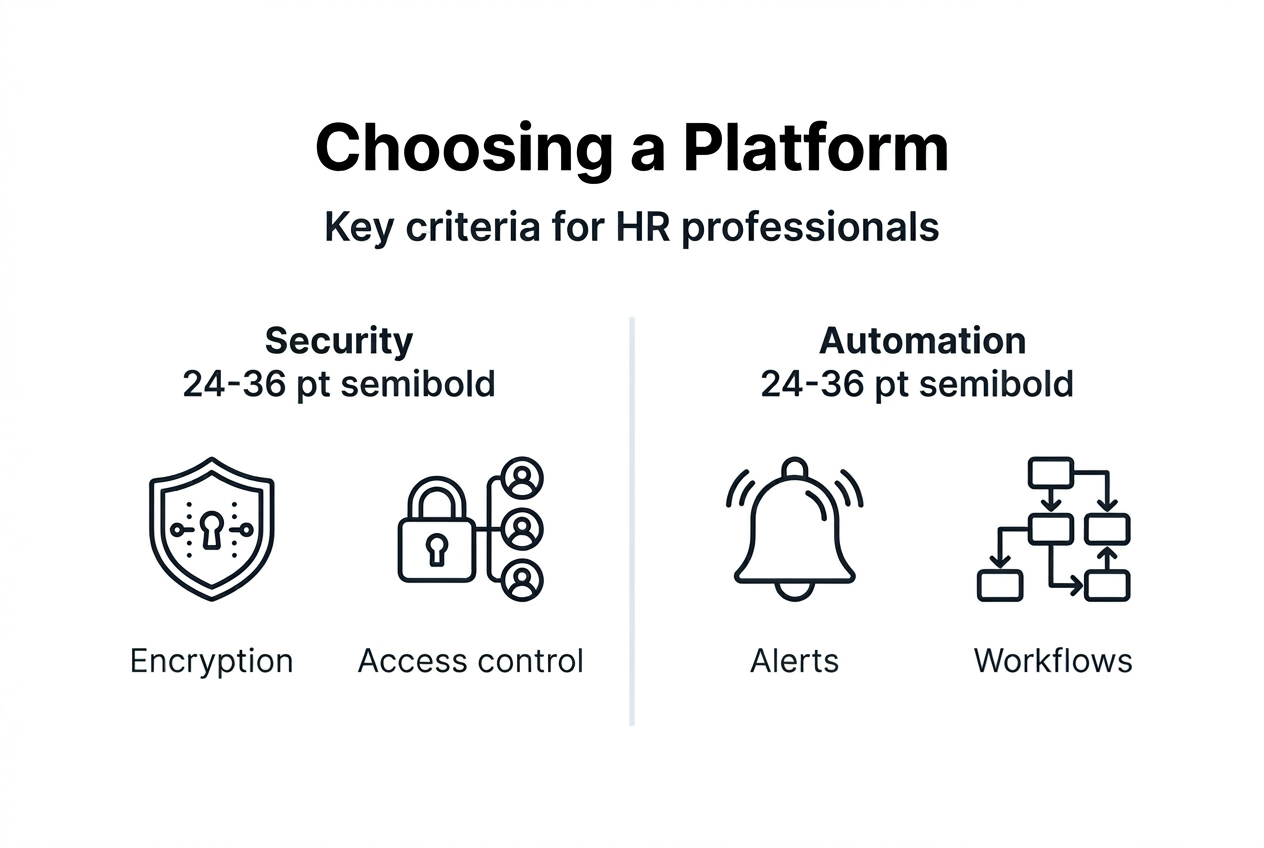
Security features demand careful scrutiny. Verify encryption standards for data at rest and in transit. Examine role-based access control granularity and multi-factor authentication options. Review backup and disaster recovery procedures. Assess vendor security certifications like SOC 2 and ISO 27001. Security failures create catastrophic consequences, making this evaluation dimension non-negotiable.
Automation capabilities directly impact your team’s productivity and compliance outcomes. Strong platforms offer document expiration alerts with configurable lead times, workflow automation routing approvals to appropriate stakeholders, template libraries for common document types, and bulk upload and processing for efficiency. These features transform time-consuming manual tasks into streamlined automated processes.
| Evaluation Criterion | What to Assess | Why It Matters |
|---|---|---|
| Compliance Support | GDPR tools, retention policies, audit trails | Prevents costly violations and simplifies audits |
| Security Features | Encryption, access controls, certifications | Protects sensitive data and meets legal requirements |
| Automation | Alerts, workflows, templates | Reduces errors and administrative burden |
| Integration | API quality, pre-built connectors | Ensures data flows across mobility ecosystem |
| User Experience | Mobile access, self-service, interface design | Drives adoption and reduces support needs |
| Vendor Support | Implementation help, training, customization | Determines long-term platform success |
Integration capabilities determine how well document management fits within your broader technology for hybrid workplaces ecosystem. Evaluate API quality and documentation, pre-built integrations with major HR and mobility platforms, data synchronization reliability, and customization options for unique workflows. Isolated systems create data silos that undermine visibility and efficiency.
User experience considerations affect both adoption rates and ongoing satisfaction. Assess mobile application functionality for on-the-go access, self-service capabilities empowering assignees to manage documents, interface intuitiveness for non-technical users, and multilingual support for global teams. Platforms requiring extensive training or causing user frustration fail regardless of technical capabilities.
Pro Tip: Request references from organizations with similar assignment volumes and geographic footprints. Implementation experiences vary dramatically based on use case complexity, so targeted references provide realistic expectations.
Vendor support quality often determines platform success more than features alone. Examine implementation methodology and timeline estimates, training programs for administrators and end users, ongoing support responsiveness and channels, and customization services for specialized needs. The enhancing employee experience in global mobility depends partly on smooth technology experiences that quality vendor support enables.
Practical impacts: how efficient document management benefits expat assignments
Improved compliance through systematic document management dramatically reduces audit risks and associated costs. Automated retention policies ensure documents remain available for required periods while safely disposing of data past retention windows. Audit trails provide instant evidence of compliance during regulatory reviews. Real-time compliance dashboards alert teams to gaps before they become violations. These capabilities transform compliance from reactive fire-fighting into proactive risk management.
Real-time document access enhances HR decision-making across the assignment lifecycle. When evaluating new assignment locations, instant access to historical documentation reveals patterns and lessons learned. During active assignments, current document status informs decisions about extensions, amendments, or early terminations. Post-assignment reviews benefit from complete documentation supporting accurate analysis and continuous improvement.
Mobile access fundamentally changes the expatriate experience by putting assignment control in assignees’ hands. Expats upload required documents immediately using smartphone cameras rather than waiting to scan at offices. They track assignment milestones and document status without repeatedly contacting HR. Secure access to important files provides peace of mind during international moves. This empowerment improves satisfaction while reducing your team’s support burden.
Cloud-based global mobility software improves assignment management visibility, cost control, and compliance adherence by consolidating employee status and document expiry data. Automation eliminates repetitive manual tasks that consume disproportionate time relative to value created. Expiration alerts remove manual tracking from your team’s responsibilities. Workflow automation routes approvals without intervention. Bulk operations process multiple assignments simultaneously. These efficiency gains allow your team to focus on strategic activities rather than administrative tasks.
Document management quality directly impacts overall assignment experience and outcomes through:
- 🔸Faster assignment startup when documents flow smoothly through approvals
- 🔸Reduced stress for assignees confident their documentation remains current
- 🔸Lower risk of assignment disruptions from expired permits or visas
- 🔸Improved cost management through better expense documentation and tracking
- 🔸Enhanced assignment outcomes when compliance and administration run smoothly
Explore our global mobility technology solutions
Modern expatriate assignments demand technology matching their complexity and importance. Xpath.global delivers integrated cloud solutions purpose-built for global mobility teams managing international assignments. Our platform consolidates document management, case tracking, vendor coordination, and compliance tools into one secure environment designed specifically for HR professionals navigating cross-border complexities.
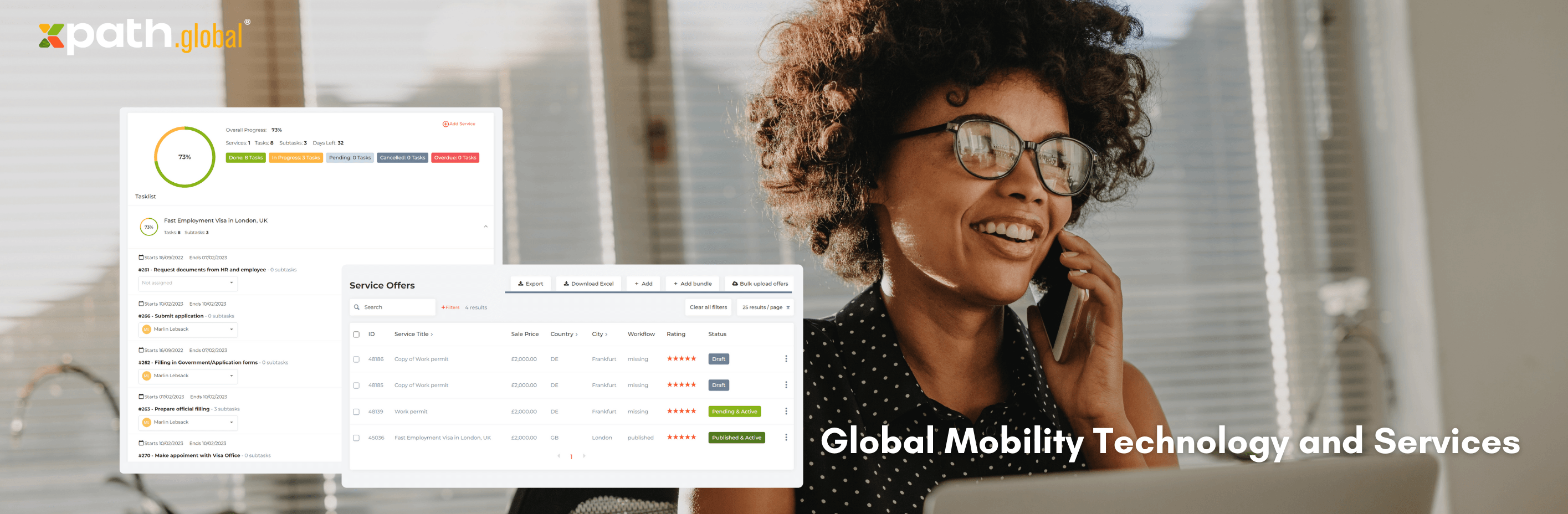
Our global mobility technology and services automate workflows that bog down manual processes, provide enterprise-grade security protecting sensitive assignee data, enable mobile access for both HR teams and expatriates, and integrate seamlessly with your existing HR systems. These capabilities directly address the document management challenges outlined throughout this guide.
Explore how xpath.global enhances employee experience in global mobility through intuitive technology that assignees actually want to use. Our platform helps you streamline expatriate management processes by eliminating manual bottlenecks and providing real-time visibility across your assignment portfolio. Join organizations across 183 countries already transforming their global mobility programs with xpath.global.
FAQ
What is document management for expats?
Document management for expats is the systematic process of organizing, storing, securing, and tracking expatriate-specific documents throughout international assignments. These documents include visas, work permits, tax forms, employment contracts, and relocation approvals. Effective management ensures compliance with varied international regulations while providing secure access to authorized stakeholders across borders.
Why is compliance important in expat document management?
Compliance ensures your organization adheres to vastly different legal requirements across jurisdictions where assignees work. Non-compliance triggers regulatory audits, substantial fines reaching millions in severe cases, and reputational damage harming employer brand and future recruiting. Document retention laws, data residency requirements, and access controls vary dramatically between countries, making jurisdiction-specific policies essential.
How do cloud-based platforms improve expat document management?
Cloud platforms centralize documents in secure repositories accessible in real time from anywhere, eliminating scattered files across email and local drives. They provide enterprise-grade security through encryption, role-based access controls, and automated backups that manual methods cannot match. Automation features reduce errors and administrative burden by triggering expiration alerts, routing approval workflows, and standardizing document creation through template libraries.
What are common mistakes HR teams make managing expat documents?
Using spreadsheets and email creates security vulnerabilities, version confusion, and inevitable data loss as assignment complexity grows. Ignoring jurisdictional differences in retention requirements and access controls causes compliance failures and regulatory violations. Underestimating security needs exposes sensitive personal information to breach risks costing millions in fines and remediation.
How should HR professionals select an expat document management system?
Evaluate compliance support including GDPR tools, country-specific retention policies, and audit trail capabilities. Assess security features like encryption standards, access controls, and vendor certifications. Examine automation capabilities for expiration alerts, workflow routing, and template libraries. Ensure platform integration with your global mobility tools through quality APIs and pre-built connectors. Consider user experience factors like mobile access and self-service capabilities alongside vendor support quality and customization options.