











Italy Checklist: Sponsoring Highly Skilled Migrant Visas
Grab a copy of a guide to international employee relocation
View E-book
Moving talent across borders is high stakes work. Expatriate failure rates reach 50% in some industries, costing companies three times an employee’s annual salary when assignments collapse. The complexity of international relocations demands more than basic logistics. Successful programs require coordinated immigration support, cultural training, tax compliance, housing assistance, and family integration services. This guide breaks down the essential components of corporate relocation services, proven planning methodologies, cost structures, risk factors, and strategic alignment practices that turn international assignments into competitive advantages for global organizations.
| Point | Details |
|---|---|
| Comprehensive service scope | Corporate relocation services integrate immigration, housing, tax equalization, cultural training, and shipment coordination through specialized providers. |
| Structured planning models | Decision gate methodologies with defined triggers, business cases, and governance frameworks significantly improve assignment success rates. |
| Substantial cost investment | International relocations average $77,000 per employee, with costs varying widely based on destination and family size. |
| High failure risk | Inadequate family support and cultural preparation drive expatriate failure rates as high as 40%, creating massive financial losses. |
| Strategic technology integration | Aligning mobility programs with business objectives and leveraging technology platforms delivers measurable ROI improvements and compliance protection. |
Corporate relocation services form the operational backbone of international workforce mobility. When organizations move employees across borders, they engage Relocation Management Companies (RMCs) that orchestrate complex, multi-layered support systems. These comprehensive packages include immigration assistance, visa processing, housing search and settlement, tax equalization consulting, cultural orientation programs, and household goods shipment coordination.

The value proposition extends beyond simple logistics. RMCs maintain extensive supplier networks across destination countries, providing HR teams with vetted service providers for everything from temporary accommodation to school search assistance. This integrated approach eliminates the need for HR departments to manage dozens of vendor relationships independently while ensuring consistent service quality across all assignment locations.
For assignees and their families, consolidated services create smoother transitions. Instead of navigating unfamiliar immigration systems, housing markets, and cultural norms alone, employees receive expert guidance at each stage. The coordination between employee immigration services and destination support reduces stress, accelerates productivity ramp up, and significantly improves assignment satisfaction scores.
Core service components typically include:
Pro Tip: Prioritize providers offering robust destination services beyond basic logistics. Cultural orientation, area tours, school selection support, and spouse employment assistance directly correlate with lower failure rates and higher assignee performance. When evaluating RMCs, ask for specific metrics on how their destination services impact assignment completion rates and employee satisfaction scores. The relocation cost analysis shows that investing in comprehensive settling support delivers far better ROI than cutting corners on family integration services.
Effective corporate relocations don’t happen by accident. They result from disciplined planning methodologies that treat workforce mobility as a strategic business process rather than a transactional HR task. The decision gate model represents current best practice, replacing outdated checklist approaches with structured phases that ensure business continuity and risk mitigation.
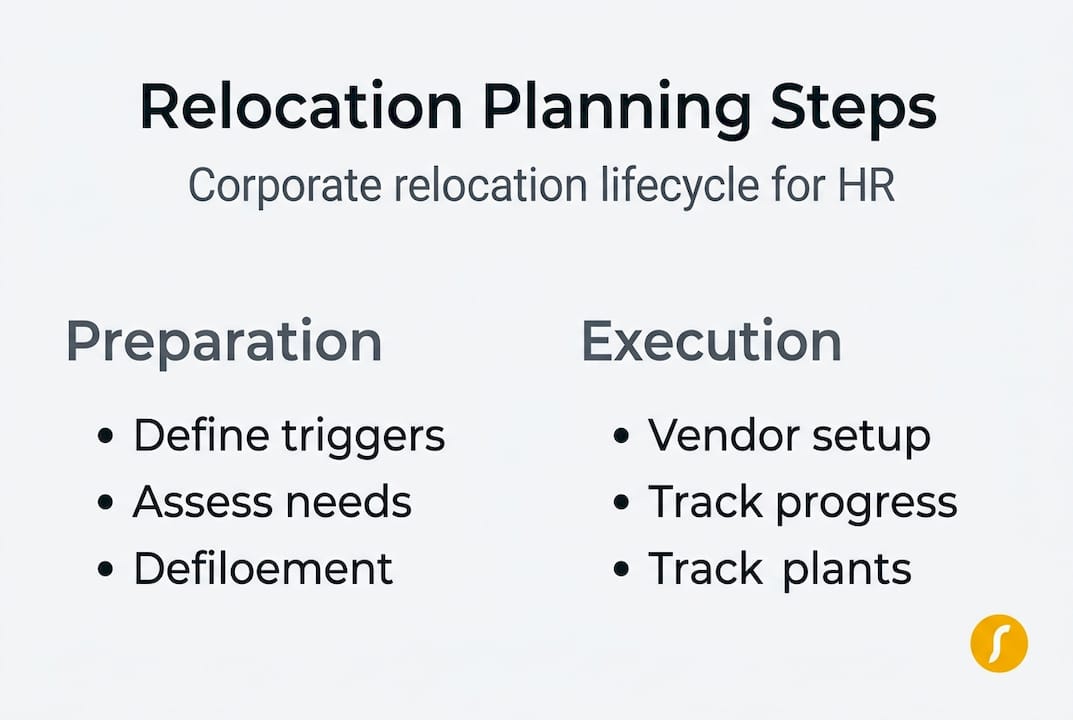
This methodology establishes clear stages: defining relocation triggers and non-negotiables, building the business case with cost-benefit analysis, locking down the operating model and technical scope, designing detailed transition and people plans, and establishing ramp-up governance structures. Each gate requires stakeholder approval before proceeding, preventing costly mid-stream corrections.
The planning framework addresses both hard and soft elements. Hard elements include facility requirements, technology infrastructure, regulatory compliance, and vendor selection. Soft elements encompass change management, employee communication strategies, cultural integration programs, and family support systems. Organizations that shortchange either dimension experience higher failure rates and extended productivity losses.
The structured planning sequence follows these stages:
Pro Tip: The ramp-up phase deserves disproportionate attention in your planning. Most relocation failures occur in the first 90 days when employees struggle with cultural adjustment, family dissatisfaction, or role ambiguity. Build intensive support structures for this critical window, including frequent check-ins, local mentorship programs, and rapid response mechanisms for family issues. Relocation program methodologies that front-load support consistently outperform those that assume employees will figure things out independently.
Governance structures separate successful relocations from expensive failures. Without clear ownership, defined escalation paths, and regular progress reviews, even well-planned moves deteriorate into crisis management exercises. Assign executive sponsors, establish weekly status reviews during active relocation phases, and create decision-making protocols that prevent delays when unexpected issues emerge.
Modern planning also incorporates mobility document management systems that centralize visa applications, tax filings, assignment letters, and compliance documentation. This technological layer ensures nothing falls through cracks while creating audit trails that protect organizations during regulatory reviews.
International relocation costs represent significant corporate investments that demand careful budgeting and risk assessment. Understanding the financial landscape helps HR teams build realistic programs while identifying areas where cost controls deliver the greatest impact without compromising assignment success.
The average international relocation totals approximately $77,000 per employee, though actual expenses vary dramatically based on family size, destination cost of living, assignment duration, and policy generosity. Breaking down typical cost components reveals where budgets get consumed:
| Cost Category | Average Amount | Primary Drivers |
|---|---|---|
| Household goods shipment | $25,000 | Volume, distance, customs, insurance |
| Temporary housing | $15,000 | Duration, location, family size |
| Home finding services | $7,500 | Market complexity, rental vs purchase |
| Visa and immigration | $5,000 | Dependent count, legal complexity |
| Tax services | $5,000 | Equalization calculations, filing requirements |
| Cultural training | $3,500 | Program depth, language instruction |
| Destination services | $8,000 | School search, settling assistance |
| Miscellaneous support | $8,000 | Travel, storage, emergency assistance |
Beyond direct financial outlays, organizations face substantial risk exposure from assignment failures. Expatriate failure rates reach 40% to 50% in some sectors, with each failed assignment costing roughly three times the employee’s annual salary when factoring in recruitment, relocation expenses, productivity losses, and replacement costs. The primary failure drivers aren’t technical incompetence but rather family adjustment issues, cultural misalignment, and inadequate preparation.
Common risk factors that derail international assignments include:
Tax and compliance risks deserve particular attention. Dual residency situations can trigger unexpected tax obligations in both home and host countries. Permanent establishment risks emerge when employee presence creates corporate tax nexus in new jurisdictions. Social security totalization agreements require careful navigation to avoid double contributions. Immigration violations from improper visa classifications expose both employees and organizations to penalties.
Smart cost management doesn’t mean slashing support services. Research consistently shows that comprehensive family support, robust cultural training, and quality destination services reduce failure rates far more than their incremental costs. The real savings come from preventing failures, not from economizing on proven success factors. Organizations should focus cost controls on administrative efficiency, vendor consolidation, and tax risks in global mobility mitigation rather than cutting employee-facing support.
Cultural preparation particularly influences outcomes. Inadequate cultural adjustment consistently ranks among the top three failure causes. Investing in pre-departure cultural training, language instruction, and ongoing cultural coaching delivers measurable returns through faster productivity ramps and higher assignment completion rates.
Strategic corporate relocation programs don’t exist in isolation. They directly support business objectives such as market expansion, talent optimization, knowledge transfer, and leadership development. Organizations that align mobility initiatives with corporate strategy achieve superior ROI while those treating relocations as purely tactical HR functions struggle with cost overruns and missed opportunities.
Recent data reveals how leading organizations approach this alignment. KPMG research shows 72% of companies now explicitly align mobility programs with business strategy, while 70% prioritize short-term assignments specifically for cost savings and ROI optimization. Additionally, 76% leverage technology platforms for program management, recognizing that manual processes cannot scale effectively or provide the visibility modern mobility demands.
The shift toward strategic alignment manifests in several ways. Companies design flexible, needs-based policies rather than one-size-fits-all approaches. They build scalable programs that adapt to changing business requirements without constant policy rewrites. They cultivate strong supplier networks that provide consistent service quality across diverse geographies. Most importantly, they adopt employee-centric program designs that recognize assignee and family satisfaction as critical success metrics, not afterthoughts.
Comparing traditional and technology-enabled approaches highlights the transformation:
| Aspect | Traditional Approach | Technology-Enabled Approach |
|---|---|---|
| Assignment tracking | Spreadsheets, email threads | Centralized platform with real-time visibility |
| Vendor management | Individual contracts, manual coordination | Integrated marketplace with transparent pricing |
| Compliance monitoring | Periodic audits, reactive responses | Automated alerts, proactive risk management |
| Cost forecasting | Historical averages, limited accuracy | Predictive analytics based on comprehensive data |
| Employee experience | Fragmented touchpoints, inconsistent service | Unified portal, self-service capabilities |
| Reporting capabilities | Manual compilation, delayed insights | Dynamic dashboards, instant analytics |
Best practices for integrating corporate relocations with business strategy include:
Technology adoption particularly transforms program effectiveness. Modern platforms consolidate assignment tracking, document management, vendor coordination, and compliance monitoring in unified systems. They provide employees with self-service portals for tracking relocation progress, accessing resources, and communicating with support teams. They generate analytics that reveal cost drivers, identify process bottlenecks, and predict risk factors before they escalate into failures.
When selecting technology solutions, prioritize platforms that support compliance requirements across multiple jurisdictions, facilitate communication between HR teams and assignees, integrate with existing HRIS systems, and provide configurable workflows matching your specific processes. The workforce management tips emphasize that technology should enhance human judgment, not replace it. The best systems combine automation for routine tasks with escalation protocols that bring experts into complex situations.
Mobility cost management strategies increasingly focus on program design rather than service reduction. Offering lump sum options for certain assignment types, implementing flexible policy tiers, negotiating volume-based supplier agreements, and using data analytics to identify cost outliers all reduce expenses without compromising support quality. The key is understanding which costs prevent failures (family support, cultural training, quality housing) versus which represent inefficiency opportunities (administrative overhead, redundant vendor fees, manual processes).
Managing international workforce mobility demands more than good intentions and spreadsheets. You need integrated technology, expert guidance, and global service networks working in concert. xpath.global delivers exactly that combination through a unified platform connecting HR teams, employees, and service providers across 183 countries.
Our global mobility solutions streamline everything from immigration and tax compliance to vendor coordination and assignment tracking. The platform provides real-time visibility into relocation progress, automates routine workflows, and connects you with 60,000+ vetted mobility services worldwide. Whether you’re managing permanent transfers, short-term assignments, or remote work global mobility programs, xpath.global scales with your needs.
What sets xpath.global apart is the combination of powerful technology with deep global mobility expertise. Our team understands the compliance complexities, cost pressures, and employee experience challenges you face daily. We’ve built solutions that address real-world problems, not theoretical scenarios. Choosing the right global mobility technology transforms your program from reactive crisis management to proactive strategic enablement. Connect with xpath.global to discover how we help organizations move talent confidently across borders.
Corporate relocation services encompass the full spectrum of support required to move employees internationally, including immigration processing, housing assistance, household goods shipment, tax consulting, and cultural training. Relocation Management Companies (RMCs) typically coordinate these services, acting as intermediaries between employers, employees, and specialized service providers across destination countries. Some organizations manage relocations internally, though most engage RMCs for their supplier networks and expertise.
Effective cost control focuses on preventing expensive failures rather than reducing support services. Companies achieve savings through tiered policy frameworks that match support levels to role criticality, negotiated volume agreements with preferred suppliers, technology platforms that eliminate administrative inefficiency, and data analytics identifying cost outliers. Investing in comprehensive family support and cultural training actually reduces total costs by preventing assignment failures that cost three times annual salary.
Family adjustment issues cause the majority of expatriate failures, with spouse employment challenges and children’s education concerns topping the list. When families struggle, even professionally successful assignees often request early repatriation. Comprehensive family support including spouse career assistance, school search services, cultural orientation, and ongoing settling help directly correlates with higher assignment completion rates and better employee performance in new roles.
Modern global mobility platforms centralize assignment tracking, automate compliance monitoring, integrate vendor management, and provide employee self-service portals. Key capabilities include workflow automation for routine tasks, document management systems for visa and tax filings, predictive analytics for cost forecasting, and real-time dashboards showing program performance. Technology eliminates manual coordination, reduces errors, and provides visibility that spreadsheets cannot match.
Compliance requires attention to immigration regulations, tax obligations, social security requirements, and employment law across multiple jurisdictions. Best practices include engaging specialized immigration counsel in each destination, implementing immigration compliance monitoring systems with automated alerts, maintaining comprehensive documentation of work authorizations and tax filings, conducting regular program audits, and using technology platforms that track regulatory deadlines and flag potential violations before they occur.

Italy Checklist: Sponsoring Highly Skilled Migrant Visas
Grab a copy of a guide to international employee relocation
View E-book