











Italy Checklist: Sponsoring Highly Skilled Migrant Visas
Grab a copy of a guide to international employee relocation
View E-book
Many global HR professionals underestimate how critical document management becomes when coordinating international assignments. They assume basic file storage suffices, only to discover compliance gaps during audits or visa renewals. Effective document management for international assignments reduces legal risks, prevents audit failures, and streamlines relocation processes across multiple jurisdictions. This guide clarifies essential documents, compliance requirements, common pitfalls, and actionable strategies to transform your global mobility operations.
| Point | Details |
|---|---|
| Essential documents | Global assignment management requires visas and permits, tax forms, contracts, relocation paperwork, and dependent documents to keep compliance complete. |
| Lifecycle phases | Pre assignment, during assignment, and post assignment phases determine collection, tracking, and archiving of documents. |
| Retention and privacy | Retention rules differ by jurisdiction such as US three years, UK six years, and GDPR data minimization requiring deletion after retention ends. |
| Centralized systems | Centralized platforms reduce audit preparation time by sixty percent and minimize security risks compared with scattered emails and spreadsheets. |
Document management for international assignments involves systematic handling of critical documents throughout the assignment lifecycle, ensuring secure storage and compliance verification. Unlike domestic HR processes, global mobility requires coordinating documents across multiple jurisdictions with varying legal frameworks and retention requirements.
Critical documents you must manage include:
The assignment lifecycle creates three distinct document management phases. Pre-assignment requires gathering immigration paperwork, medical clearances, and housing agreements. During assignment, you track tax filings, permit renewals, and compliance certifications. Post-assignment demands final expense reconciliation, tax closing statements, and repatriation documentation.
Secure storage protects sensitive employee data while enabling quick retrieval during audits or disputes. Multi-jurisdiction management complicates this process because each country enforces different data privacy laws, retention periods, and access requirements. A document approved in one jurisdiction may violate data residency rules in another, creating compliance risks that spreadsheets cannot adequately address.

Proper document management directly reduces legal risks and audit failures by maintaining organized, accessible records that satisfy regulatory inspections. When tax authorities or immigration officials request proof of compliance, you can retrieve documents immediately rather than scrambling through email threads or disconnected file systems.
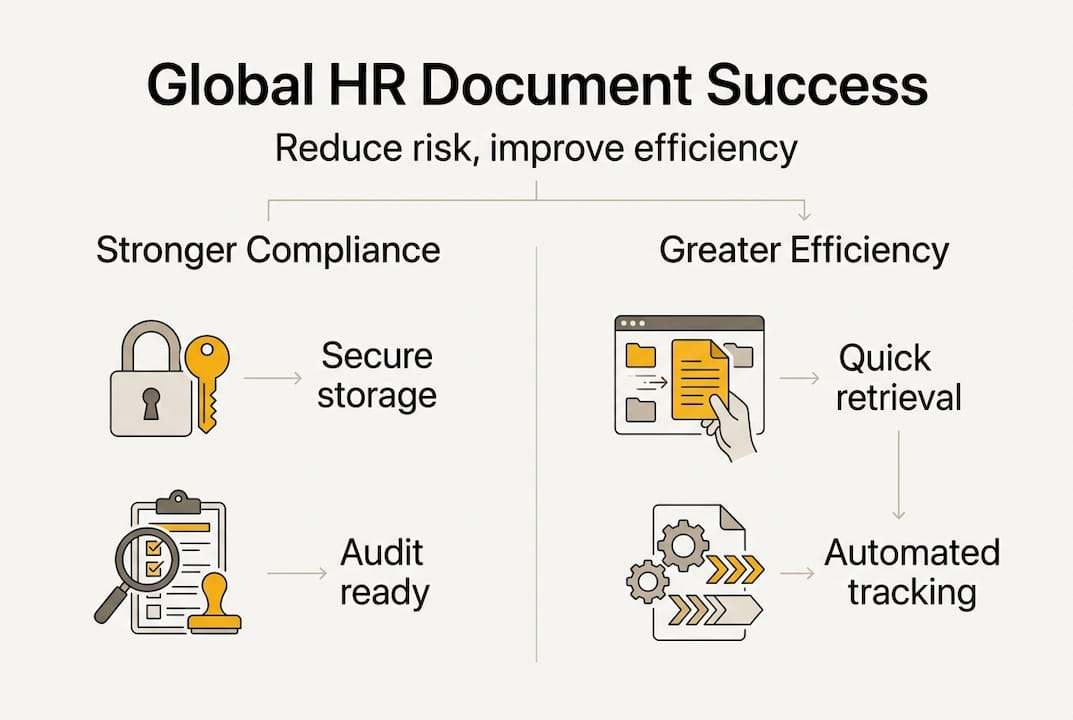
Quick document retrieval becomes essential during disputes. An employee challenges their tax treatment, or a host country questions work authorization. Without centralized records, you waste days reconstructing timelines and gathering evidence. Efficient systems provide instant access to assignment letters, tax certificates, and permit approvals, resolving disputes before they escalate into legal proceedings.
Jurisdiction-specific retention rules demand careful tracking. US federal law requires payroll records for 3 years, while UK employment law mandates 6-year retention for most employment documents. EU GDPR adds data minimization requirements, forcing you to delete documents once retention periods expire. Managing these conflicting timelines manually creates compliance gaps.
Key compliance benefits include:
“Organizations that maintain compliance through centralized platforms reduce audit preparation time by 60% compared to manual processes.”
GDPR requires data minimization, meaning you cannot retain employee documents indefinitely. You must establish clear retention schedules, automatically flag documents for review, and securely delete records when legal obligations end. Traditional file storage systems lack these automated controls, exposing your organization to privacy violations and potential fines reaching 4% of global revenue.
Edge cases complicate document management significantly beyond standard assignment scenarios. Dependent documents require separate visa applications, school enrollment records, and medical insurance certificates. Each family member adds documentation complexity that multiplies across jurisdictions. Relocation receipts must be tracked for tax gross-up calculations and expense reimbursements, often spanning multiple currencies and vendors.
Remote work creates Permanent Establishment tax risks when employees work from jurisdictions not covered by original assignment agreements. OECD 2026 guidelines tighten reporting requirements for hybrid arrangements, demanding documentation of work location, duration, and business activities. Failure to track these details triggers tax liabilities and penalties in unexpected jurisdictions.
Version control challenges emerge when documents require updates for multiple jurisdictions. An employment contract amended for German tax law may not reflect changes needed for French social security. Spreadsheets create version confusion because multiple users edit copies simultaneously, losing track of which version represents current reality. Email attachments compound this problem, scattering authoritative documents across individual inboxes.
| Document management approach | Security level | Version control | Audit readiness | Compliance risk |
|---|---|---|---|---|
| Spreadsheets and email | Low | Poor | Difficult | High |
| Shared drives | Medium | Limited | Moderate | Medium |
| Specialized platforms | High | Automated | Immediate | Low |
Data residency compliance adds geographic complexity. China requires employee data storage within national borders. Russia mandates local servers for personal information. EU GDPR restricts transfers outside approved countries. Your document management system must enforce these residency rules automatically, preventing accidental violations that trigger regulatory action.
Pro Tip: Implement centralized digital platforms with automated version control and jurisdiction-specific access rules to eliminate version confusion and strengthen security across your global mobility program.
Avoiding spreadsheets and adopting specialized platforms enhances compliance, security, and audit readiness by centralizing records within structured workflows. Efficient document management processes require clear protocols, regular reviews, and staff training to maintain accuracy as regulations evolve.
Follow these critical steps to improve your document management:
| Jurisdiction | Payroll retention | Employment contracts | Tax documents | Immigration records |
|---|---|---|---|---|
| United States | 3 years | 1 year post-termination | 7 years | Duration + 1 year |
| United Kingdom | 6 years | 6 years | 6 years | Duration + 2 years |
| European Union | 3-10 years (varies) | Duration + 3 years | 10 years | Duration + 5 years |
| Germany | 6 years | 3 years post-termination | 10 years | Duration + 10 years |
Technology choices directly impact efficiency and risk mitigation. Legacy systems force manual tracking of retention deadlines, creating opportunities for human error. Modern platforms automate notifications when documents require renewal, flag compliance gaps, and generate audit reports instantly. This automation reduces administrative burden while improving accuracy.
Regular audits prevent compliance drift as regulations change and staff turnover occurs. Quarterly reviews verify that all active assignments maintain current documentation, retention schedules align with updated laws, and access controls reflect current team structure. Without scheduled audits, gaps accumulate silently until discovered during regulatory inspections.
Pro Tip: Secure document management systems with role-based access ensure only authorized personnel view sensitive employee information, satisfying data privacy requirements while maintaining operational efficiency.
Staff training addresses the human element of compliance. Even sophisticated platforms fail when users lack understanding of why specific documents matter or how retention rules apply. Training should cover jurisdiction-specific requirements, data privacy principles, and practical platform navigation. Annual refresher sessions keep teams current as regulations evolve and new assignment destinations emerge.
Managing documents across multiple jurisdictions demands technology purpose-built for global mobility complexity. xpath.global provides centralized platforms that automate compliance tracking, enforce retention schedules, and maintain secure audit trails across your entire assignment portfolio.
Our expertise in international assignment management helps HR teams eliminate spreadsheet risks while improving efficiency and reducing compliance exposure. Whether you manage 10 assignments or 1,000, our technology adapts to your program complexity and growth trajectory. Contact our HR specialists to explore how tailored solutions can transform your document management processes and strengthen global mobility operations.
You must manage work visas, permits, tax equalization forms, employment contracts, assignment letters, relocation approvals, and dependent documentation. These essential assignment documents ensure legal work authorization, tax compliance, and family support throughout the assignment lifecycle. Missing or expired documents trigger immediate compliance violations and potential assignment termination.
Understand jurisdiction-specific retention periods like US 3-year payroll requirements versus UK 6-year employment records. Implement centralized systems that automatically track retention schedules, flag documents approaching deletion dates, and enforce data residency rules. Regular audits verify your processes maintain compliance as regulations change across active assignment locations.
Avoid relying on spreadsheets and emails, which create security vulnerabilities and version confusion. Maintain strict version control especially when updating documents for multiple jurisdictions simultaneously. Recognize edge cases like remote work tax risks and dependent documentation requirements that standard processes overlook. Implement automated platforms to eliminate these systematic weaknesses.
Centralized platforms provide instant access to organized records with complete audit trails, eliminating manual document gathering. When auditors request proof of compliance, you generate reports immediately rather than reconstructing timelines from scattered files. Automated retention tracking demonstrates systematic compliance processes, reducing auditor scrutiny and accelerating review completion.
Technology automates jurisdiction-specific retention schedules, enforces data residency rules, and tracks document expiration dates across your assignment portfolio. Specialized mobility platforms eliminate manual tracking errors, provide role-based access controls, and generate compliance reports instantly. This automation transforms document management from administrative burden into strategic advantage.
Previous article
Italy Checklist: Sponsoring Highly Skilled Migrant Visas
Grab a copy of a guide to international employee relocation
View E-book