





TL;DR:
- Effective process tracking provides real-time visibility into international employee relocations.
- Modern software features include automated workflows, document management, and predictive analytics.
- Successful implementation requires organizational alignment, ongoing training, and viewing technology as part of a broader operating model.
Managing international employee relocations without reliable process tracking is like navigating cross-border compliance in the dark. Multinational HR teams frequently contend with missed immigration deadlines, incomplete audit trails, and siloed data scattered across spreadsheets and email chains. The consequences reach far beyond internal inefficiency: failed audits, tax penalties, and assignment delays directly affect the business and the employee experience. Modern global mobility software changes this picture entirely, offering end-to-end visibility across every relocation stage, from pre-departure approvals to repatriation. This article examines what effective process tracking looks like, which features matter most, and how to implement it with lasting impact.
Key Takeaways
| Point | Details |
|---|---|
| Unified tracking reduces risk | Moving from fragmented tools to unified software dramatically improves compliance and relocation outcomes. |
| Core features to prioritize | Workflow automation, integrations, and predictive analytics are essential for effective process tracking. |
| Legacy vs. modern solutions | Modern mobility platforms lower error rates and improve audit-readiness compared to manual, siloed methods. |
| Best practices drive success | Map workflows, train users, and review processes regularly for sustainable improvements. |
| Culture matters too | Technology alone isn’t enough—the right mindset and collaboration are key for lasting transformation. |
Why process tracking matters in global mobility
Process tracking in global mobility refers to the structured, real-time monitoring of every action, approval, and compliance check involved in managing international assignments. This includes work permit applications, immigration filings, tax registrations, relocation service coordination, and assignment closure activities. When tracking is fragmented or manual, critical tasks slip through the gaps.
The consequences are significant and measurable. Missed filing deadlines can trigger immigration violations or work permit lapses, placing employees at legal risk and exposing the company to regulatory fines. Incomplete audit trails make it impossible to demonstrate compliance during government inspections or internal reviews. Relocation delays caused by disorganized approvals damage employee trust and undermine the effectiveness of international talent strategies.
Legacy tracking methods compound these risks. Most global mobility teams that rely on spreadsheets and email chains face a structural problem: there is no single source of truth. One team member may update a relocation status in a spreadsheet while another proceeds with outdated information from an email thread. This fragmentation is not an edge case; it is the norm for programs that have not modernized.
Fragmented systems increase compliance risk significantly, and unified platforms are essential for organizations scaling global mobility programs across multiple jurisdictions.
Software-enabled process tracking replaces this fragmentation with structured workflows, automated task assignments, and centralized data that every authorized stakeholder can access in real time. The shift is not merely operational; it is a compliance and risk management imperative. Organizations that adopt a unified global mobility ecosystem gain the visibility needed to prevent issues before they escalate, rather than discovering them during an audit.
For HR leaders managing programs across five or fifty countries, this distinction is decisive. A compliance health check can reveal exactly where your current tracking falls short and where structured software would deliver the greatest risk reduction.
Core features: What effective process tracking looks like
Understanding the risks, it is crucial to know which software features directly address these issues. Not all global mobility platforms offer the same depth of process tracking capability, and selecting the right one requires evaluating specific functionality against your organization’s scale and complexity.
The most effective platforms offer the following capabilities:
- Automated approval workflows. Approvals for assignment initiation, policy exceptions, and compliance sign-offs are routed automatically to the correct stakeholders, eliminating bottlenecks caused by manual handoffs.
- Document management workflows. Structured document collection, version control, and expiry tracking ensure that visa applications, tax forms, and relocation agreements are always current and accessible.
- No-code policy customization. HR teams can configure assignment policies, benefit rules, and compliance checklists without relying on IT resources, allowing rapid adaptation to regulatory changes.
- HRIS and payroll integrations. Seamless connections with existing HR information systems and payroll platforms eliminate duplicate data entry and keep assignment data synchronized across the organization.
- Real-time SLA tracking. Service level agreement monitoring flags tasks that are approaching deadlines or have exceeded agreed turnaround times, enabling proactive intervention.
- Predictive analytics and AI-driven risk detection. Machine learning models analyze historical assignment data to surface early warning signals, such as jurisdictions with high compliance incident rates or assignment types prone to delays.
Key methodologies including workflow automation, integration, lifecycle management, and AI-driven analytics form the foundation of any platform capable of handling enterprise-scale mobility programs.

Reviewing the best global mobility platforms currently available confirms that the gap between basic dashboard tools and genuinely integrated platforms is substantial. Understanding steps to simplify global mobility helps HR leaders prioritize features that align with their program’s maturity.
Pro Tip: If your program involves fewer than 100 annual assignments, prioritize automation and integration over advanced analytics. For programs exceeding 500 assignments per year across multiple regions, predictive analytics and real-time SLA tracking become critical differentiators. Match feature investment to your actual complexity, and evaluate cloud platform integration benefits as part of your selection criteria.
Comparing legacy systems vs. modern global mobility software
To illustrate the benefits vividly, let us see how modern software stacks up against older methods. The contrast is not subtle.
| Capability | Legacy systems | Modern global mobility software |
|---|---|---|
| Process visibility | Fragmented across emails and spreadsheets | Centralized, real-time dashboards |
| Compliance tracking | Manual checklists, prone to error | Automated policy checks with audit trails |
| Document management | Stored in local drives or email attachments | Structured workflows with version control |
| Approval workflows | Ad hoc, email-based | Automated routing with deadline alerts |
| Audit readiness | Difficult to reconstruct, high risk | Instant reporting with full activity logs |
| Employee self-service | Minimal or absent | Mobile-friendly portals with task visibility |
| Vendor coordination | Managed through separate emails | Integrated vendor marketplace in one platform |
| Error and rework rate | High due to manual data handling | Significantly reduced through automation |
The data is clear. Organizations using integrated platforms report measurable reductions in compliance incidents compared to those relying on legacy tools. Traditional relocation management approaches focus narrowly on physical relocation logistics, while modern platforms emphasize compliance automation and employee self-service as core functions.
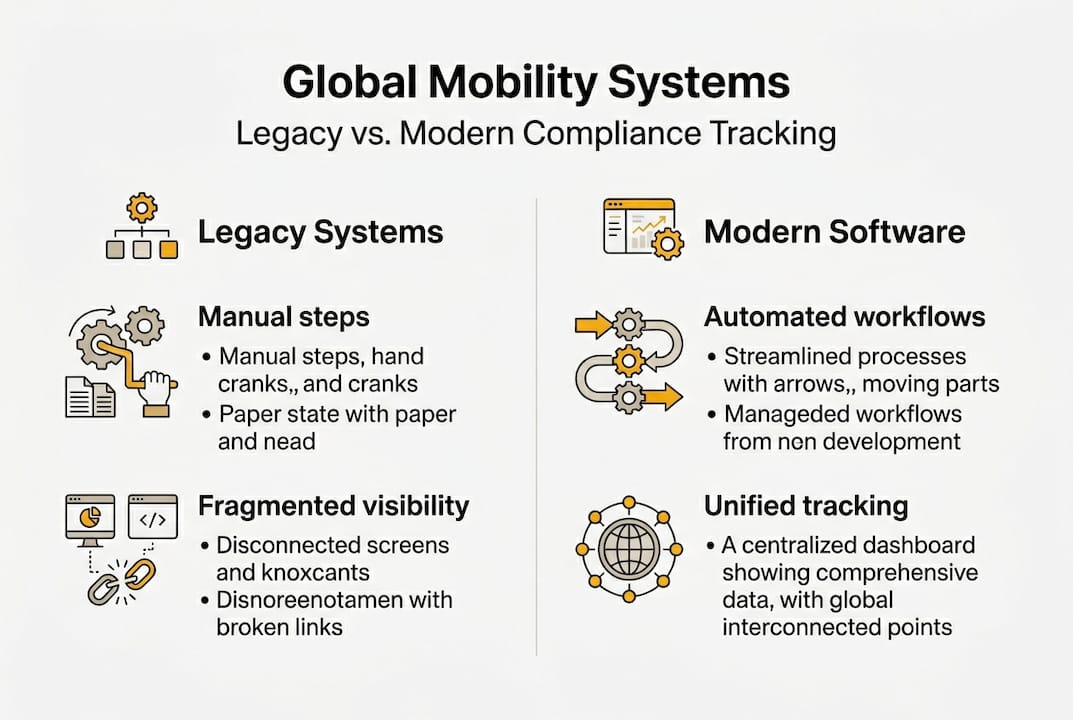
The practical implication for HR leaders is that legacy systems create a compounding liability. Each manual step is an opportunity for error, and each error increases audit exposure. Reviewing internal management approaches can help identify where legacy processes are creating the greatest risk within your existing program structure.
Best practices for process tracking and implementation
Now that you know what to look for and why it matters, here is how to launch and optimize your process tracking effectively.
A successful implementation follows a deliberate sequence:
- Map existing workflows before selecting software. Document every current process, including who owns each step, what tools are used, and where delays or errors typically occur. This baseline determines which platform features will deliver the greatest immediate value.
- Secure stakeholder buy-in early. Involve HR operations, legal, finance, and IT leadership during the evaluation phase. Platforms that automate compliance workflows affect multiple functions, and cross-functional alignment accelerates adoption.
- Adopt a phased implementation approach. Start with the mobility types or regions that present the highest compliance risk or the greatest operational volume. Demonstrate measurable results in those areas before expanding to the full program.
- Establish process ownership. Assign clear accountability for each tracked workflow. Software provides visibility, but humans must be responsible for acting on that visibility when issues arise.
- Review and adjust regularly. Process tracking is not a one-time configuration. Monthly or quarterly reviews of SLA performance, error rates, and compliance incident data should drive continuous improvement.
Unified platforms with automation reduce risk and give global teams the structural foundation needed to scale mobility programs without proportionally increasing headcount or compliance exposure.
Pro Tip: One of the most common implementation failures is underinvesting in user training. A platform with sophisticated automation delivers no value if HR teams revert to email and spreadsheets out of habit. Budget for structured onboarding, designate internal platform champions, and schedule refresher sessions as new features are released.
For teams managing diverse assignment types, resources on optimizing mobility programs and managing all mobility types provide practical frameworks for structuring tracking across short-term, long-term, and commuter assignments.
Why real transformation is about more than software
Here is a perspective that many technology vendors will not offer: software alone does not fix broken process tracking. It amplifies whatever processes and behaviors already exist within your organization. If accountability is unclear, automation will route tasks to the wrong people faster. If data quality is poor, analytics will surface misleading insights more efficiently.
Real transformation in global mobility process tracking requires a parallel investment in organizational culture. Clear process ownership, continuous training, and genuine collaboration between HR, legal, tax, and finance teams are what convert a software deployment into a functioning compliance infrastructure.
Treating a platform implementation as a destination rather than a starting point is the single most common reason mobility programs fail to improve after a technology investment.
The organizations that extract lasting value from global mobility software are those that treat the platform as part of a broader operating model, not a substitute for one. Ecosystem thinking where technology, people, and process are designed to work together from the outset, is what separates programs that achieve compliance maturity from those that simply have better-looking dashboards.
Start transforming your global mobility process
If your current process tracking relies on disconnected tools or manual coordination, the gap between where you are and where you need to be is wider than it appears. The good news is that it is entirely closeable.
xpath.global provides a unified platform purpose-built for the complexity of international workforce mobility, combining automated workflows, real-time compliance tracking, and a global vendor marketplace into one integrated environment. Whether you are evaluating your first mobility platform or replacing a legacy system, our team can help you map the right path forward. Explore how selecting mobility technology works in practice, connect with HR specialists for a tailored consultation, or learn how organizations master employee relocation with xpath.global’s ecosystem.
Frequently asked questions
What does global mobility process tracking involve?
It monitors every stage of an employee’s international assignment, from approvals and documentation to compliance checks and repatriation, providing a structured end-to-end lifecycle record accessible to all authorized stakeholders.
How does modern software improve compliance?
Modern platforms automate policy checks, track regulatory deadlines in real time, and use AI-driven risk detection to surface early warnings, significantly reducing the likelihood of errors and audit failures.
What features should HR leaders prioritize?
Prioritize platforms that offer real-time SLA tracking and predictive analytics, along with automation and HRIS integration, over tools that provide only basic reporting dashboards.
How long does it take to implement a new global mobility process tracking system?
Implementation timelines range from a few weeks for smaller organizations with straightforward assignment structures to several months for large multinationals with complex, multi-jurisdiction programs and deep HRIS integration requirements.
Are legacy tracking methods still used?
Yes, many organizations still rely on spreadsheets and email for mobility tracking, but fragmented systems increase compliance risk substantially and limit the scalability of global mobility programs.