






TL;DR:
- Fragmented mobility processes create compliance, cost, and employee experience risks that end-to-end solutions aim to eliminate. True platforms integrate all assignment phases with process automation, clear accountability, and real-time visibility across stakeholders. Evaluating vendors involves demonstrating seamless workflows, comprehensive compliance tracking, and unified data to ensure genuine end-to-end management.
HR and relocation managers know the frustration well. An employee’s international assignment is underway, immigration paperwork sits with one vendor, tax compliance is handled by another, housing logistics are tracked on a spreadsheet, and nobody has a clear picture of what’s happening at any given moment. This fragmented reality is far more common than it should be, and it creates serious compliance risks, budget overruns, and employee dissatisfaction. The phrase “end-to-end mobility solution” gets used constantly by vendors, yet few organizations truly understand what it means or how to evaluate whether a platform actually delivers on that promise.
Key Takeaways
| Point | Details |
|---|---|
| Integrated approach | An end-to-end mobility solution unifies all HR, legal, and financial tasks for assignments. |
| Compliance assurance | Centralized oversight helps HR avoid legal and regulatory missteps in global relocations. |
| Vendor accountability | Clear roles and dashboards cut through confusion—know exactly who owns each relocation task. |
| Process visibility | Real-time insights let HR teams monitor, report, and adjust every stage of mobility instantly. |
| Smarter decision-making | Unified data drives smarter choices and smoother employee experiences. |
What is an end-to-end mobility solution?
An end-to-end mobility solution manages every phase and task of employee relocation within a single, integrated system. This spans from the moment an assignment is initiated through immigration filing, tax compliance, housing search, cost tracking, and ultimately post-assignment reintegration. The idea is that no single phase operates in isolation. Every function connects to the next, with data flowing across teams and vendors without manual intervention or duplicate entry.
The mobility services explained concept covers a wide range, but an end-to-end approach goes further than simply listing services. It requires process integration, compliance management, vendor coordination, expense management, real-time technology, and visibility across every stakeholder involved in the assignment.
Here are the core elements that define a genuinely end-to-end approach:
- Process integration: Each stage of an assignment feeds directly into the next, with no manual handoffs or information gaps between phases.
- Compliance management: Immigration, tax, and social security obligations are tracked automatically, with alerts triggered before deadlines pass.
- Vendor coordination: Immigration lawyers, relocation companies, tax advisors, and housing providers all operate within the same system, under defined accountability structures.
- Expense management: Costs are projected, approved, and tracked in real time, eliminating surprises at the end of an assignment.
- Technology and automation: Workflows run automatically, reducing administrative workload for HR teams and minimizing the risk of human error.
- Real-time visibility: Every stakeholder, from HR to finance to the relocating employee, can see current status, outstanding tasks, and upcoming milestones.
A critical distinction that many organizations overlook is the role of accountability. As end-to-end mobility experts note, true end-to-end solutions require clear accountability and visibility across functions including HR, tax, legal, finance, procurement, and external vendors. Fragmentation and unclear responsibility are explicitly the obstacle to achieving end-to-end mobility visibility.
“End-to-end is not just a feature list. It’s a guarantee that every function in your mobility program has a defined owner and that no task falls into the space between teams.”
Pro Tip: When evaluating any platform, ask the vendor to walk you through HR mobility workflows and show you exactly who is accountable for each task at every stage of an assignment. If the answer is vague, the solution is not truly end-to-end.
Core components: What makes a true end-to-end solution?
Knowing the definition is one thing. Recognizing a genuine end-to-end solution in practice requires understanding each component and how it performs under daily HR operations. The table below summarizes the essential elements and what they mean for your team.
| Component | What it means in daily operations |
|---|---|
| Process integration | Assignment stages connect automatically, eliminating manual transitions |
| Compliance management | Deadlines for immigration, tax, and social security are tracked and flagged |
| Vendor ecosystem | Vetted providers operate within the same platform, with documented accountability |
| Technology and automation | Workflows trigger without manual input, reducing error and saving time |
| Data and analytics | Dashboards display real-time assignment status, costs, and compliance risks |
| User experience | Both HR teams and employees can access relevant information through a single interface |
Many platforms market themselves as end-to-end but fall short on one or more of these dimensions. The most common gap is legal and finance integration. A platform may handle immigration and housing effectively but leave tax compliance and financial reporting to entirely separate systems, creating the same fragmentation the solution was supposed to solve.
Here is a practical, step-by-step way to assess each component when evaluating a solution:
- Process integration: Request a live demonstration of how the system connects visa filing to housing search to tax registration without a manual handoff. Any gap in that flow reveals a structural weakness.
- Compliance management: Ask whether compliance deadlines trigger automatic alerts. Confirm that the system covers the specific countries relevant to your mobility program, not just the most common destinations.
- Vendor ecosystem: Determine whether vendors operate within the platform or whether they are simply listed in a directory. A directory is not integration.
- Technology and automation: Evaluate whether workflow automation covers edge cases, such as short-term assignments, extensions, or policy exceptions, not just standard relocations.
- Data and analytics: Look for dashboards that consolidate data from immigration, relocation, tax, and cost management in one view. Siloed reporting across modules is a red flag.
- User experience: Test the employee-facing portal. If relocating employees cannot access their own documents and track progress independently, HR will spend excessive time answering basic questions.
As mobility best practices research consistently shows, fragmentation and unclear responsibility are the primary obstacles to achieving end-to-end mobility visibility. A platform that does not resolve both of those issues is not a complete solution regardless of how it is marketed.
Pro Tip: Unified dashboards and real-time reporting are non-negotiable. If a platform requires you to log into three different modules or generate separate reports for immigration, finance, and relocation, it is replicating the fragmentation you already have.
Reviewing international workforce management tips alongside vendor demonstrations can help your team form sharper evaluation questions before entering procurement conversations.
Why does end-to-end mobility matter? Key business benefits
The business case for end-to-end mobility is not just about convenience. It directly affects compliance exposure, cost control, employee retention, and organizational agility. The comparison below illustrates the difference between fragmented and integrated approaches.

| Outcome | Fragmented mobility | End-to-end mobility |
|---|---|---|
| Compliance tracking | Manual, prone to missed deadlines | Automated alerts and centralized records |
| Cost visibility | Delayed, often incomplete | Real-time projections and actuals |
| Vendor accountability | Unclear, managed through email | Defined within platform workflows |
| Employee experience | Confusing, inconsistent | Transparent, self-service access |
| HR administrative burden | High, repetitive coordination tasks | Reduced through automation |
| Error response time | Slow, requires manual investigation | Immediate, visible through dashboards |
The risks of fragmentation are concrete and measurable. When fragmentation and unclear responsibility define a mobility program, the consequences include:
- Compliance penalties: Missed immigration or tax filing deadlines can result in fines, work permit revocations, or reputational damage with host country authorities.
- Cost overruns: Without real-time expense tracking, assignment costs frequently exceed budgets by significant margins, often discovered only after the fact.
- Employee disengagement: Relocating employees who cannot get timely answers or track their own assignment progress report higher stress levels and lower commitment to the assignment.
- HR inefficiency: Teams spend disproportionate time coordinating between vendors and chasing status updates rather than managing strategic mobility decisions.
By contrast, an integrated end-to-end approach delivers measurable gains. Talent management insights consistently point to the connection between mobility program quality and employee retention during international assignments. Organizations with coordinated processes report faster error identification, lower compliance risk, and more positive expat experiences.
Effective management of cross-border employee benefits is another area where end-to-end solutions outperform fragmented ones significantly. Benefits coordination across jurisdictions requires data from immigration, tax, and HR systems simultaneously. A unified platform makes that coordination possible. A fragmented one makes it a manual, error-prone exercise every time.
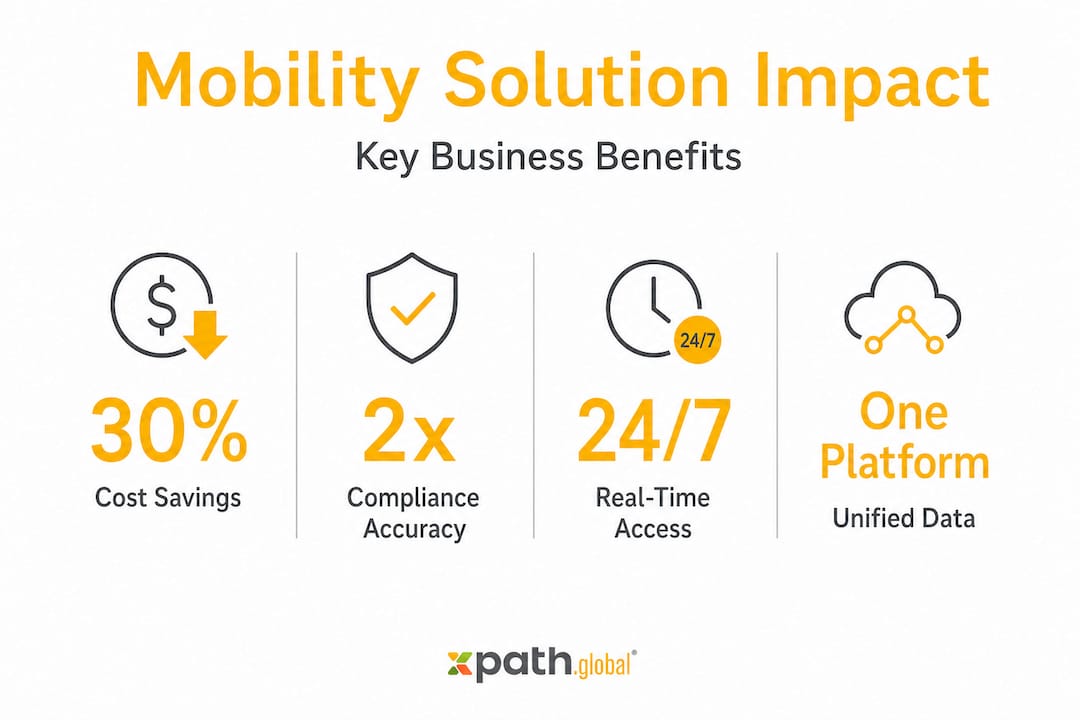
Key insight: Visibility and clear ownership across mobility functions are the single most reliable predictors of assignment success. Organizations that cannot answer the question “who is accountable for this task right now?” face the highest rates of compliance incidents and assignment failure.
What HR teams must consider when evaluating mobility solutions
Once you understand what end-to-end mobility requires and why it matters, the next step is evaluating whether a given solution actually delivers it. The following checklist is designed specifically for HR and relocation managers preparing to assess or upgrade their mobility technology.
- Process integration: Confirm that the platform connects all phases of an assignment in a single workflow, from initiation through post-assignment reintegration. Ask the vendor to demonstrate a complete assignment lifecycle, not individual features in isolation.
- Data security: Verify that the platform complies with relevant data protection regulations, including GDPR for assignments involving European employees. Understand where data is stored, who can access it, and how long it is retained.
- Vendor accountability: Determine whether vendors are integrated into the platform’s workflow or simply referenced externally. Integrated vendors receive tasks through the platform and report back within it. External references create the same handoff problems as email coordination.
- Compliance automation: Confirm that compliance tracking covers your specific assignment destinations and assignment types. A platform that automates compliance for standard long-term assignments but struggles with short-term business travel or hybrid arrangements may not meet your needs.
- User support: Evaluate the quality of support available to both HR administrators and relocating employees. Platforms that offer strong technology but weak support create gaps during complex or urgent situations.
As streamlining mobility programs research demonstrates, fragmentation and unclear responsibility remain the defining obstacles to effective global mobility management. Every item on this checklist is designed to surface those gaps before you commit to a platform.
“Visibility is not a buzzword in global mobility. It is the operational difference between proactive assignment management and constant firefighting across vendors, geographies, and functions.”
Pro Tip: Ask every vendor you evaluate to provide specific case studies showing how their platform maintained visibility and accountability during a complex multi-country assignment. Generic feature walkthroughs reveal what the software can do. Case studies reveal how it performs under real conditions.
Reviewing GDPR best practices for mobility is particularly important for HR teams managing assignments within or into the European Union, where data processing requirements are strict and penalties for non-compliance are substantial.
Perspective: What most HR teams get wrong about ‘end-to-end’ mobility
Here is an uncomfortable reality that the industry rarely discusses openly. Most HR teams that adopt platforms marketed as end-to-end do not check for true integration and accountability before signing. They evaluate features, compare pricing, and review dashboards. Then they discover six months into implementation that immigration data does not connect to tax management, or that vendor task completion is still tracked manually by email.
The failures almost never happen in the obvious places. They happen at the boundaries. The handoff from immigration filing to tax registration. The transition from temporary housing to permanent housing search. The moment an assignment extension is approved but the compliance calendar is not automatically updated to reflect the new timeline. These boundary failures are where fragmented systems reveal themselves, and they are precisely where end-to-end accountability gaps do the most damage.
The real test of any end-to-end solution is simple. At any moment in any active assignment, can you identify who is accountable for the current open task? Not which team or which vendor in general, but which specific person or function holds responsibility right now, and what their deadline is. If you cannot answer that question instantly from within the platform, the solution is not truly end-to-end regardless of the marketing language around it.
The international mobility management community needs to raise its standards for what end-to-end actually means. Buying technology is not enough. Organizations must demand that clear ownership and real-time visibility are embedded in the platform’s architecture, not described as aspirational features on a product roadmap. The difference between proactive mobility management and reactive crisis resolution comes down to that single standard.
How xpath.global supports true end-to-end mobility
Managing global assignments at scale requires more than a checklist. It requires a platform built with accountability and visibility at its core, not bolted on as an afterthought.
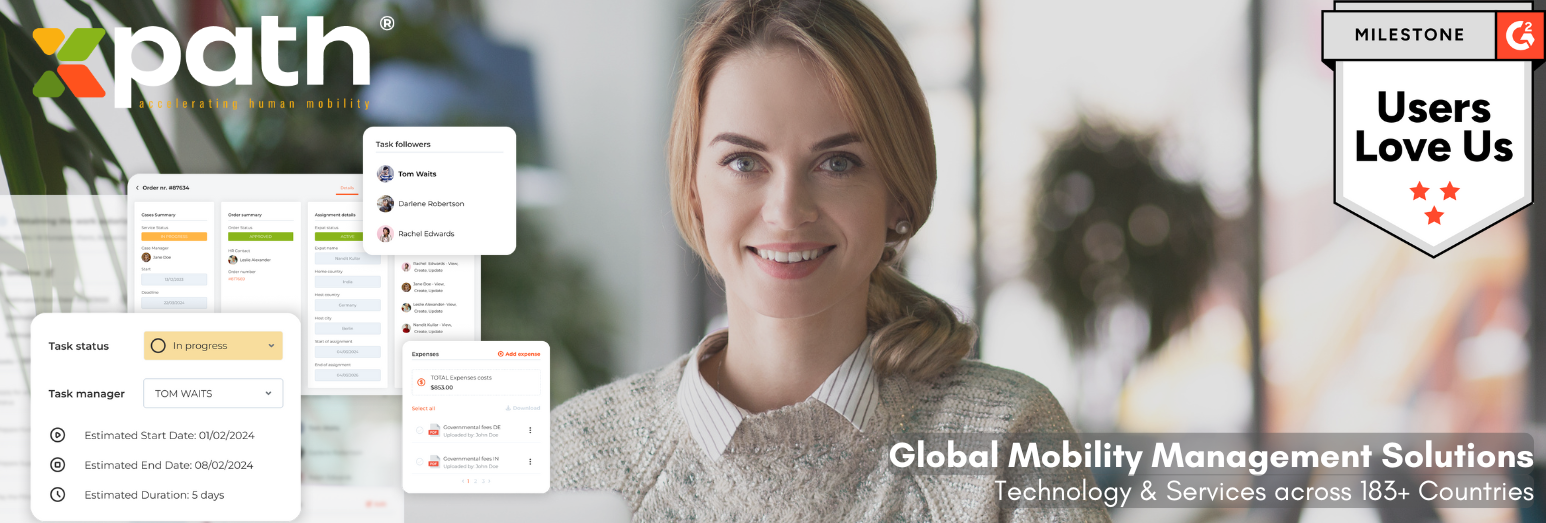
xpath.global is designed by global mobility professionals who understand exactly where fragmented processes create risk and inefficiency. The platform unifies immigration, tax coordination, relocation services, vendor management, cost tracking, and employee experience in one digital environment, giving HR teams and relocating employees a single source of truth for every assignment. With access to over 60,000 mobility services across 183 countries, organizations can manage assignments from initiation to completion without switching systems or chasing vendors across disconnected channels. If you want to see how end-to-end accountability works in practice, talk to our HR experts or explore our global mobility technology to find the right solution for your organization.
Frequently asked questions
How does an end-to-end mobility solution improve compliance?
It centralizes data and standardizes processes across immigration, tax, and vendor management, reducing missed deadlines and legal risks that typically arise when fragmentation and unclear responsibility define a mobility program.
What roles are typically covered within end-to-end mobility?
A true end-to-end solution aligns HR, tax, legal, finance, procurement, and outside vendors on one unified platform, ensuring that accountability spans all functions involved in the assignment lifecycle.
What is the biggest risk of a non-end-to-end solution?
Fragmentation causes missed handoffs, delayed actions, and increased compliance risk, particularly for international assignments where immigration and tax deadlines are time-sensitive and unclear responsibility accelerates the damage.
Are end-to-end solutions only for large corporations?
No. Businesses of all sizes benefit from improved visibility, compliance automation, and reduced administrative burden, and the compliance risks of fragmented programs are equally serious regardless of organization size.
What’s the first step for HR teams to implement an end-to-end solution?
Begin with a structured audit of your current mobility processes, identify where handoffs break down and where accountability is unclear, and then evaluate platforms specifically designed for unified assignment management rather than those offering individual mobility tools in parallel.
Recommended
Previous article