






- Structured workflows are essential to ensure compliance, control costs, and maintain employee satisfaction in global mobility.
- Effective mobility programs require clear policies, automated tracking, and early planning across all assignment phases.
- Integrating digital solutions enables real-time visibility, reduces errors, and enhances strategic talent outcomes.
Managing international assignments without structured workflows is one of the most reliable ways to generate compliance failures, cost overruns, and frustrated employees. The complexity compounds quickly: immigration timelines collide with tax deadlines, housing logistics stall while payroll adjustments lag, and repatriation planning gets delayed until it becomes a crisis. HR professionals responsible for global mobility programs need more than good intentions. They need a clear, repeatable workflow architecture that covers every phase of the assignment lifecycle, from initial policy design through final repatriation, so that nothing falls through the cracks and every move is executed with precision.
Define a mobility policy and planning process
Every successful international assignment begins well before the employee packs a single box. The foundation is a clearly documented mobility policy that defines assignment types, eligibility criteria, benefit structures, and the organization’s compliance approach. Without this framework, individual assignments become ad hoc decisions that create inconsistency, legal exposure, and budget surprises.
A strong policy covers several core elements:
🔸Assignment categories: short-term, long-term, permanent transfer, commuter, and project-based
🔸Eligibility requirements: seniority thresholds, performance criteria, and family considerations
🔸Cost projection methodology: how estimates are built, approved, and tracked
🔸Compliance framework: which jurisdictions require specific tax or immigration treatment
🔸Stakeholder roles: who owns each phase across HR, legal, finance, and business units
The end-to-end relocation lifecycle follows a structured sequence: pre-move planning that includes policy definition, cost projections, and stakeholder briefings; pre-departure steps covering immigration and home logistics; on-assignment support for housing, tax, and payroll; and finally repatriation. Getting stakeholders aligned at the planning stage prevents costly corrections later.
A pre-move planning checklist should include: confirming business rationale for the assignment, completing a cost estimate and budget approval, briefing the employee and family, identifying host country compliance requirements, and selecting service providers. Understanding mobility policy basics helps HR teams build frameworks that scale across multiple assignment types.
Pro Tip: Use a centralized digital platform to house all policy documents, cost templates, and assignment checklists. When every stakeholder accesses the same source, version conflicts and miscommunication drop significantly.
Manage pre-departure compliance and employee support
After setting policy and initial planning, the real compliance work begins before any move. This phase is where most programs encounter their most serious risks, and the sequencing of tasks matters enormously.

Immigration and work permit applications must come first. Attempting to finalize tax structures or housing arrangements before confirming the employee’s legal right to work in the host country is a sequencing error that causes expensive delays. Key compliance elements require immigration and work permits to be addressed first, followed by tax and social security planning, with automated tracking systems maintaining deadline visibility throughout.
Here is a structured pre-departure process:
🔸Initiate work permit or visa application with qualified immigration counsel
🔸Conduct a tax residency analysis for both home and host countries
🔸Assess social security treaty applicability and certificate of coverage requirements
🔸Coordinate home sale, lease termination, or property management arrangements
🔸Begin school search and enrollment for relocating dependents
🔸Launch spousal or partner career support programs
🔸Complete pre-departure orientation and cultural briefing
🔸Confirm payroll split arrangements and shadow payroll setup where required
For organizations managing remote or hybrid assignments, telecommuting compliance introduces additional layers of complexity that require dedicated attention. Broader mobility compliance strategies help HR teams build systematic approaches rather than reacting to issues as they arise.
Pro Tip: Schedule bi-weekly cross-functional check-ins between HR, legal, and finance during the pre-departure phase. These short meetings surface blockers early and prevent last-minute scrambles that delay departure dates.
On-assignment: Deliver ongoing support and ensure compliance
Once compliance and logistics are handled, on-assignment support ensures success throughout the duration of the posting. This phase is often underestimated in terms of administrative intensity, but it carries significant financial and compliance weight.
Core on-assignment services include:
🔸Housing administration: lease management, utility setup, and interim housing coordination
🔸Payroll administration: split payroll, shadow payroll, and home country payroll maintenance
🔸In-country tax compliance: quarterly estimated payments, local filing obligations, and year-end reconciliation
🔸Family support: school transitions, spousal career assistance, and community integration programs
The financial scale of long-term assignments is substantial. Total assignment cost averages $311,000 per year per long-term assignee, with the home country balance sheet approach driving compensation through housing allowances (the largest single cost), cost-of-living adjustments (COLA), and hardship premiums. Total cost typically runs 2 to 3 times a comparable domestic salary.
| Cost component | Typical share of total cost |
|---|---|
| Housing allowance | 30 to 40% |
| COLA and goods/services | 20 to 25% |
| Tax equalization | 15 to 20% |
| Hardship and location premiums | 5 to 15% |
| Relocation logistics | 5 to 10% |
Automating compliance tracking during this phase is not optional. Achieving ongoing compliance requires continuous monitoring of tax filing deadlines, permit renewals, and payroll obligations across multiple jurisdictions simultaneously.
“The average annual cost of a long-term international assignment reaches $311,000, underscoring why structured cost management and compliance automation are non-negotiable for HR mobility programs.”
Master repatriation: Prepare for return and reintegrate talent
With on-assignment needs addressed, planning must shift early to the return process. Repatriation is consistently the most neglected phase of the assignment lifecycle, and that neglect carries a measurable cost: organizations lose institutional knowledge, damage employee trust, and reduce the return on their mobility investment.
Early repatriation planning, starting six months before assignment end, prevents knowledge loss and creates the conditions for effective career reintegration. Waiting until the final month produces rushed logistics and disengaged returnees.
| Standard repatriation | Best-practice repatriation |
|---|---|
| Logistics arranged 4 to 6 weeks out | Planning begins 6 months prior |
| Employee finds own role on return | Career reintegration plan defined early |
| Tax equalization settled reactively | Tax equalization estimated and communicated in advance |
| No formal knowledge transfer | Structured debriefs and knowledge capture sessions |
| High attrition within 12 months | Improved retention through career continuity |
Key repatriation logistics include home country housing search, household goods shipment coordination, school enrollment for dependents, and home country payroll reinstatement. Tax equalization settlement, which reconciles any over or under-withholding against the hypothetical tax calculation, must be completed accurately to avoid employee disputes.
Common repatriation pitfalls to avoid:
🔸Failing to identify a role before the employee returns
🔸Delaying tax equalization calculations until after filing deadlines
🔸Ignoring the returnee’s newly acquired cross-cultural skills in role placement
🔸Skipping formal reintegration support for spouses and dependents
Exploring proven repatriation strategies and connecting them to broader talent pool strategies positions returned assignees as strategic assets rather than administrative closeouts.
Integrate digital solutions for workflow automation
With complex, multi-step workflows spanning immigration, tax, payroll, housing, and repatriation, digital automation brings much-needed visibility and control. Manual coordination through spreadsheets and email chains is not a scalable model for any organization managing more than a handful of assignments annually.
Automated workflow platforms address the core challenge identified by cross-functional coordination requirements: HR, legal, and finance teams must operate in sync, with shared visibility into deadlines and task status. Automation enforces this coordination without relying on individuals to remember to send updates.
Key capabilities to prioritize in platform selection:
🔸Automated document management: version control, expiry alerts, and secure sharing for permits, contracts, and tax forms
🔸Compliance deadline tracking: automated alerts for permit renewals, tax filing deadlines, and payroll cutoffs
🔸Assignment dashboards: real-time visibility into cost, timeline, and milestone status across all active assignments
🔸HRIS and payroll integration: seamless data exchange eliminates duplicate entry and reduces error rates
🔸Vendor management: centralized coordination with immigration counsel, relocation firms, and tax advisors
🔸Employee self-service portal: mobile access for document uploads, progress tracking, and communication
A structured mobility compliance checklist integrated into the platform ensures that no step is skipped, regardless of which team member is managing the case.
Pro Tip: When evaluating mobility platforms, prioritize native integration with your existing HRIS and payroll systems. Platforms that require manual data exports create the same fragmentation problems they are supposed to solve.
What most HR leaders miss about mobility workflow ROI
The prevailing instinct in corporate mobility programs is to treat workflow optimization as a cost-reduction exercise. Tighter processes mean fewer errors, fewer errors mean lower remediation costs, and lower costs mean a better budget outcome. That logic is correct but incomplete.
Building global mobility programs with genuine strategic value requires a different measurement framework. When 82% of firms now anchor mobility directly in talent strategy, the question shifts from “how much did we save per assignment” to “what talent outcomes did this program produce.” Retention rates of returned assignees, time-to-productivity in new roles, and leadership pipeline contributions are the metrics that win C-suite investment.
Small organizations can capture this value by outsourcing mobility operations to specialized providers, gaining access to enterprise-grade workflows without building internal teams. Larger organizations with dedicated mobility functions should embed talent outcome tracking directly into their program governance. In either case, the workflows described in this article are not just administrative tools. They are the operational infrastructure that determines whether your mobility program is seen as a cost center or a competitive advantage in the market for global talent.
Elevate your HR mobility program with xpath.global
Structured workflows are the difference between a mobility program that delivers results and one that generates compliance risk and employee frustration. xpath.global provides the technology and services to implement every phase of the assignment lifecycle with precision.
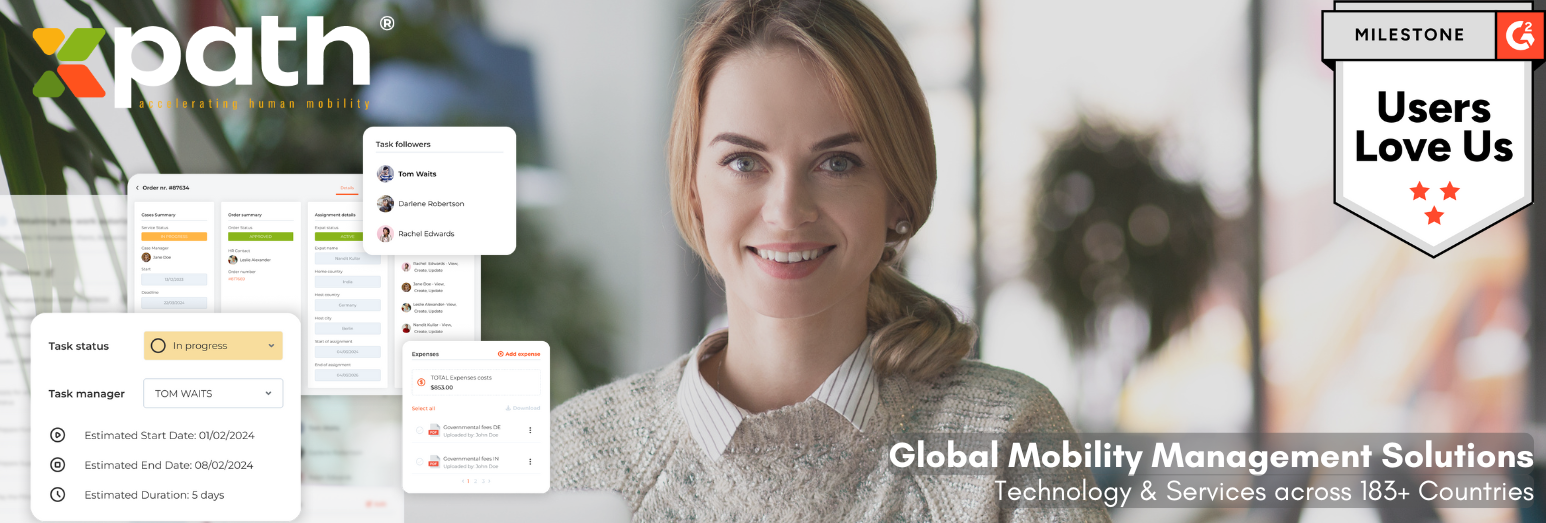
From corporate relocation guidance to automated compliance tracking and vendor coordination across 183 countries, the platform gives HR teams a single environment for managing assignments at scale. Explore selecting mobility technology to understand what to look for in a platform, or consult HR experts at xpath.global to discuss your program’s specific needs. The right infrastructure makes every assignment more predictable, more compliant, and more valuable to the organization.
Frequently asked questions
What is the typical lifecycle of an HR mobility assignment?
Assignments follow a structured lifecycle that includes policy planning and cost projections, pre-departure compliance and employee preparation, on-assignment support covering housing and tax, and a formal repatriation phase with career reintegration.
How can HR manage tax and immigration compliance efficiently?
Effective compliance management begins with immigration and work permits before addressing tax and social security planning, supported by automated tracking systems that maintain deadline visibility across all active assignments.
What are the major cost drivers in international assignments?
Housing allowances represent the largest single cost component, followed by cost-of-living adjustments and hardship premiums, with total assignment costs averaging 2 to 3 times a comparable domestic salary.
Why is early repatriation planning important?
Starting repatriation planning six months before assignment end prevents knowledge loss, allows time for career reintegration planning, and reduces the attrition risk that undermines the return on mobility investment.
Recommended
- 10 Powerful Ways Global Mobility Technology Is Changing Workforce Management – xpath.global
- Smart Global HR: Work Less, Achieve More – xpath.global
- Streamline your international relocation workflow: HR guide
- How technology empowers smaller HR teams to manage complex global assignments. – xpath.global
- Language localisation checklist: boost global reach