






- Global mobility involves complex compliance, talent management, and organizational risk, requiring strategic oversight.
- Challenges include regulatory changes, cost control, remote work complexities, and vendor coordination.
- Effective programs combine policy, process, technology, and expert support to ensure compliance and optimize employee experience.
Global mobility sits at the intersection of talent strategy, legal compliance, and organizational agility, yet many HR teams still treat it as little more than a logistics exercise. That view is costly. Managing international assignments requires coordinating immigration, tax equalization, social security obligations, relocation benefits, and employee well-being, often across multiple jurisdictions simultaneously. Global mobility extends far beyond moving an employee from one country to another, requiring careful compliance and talent management at every stage. This guide lays out the strategies, frameworks, and digital tools that help HR professionals build mobility programs that protect the business and support the people at the center of every assignment.
Understanding global mobility in HR
Global mobility, in its fullest sense, refers to the policies, processes, and operational infrastructure that enable organizations to deploy employees across international borders in support of business objectives. It is not a standalone HR function. It touches immigration law, international taxation, compensation equity, housing logistics, and cultural integration all at once.
As SHRM notes, understanding global mobility requires recognizing how deeply it connects to workforce planning and organizational risk. For HR managers, this means owning responsibilities that go well beyond coordinating a moving van.
Core responsibilities in a global mobility function typically include:
🔸Immigration compliance: Securing work permits, visas, and residency authorizations in destination countries
🔸Tax and social security coordination: Managing cross-border tax exposure, tax equalization policies, and bilateral social security agreements
🔸Relocation benefits administration: Structuring housing allowances, school fees, cost-of-living adjustments, and home-finding support
🔸Assignment tracking and documentation: Maintaining accurate employee records throughout the assignment lifecycle
🔸Employee support and experience: Ensuring assignees and their families receive practical support before, during, and after relocation
Why does this matter? Organizations that manage mobility well retain high-potential talent and respond faster to market opportunities. Those that manage it poorly face regulatory penalties, assignment failures, and reputational damage. Review expat assignment tips to see how assignment success correlates directly with upfront planning and structured support.
A common misconception is that global mobility is only relevant when a company reaches enterprise scale. In reality, even mid-sized organizations face complex compliance obligations the moment they send an employee abroad, regardless of assignment duration.
Pro Tip: HR should be involved from the earliest stage of international business expansion planning, not called in once leadership has already committed to a market entry. Early involvement allows time to assess immigration lead times, establish vendor relationships, and build compliant compensation frameworks before the first assignment begins.
Learning to streamline HR mobility workflows is one of the fastest ways to reduce the administrative burden that grows alongside an expanding mobility portfolio.
Key challenges of global mobility
With a solid grasp of mobility’s scope, HR must recognize the pressing challenges these programs face in practice. The regulatory environment is not static. Immigration laws, bilateral tax treaties, and social security agreements shift frequently, and the compliance risk for organizations that fail to track these changes is significant.
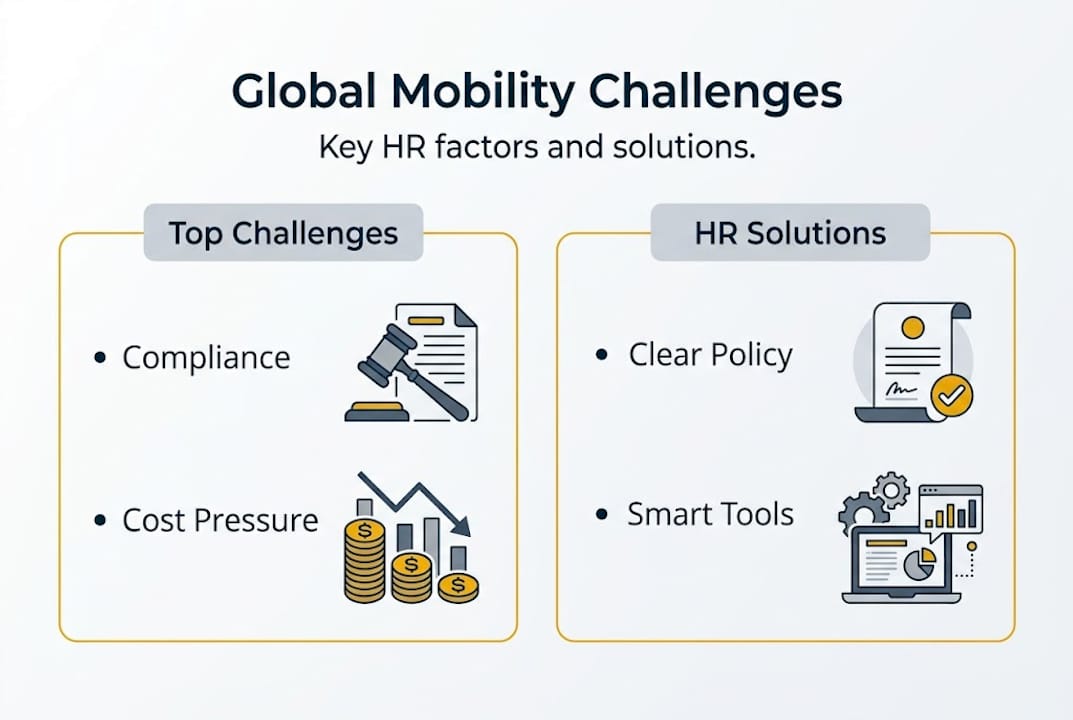
Maintaining compliance with evolving immigration and tax regulations is consistently cited as a leading challenge for HR mobility teams. And the consequences of getting it wrong are serious: back taxes, work authorization violations, reputational risk with host-country regulators, and disrupted assignments.
The top challenges HR mobility programs face today include:
Regulatory compliance: Tracking immigration rules, tax treaties, and social security agreements across multiple jurisdictions
Cost management: Controlling assignment costs that can escalate quickly without structured oversight and effective expense tracking
Remote and hybrid complexity: Managing compliance for employees working across borders without formal assignments
Employee experience: Reducing the stress and friction that assignees and their families experience during transitions
Vendor coordination: Managing multiple third-party service providers without a centralized platform
“The cost of global assignment failure can exceed $1 million, including lost productivity and direct expenses.”
The table below illustrates how key mobility challenges translate into measurable HR impacts:
| Challenge | HR impact |
|---|---|
| Immigration violations | Fines, deportation risk, reputational harm |
| Tax non-compliance | Back taxes, penalties, audit exposure |
| Poor employee experience | Assignment abandonment, attrition |
| Uncontrolled costs | Budget overruns, reduced program scope |
| Fragmented vendor management | Delays, inconsistent service quality |
PwC’s global mobility practice identifies regulatory complexity and cost pressure as the two factors most likely to limit mobility program effectiveness. The rise of hybrid and remote work arrangements has added another layer of complexity, as employees increasingly work across borders without triggering formal assignment processes, creating shadow mobility risks that many HR teams have yet to address fully.
Building an effective global mobility program
Understanding the hurdles allows HR teams to design more resilient, effective global mobility programs. A formalized approach reduces guesswork, limits compliance drift, and creates consistency across every assignment type.

A formalized mobility program ties together policy, process, and technology to ensure consistency, regardless of whether an organization is managing five assignments or five hundred. The critical pillars are policy design, process standardization, technology enablement, and stakeholder communication.
Companies often debate whether to manage mobility in-house or outsource it to a relocation management company. Both approaches have merit depending on program scale and internal capacity:
| Factor | In-house management | Outsourced management |
|---|---|---|
| Control | High | Moderate |
| Cost at low volume | Higher per-assignment | Lower per-assignment |
| Expertise depth | Dependent on team | Access to specialists |
| Flexibility | High | Structured by vendor |
| Scalability | Limited by headcount | Easier at scale |
For most mid-to-large organizations, a hybrid model works best: in-house HR teams own policy and strategy while specialist vendors and technology platforms handle execution and compliance.
A well-structured program should include these core elements:
🔸Written assignment policies covering short-term, long-term, and permanent transfer scenarios
🔸Compensation and benefits frameworks aligned with cost-of-living differentials
🔸Immigration and tax compliance checklists for each destination country
🔸Pre-assignment, during-assignment, and repatriation support protocols
🔸Regular policy reviews conducted at least annually to prevent compliance drift
Pro Tip: Schedule formal policy reviews every 12 months at minimum. Immigration regulations, tax treaties, and social security rules change frequently enough that a two-year-old policy may expose your organization to serious compliance risk without anyone realizing it.
Explore mobility program tools and detailed relocation program guides to benchmark your program against industry standards. EY’s analysis reinforces that programs delivering clear value to both the business and the employee outperform those built primarily for administrative convenience.
Harnessing technology for global mobility success
A solid program needs the right digital tools for maximum impact. Manual coordination through spreadsheets, shared inboxes, and disconnected vendor portals simply cannot scale, and it introduces error and compliance risk at every step.
87% of HR leaders plan to increase investment in mobility technology to improve program administration, reflecting a broader recognition that digital infrastructure is now essential rather than optional. Gartner’s HR technology research similarly points to automation and integrated platforms as the defining characteristics of high-performing mobility programs going forward.
The benefits of purpose-built mobility platforms are concrete. HR teams report lower administrative time per assignment, improved compliance tracking across jurisdictions, faster vendor coordination, and better visibility into assignment costs. Employee satisfaction scores also improve when assignees have self-service access to relocation resources and real-time status updates.
Learn how technology is changing global mobility to understand the operational shifts now within reach for HR teams at every scale.
When evaluating mobility software, look for these features:
🔸Automated compliance workflows: Triggered alerts and task assignments for immigration deadlines, tax filing dates, and permit renewals
🔸Centralized case management: A single record per employee covering immigration, tax, relocation, and vendor activity
🔸Vendor marketplace integration: Direct access to vetted immigration lawyers, tax advisors, and destination services providers
🔸Cost projection tools: Real-time calculators that model assignment costs against budget parameters
🔸Employee self-service portal: A mobile-accessible interface where assignees can track progress, upload documents, and access support
🔸Reporting and analytics: Dashboards showing assignment status, compliance risk, cost trends, and program performance
HR teams that are concerned about budget should review affordable mobility technology options that deliver enterprise-grade functionality without enterprise-scale pricing. The right platform pays for itself quickly through reduced compliance errors and lower administrative overhead. HR tech for assignments provides a detailed cost-benefit framework for evaluating platform investments.
Why technology alone won’t solve global mobility complexity
Here is a perspective that the mobility industry does not discuss enough: organizations that invest in platforms without first fixing their policies and communication structures rarely achieve the efficiency gains they expect. Technology is the enabler, not the driver, of HR success.
We have seen organizations implement sophisticated mobility platforms only to replicate broken processes in a digital format. If the underlying policy is ambiguous, if stakeholders are not aligned, or if HR does not have a seat at the strategic table, no software will close those gaps. The platform automates what you feed into it, nothing more.
The organizations that genuinely excel at global mobility combine rigorous policy design, strong cross-functional relationships between HR, finance, legal, and business leadership, and technology that connects all of these layers in one environment. Cultural alignment matters too. Mobility professionals who understand destination culture brief assignees more effectively, which reduces early return rates and assignment failure.
Review smart strategies for HR teams to see how leading organizations align people, process, and technology rather than treating digital tools as a substitute for operational discipline.
Your next steps: Boost HR mobility with expert support
Armed with both insight and context, here are practical steps you can take today. Building or refining a global mobility program is a structured process, and you do not have to navigate it alone.
xpath.global provides the technology, compliance resources, and consulting expertise that HR mobility teams need to operate efficiently and compliantly at scale. From automated workflow management and a marketplace of over 60,000 vetted services across 183 countries to dedicated compliance support, the platform is built specifically for the complexity you face daily. If you are ready to evaluate your current program or explore a better approach to managing international assignments, contact the HR team at xpath or review guidance on choosing mobility technology that fits your organization’s needs and scale.
Frequently asked questions
What does global mobility mean for HR?
Global mobility includes all aspects of cross-border assignments, from immigration and tax compliance to talent retention, making it a core strategic function rather than a purely administrative one.
What are common global mobility challenges for HR?
Compliance remains a top concern for mobility programs, alongside cost control, vendor coordination, and ensuring employee well-being throughout the assignment lifecycle.
How can technology help HR manage global mobility?
Mobility technology automates compliance checking, tracks assignments in real time, and gives relocating employees self-service access to resources, reducing both administrative burden and error rates for HR teams.
What is the business case for investing in a formal global mobility program?
Formalized programs align mobility with business goals, reduce compliance risks, and improve talent retention by giving assignees structured, consistent support throughout every phase of their international assignment.
Where can HR go for expert help with global mobility?
Specialized solution providers like xpath.global offer integrated technology and compliance support designed specifically for HR leaders managing complex international workforce programs.