






TL;DR:
- Many HR professionals mistakenly believe digitizing RFQ and RFP processes simply involves converting documents into PDFs, which leads to inefficiencies and risks. True digital sourcing uses purpose-built platforms to create structured, transparent, and scalable procurement workflows that improve compliance and vendor engagement. Implementing these systems thoughtfully can significantly accelerate global mobility sourcing, enhance decision-making, and reduce operational complexity.
Many HR professionals managing global mobility programs assume that “digitizing” their RFQ (Request for Quotation) or RFP (Request for Proposal) process simply means converting a Word document into a PDF and sending it by email. That assumption is costing organizations significant time, money, and compliance accuracy. The reality is that true digital sourcing, powered by purpose-built e-sourcing platforms, transforms vendor engagement from a fragmented, manual exercise into a structured, auditable, and scalable procurement workflow. Understanding how this transformation applies specifically to international employee mobility is where the real operational advantage lies.
Key Takeaways
| Point | Details |
|---|---|
| RFQ vs RFP decision | Use RFQ for clear specs and price comparison, RFP for complex solutions. |
| Digital sourcing advantages | E-sourcing automates workflows and improves speed, accuracy, and compliance. |
| Global mobility application | Digital RFQ/RFP tools help manage vendor selection and assignments efficiently. |
| Common pitfalls | Teams often miss the full benefits by simply digitizing old manual processes. |
| Best practices | Set up clear templates, criteria, and process redesign for maximum value. |
Understanding RFQ and RFP: Roles and differences
Having identified the core confusion, the next step is clarifying what RFQ and RFP actually mean and how their roles diverge in practice.
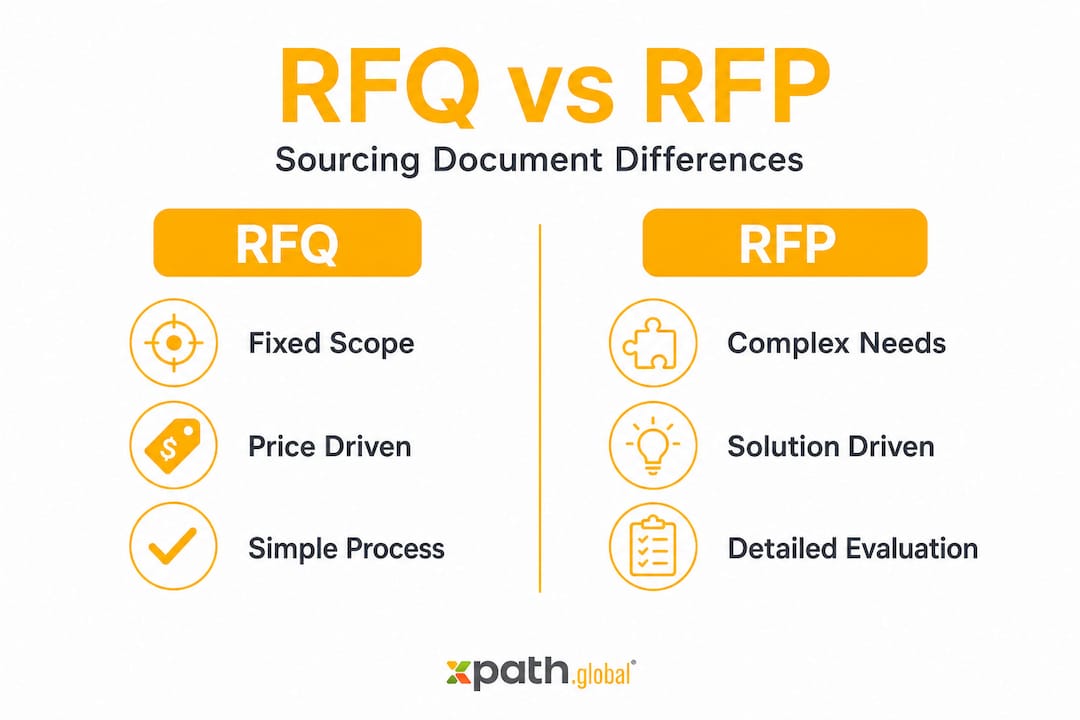
An RFQ is a sourcing document used when requirements are well-defined and the buyer mainly wants comparable pricing and terms from qualified suppliers. In global mobility, this applies when a company already knows exactly what service it needs, for instance, transporting household goods from Frankfurt to Singapore under a fixed weight category, and simply wants to gather and compare cost proposals from multiple vendors. The scope is not open to interpretation. The deliverable is standardized.
An RFP is a sourcing document used when the buyer needs vendors to propose a solution or approach to a more complex or customized need, typically evaluating both capability and pricing together. In global mobility, an RFP is appropriate when the need involves judgment and tailored delivery, such as selecting an immigration law firm to manage complex multi-country work permit applications for a cohort of senior executives.
The decision rule between the two is straightforward once you understand their intent. Consider this breakdown:
| Criteria | RFQ | RFP |
|---|---|---|
| Requirement clarity | Well-defined, fixed scope | Complex or open-ended |
| Primary evaluation | Price comparison | Capability and approach |
| Response format | Standardized cost tables | Narrative proposals with pricing |
| Typical mobility use case | Moving services, temp housing | Immigration management, tax advisory |
| Vendor relationship | Transactional | Strategic |
| Evaluation complexity | Low | High |
When global mobility teams consult the broader global mobility process guide, the pattern becomes clear: using an RFP when an RFQ would suffice adds unnecessary complexity and delays. Conversely, using an RFQ for a nuanced, solution-dependent need often results in selecting a vendor on price alone, which carries substantial compliance and service quality risk.
Key decision factors include:
- Fixed vs. variable scope: If every vendor will deliver the same thing under the same conditions, use an RFQ.
- Evaluation criteria: If price is the only differentiator, an RFQ is appropriate. If approach, experience, or methodology matters, use an RFP.
- Vendor relationship type: Transactional services favor RFQ; strategic partnerships favor RFP.
- Compliance sensitivity: Higher compliance stakes generally call for RFP, where vendor qualifications are scrutinized more thoroughly.
“RFQ for standard specs and fixed scope; RFP for solution-based complex needs” is not just a simplification. It reflects a fundamental procurement principle that holds equally true in global mobility as in any other sourcing context.
What makes RFQ and RFP “digital”? Core features
Once the definitions and decision rules are clear, understanding how digital technology amplifies their value is crucial for HR teams looking to modernize their sourcing approach.

Digital RFQ and RFP processes use e-sourcing workflows and templates rather than email and spreadsheets, enabling centralized management, cross-team collaboration, structured bid evaluation, and automated award decisions. This is not a cosmetic change. It fundamentally restructures how sourcing events are initiated, managed, and concluded.
Here is how the digital transformation of RFQ and RFP works in practice:
- Template-driven event creation: Instead of drafting documents from scratch, teams select from standardized templates that enforce consistent requirements capture, which reduces errors and speeds up preparation.
- Guided workflow execution: The platform walks procurement teams and HR managers through each stage, from vendor invitation to bid collection, ensuring no step is skipped.
- Structured response collection: Vendors respond within the system using predefined fields, making all bids directly comparable without manual reformatting or interpretation.
- Multi-round bid management: For complex RFPs, the system supports multiple rounds of evaluation, clarifications, and revised submissions, all tracked within the platform.
- Automated evaluation scoring: Weighted scoring criteria are applied automatically, reducing subjective bias and accelerating shortlisting.
- Award tracking and audit trail: Every decision, communication, and document is recorded, creating a complete audit trail for compliance review.
The xpath.global platform provides a purpose-built digital RFQ and RFP system for service providers and a parallel digital RFQ and RFP system for HR teams, ensuring both sides of the sourcing relationship operate within a structured, transparent environment. This dual-sided design is important because it eliminates the asymmetry of information that often disadvantages buyers or creates uncertainty for vendors in traditional email-based sourcing.
Organizations that have invested in streamlining HR workflows consistently report that structured digital sourcing reduces cycle times by a material margin compared to manual processes, while also improving the quality and comparability of vendor responses.
Pro Tip: When setting up your first digital RFQ or RFP event, resist the temptation to replicate your existing email-based process inside the tool. Instead, review the platform’s native templates and workflow recommendations first. Designing for digital from the start yields far better results than forcing old habits into a new system.
Digital RFQ vs digital RFP in global mobility: Practical use cases
Knowing what digitalization means, it is time to see how RFQ and RFP actually function within HR-managed global mobility programs, using concrete scenarios.
When to use a digital RFQ in global mobility:
- Sourcing moving companies to transport household goods for a group of relocating employees, where volume, destination, and service level are already defined.
- Procuring temporary furnished accommodation for assignees arriving in a specific city, where room specifications, duration, and location radius are fixed.
- Engaging a local destination services provider for a standard orientation tour and settling-in support package, where the deliverables are consistent across assignees.
- Securing airport transfer and ground transportation services at a standard rate for an ongoing mobility program.
In each of these cases, the practical rule of thumb applies clearly: when you already know the exact scope, an RFQ gives you comparable pricing quickly and efficiently.
When to use a digital RFP in global mobility:
- Selecting an immigration law firm to manage complex, multi-country visa and work permit portfolios for senior leadership cohorts, where the firm’s methodology, country coverage, and case management approach all matter.
- Engaging a tax advisory firm for expatriate tax equalization services, where the complexity of bilateral tax treaty interpretation and social security coordination requires evaluation of technical expertise.
- Choosing an end-to-end relocation management provider to support a large-scale workforce transition involving multiple business units and destinations.
- Identifying a technology vendor to integrate mobility case management with the company’s existing HRIS and payroll systems.
For HR teams managing complex vendor portfolios, the principles covered in vendor collaboration tips and the strategic guidance on managing vendor relationships are directly applicable when designing RFP evaluation criteria. Vendor relationship quality, measured through responsiveness, compliance track record, and local expertise, should carry explicit weighting in any RFP scoring model.
Teams managing internationally distributed workforces can also benefit from understanding how EOR remote hiring workflows interact with mobility sourcing decisions, particularly when new market entry involves a combination of Employer of Record (EOR) arrangements and traditional assignment structures.
Pro Tip: For global mobility programs managing more than 50 annual moves, consider running an annual digital RFQ for transactional services (moving, housing, transport) and an RFP cycle every two to three years for strategic services (immigration, tax, program management). This cadence balances administrative efficiency with the thoroughness that complex vendor selection demands.
Benefits and pitfalls of digital RFQ/RFP in global mobility
Now, let us weigh the practical trade-offs when implementing digital RFQ and RFP processes for global mobility sourcing.
Key benefits:
- Speed: Structured templates and automated communications reduce the time from sourcing event launch to award decision, often by several weeks compared to email-based processes.
- Transparency: All vendors receive identical information simultaneously, eliminating the inconsistencies that arise when requirements are communicated informally.
- Auditability: Every bid, score, communication, and decision is logged, which supports internal governance requirements and external compliance reviews.
- Scalable vendor engagement: Digital platforms allow HR teams to engage a larger panel of vendors without proportionally increasing administrative effort.
- Improved vendor selection quality: Structured evaluation criteria reduce selection bias and ensure that compliance-relevant factors, such as licensing, insurance, and jurisdictional experience, are formally assessed.
Digitalization mainly changes the mechanics through templates, guided workflows, structured response capture, multi-round management, and evaluation automation, while the underlying procurement intent remains the same. An RFQ is still about price comparison; an RFP is still about solution evaluation. Technology accelerates and structures these processes without altering their fundamental logic.
Common pitfalls to avoid:
- Unclear requirements documentation: A digital platform cannot compensate for vague or incomplete scope definitions. Poorly written requirements produce poor vendor responses, regardless of the tool used.
- Process rigidity: Some teams over-engineer their digital workflows, creating unnecessarily complex approval chains that slow down rather than accelerate sourcing cycles.
- Data security gaps: Sharing sensitive employee assignment details or commercially sensitive pricing data through inadequately secured platforms creates compliance and confidentiality risks.
- Change management resistance: Internal stakeholders accustomed to informal vendor relationships may resist structured digital processes. Adoption requires deliberate training and clear communication of the benefits.
“The mechanics change; the intent does not. Templates and automation serve the same procurement logic that manual processes attempted to follow, but with greater consistency, speed, and transparency.”
The xpath.global service provider technology and the HR-focused supplier management platform are designed to address these pitfalls directly, offering pre-built templates, role-based access controls, and audit logging as standard features.
Pro Tip: Before launching your first digital RFQ or RFP event, define your evaluation criteria and scoring weights in writing. This single step prevents scope creep during evaluation, reduces disputes about vendor selection decisions, and creates a defensible record for internal stakeholders and auditors.
Why most global mobility teams make digital RFQ/RFP harder than it should be
After learning the mechanics, stepping back to examine why teams struggle to realize the full benefits of digital sourcing reveals a pattern that goes beyond technology.
Most global mobility teams do not fail at digital RFQ and RFP because the technology is too complex. They fail because they digitize their existing manual workflows without redesigning those workflows for digital execution. This is a critical distinction. Replicating a broken email-based process inside a sophisticated platform does not produce better outcomes. It produces the same outcomes, faster, with more documentation.
The teams that realize the most value from digital sourcing share a common characteristic: they treat the implementation of a digital RFQ and RFP system as an opportunity to rethink the entire sourcing process, not just the delivery mechanism. They question which services actually need a competitive tender, what criteria genuinely predict vendor performance in global mobility, and how sourcing decisions connect to downstream compliance and employee experience outcomes.
There is also a mindset issue that the in-depth process guide addresses directly. Many HR and mobility teams view RFQs and RFPs as administrative obligations rather than strategic levers. As a result, they invest minimal effort in requirements documentation, evaluation design, and vendor communication, then wonder why the resulting vendor panel underperforms. The document is not the deliverable. The outcome of a well-executed sourcing event is a vendor relationship that delivers measurable value across the assignment lifecycle.
The most successful global mobility teams treat every sourcing event, whether an RFQ for temporary housing or an RFP for a tax advisory partner, as an investment in program performance. They allocate appropriate time to requirements definition, engage internal stakeholders in evaluation design, and use the data generated by digital platforms to continuously improve their vendor panels. That discipline, more than any specific technology feature, is what separates high-performing mobility programs from those that perpetually struggle with vendor quality, cost overruns, and compliance gaps.
Explore digital sourcing solutions for global mobility
Digital sourcing is one of the most impactful improvements a global mobility team can make to its operational model. The right platform connects structured RFQ and RFP workflows with a vetted global vendor network, creating the conditions for faster, more compliant, and more cost-effective vendor selection.
xpath.global provides HR professionals with purpose-built tools to manage the full sourcing lifecycle within a single global mobility marketplace. Whether you are ready to launch your first digital RFQ event or evaluating global mobility technology options for a more substantial program upgrade, xpath.global offers the infrastructure, vendor network, and process expertise to support your goals. To speak with a specialist about your specific sourcing challenges, contact our HR professional team and explore how digital RFQ and RFP tools can be integrated into your current program.
Frequently asked questions
How does a digital RFQ differ from a traditional RFQ?
A digital RFQ uses e-sourcing workflows and automated templates rather than email or spreadsheets, enabling centralized bid management, structured evaluation, and automated award decisions that are not possible in manual processes.
When should HR teams use an RFP vs an RFQ?
Use an RFQ when requirements are fixed and price is the primary differentiator; use an RFP when vendors need to propose solutions for complex or customized needs, as the rule of thumb for standard vs. complex scope clearly distinguishes between the two.
What are the benefits of digital RFQ/RFP for relocation managers?
Digitalization improves sourcing speed, enhances transparency and auditability, reduces vendor selection bias, and scales vendor engagement without proportionally increasing administrative workload.
Are there any risks with digitalizing RFQ/RFP workflows?
Yes. Risks include poorly defined requirements that undermine response quality, over-engineered approval workflows that slow sourcing cycles, and data security concerns when sensitive assignment or commercial data is handled on inadequately secured platforms.
Can digital RFQ/RFP systems integrate with global mobility platforms?
Yes. Purpose-built global mobility platforms such as xpath.global incorporate digital RFQ and RFP functionality natively, connecting sourcing workflows directly to vendor management, case tracking, and compliance monitoring within a single unified environment.
Recommended
Previous article