






TL;DR:
- Managing multiple vendors creates significant compliance and financial risks in international relocations.
- Centralized vendor governance and integrated platforms improve compliance tracking and reduce errors.
- A structured, proactive approach to vendor management is essential for scalable and risk-aware global mobility programs.
Managing international employee relocations is rarely as straightforward as it appears on paper. Most HR leaders and global mobility managers focus their preparation on visa timelines and housing budgets, while underestimating the coordination burden created by managing multiple vendors across jurisdictions. A single relocation assignment routinely involves immigration attorneys, tax advisors, destination services providers, moving companies, and temporary housing specialists, each operating on separate systems with separate deliverables. When these relationships are uncoordinated, the result is not just inefficiency. It is a measurable compliance and financial risk that can derail assignments, trigger regulatory penalties, and consume HR bandwidth that should be directed elsewhere.
Key Takeaways
| Point | Details |
|---|---|
| Vendor complexity is risky | Using multiple vendors without coordination creates compliance dangers and wastes HR time. |
| Centralization drives compliance | Bringing vendors under a unified system reduces administrative headaches and legal risk. |
| Integrated platforms are essential | Modern tech provides the visibility and control needed for successful global relocations. |
| One-size does not fit all | Your approach should balance control and flexibility based on business needs and case complexity. |
The hidden risks of multi-vendor relocation management
The complexity of international relocation escalates quickly once you account for every service provider involved in a single assignment. Each relocation averages 7+ vendors, and HR and mobility professionals spend 60 to 70 percent of their time on administrative coordination rather than strategic program management. That is a striking allocation of resources for tasks that, in many cases, technology and structured governance could handle more reliably.
The risks created by unmanaged vendor relationships fall into several distinct categories:
- Missed compliance deadlines: Immigration permit renewals, tax filing deadlines, and social security registration windows each have strict timelines. When vendors operate independently, critical dates can fall through the cracks.
- Duplicate or inconsistent data: Multiple vendors maintaining separate employee records increases the likelihood of discrepancies that can trigger regulatory scrutiny.
- Miscommunication between providers: A moving company unaware of a delayed visa approval may proceed with logistics on a schedule that no longer aligns with the employee’s legal right to enter the destination country.
- Untracked immigration milestones: Missed work permit renewals or incorrect visa categories can result in employees working out of status, which carries serious legal consequences for both the individual and the company.
- Cost overruns from uncoordinated invoicing: Without centralized billing oversight, duplicate service charges and unbudgeted vendor fees become difficult to detect.
The financial consequences of compliance failures are not trivial. According to relocation vendor best practices in the global mobility field, fines for non-compliance run from $1,000 to $25,000 per violation, and that range does not account for the reputational damage or assignment disruption that typically accompanies a regulatory investigation.
Key risk indicator: Fines for non-compliance in international mobility assignments range from $1,000 to $25,000 per violation, with some jurisdictions imposing additional operational restrictions that can delay or terminate the assignment entirely.
A mobility compliance checklist can help identify gaps, but a checklist alone does not solve the structural problem of fragmented vendor oversight. Organizations that rely on email threads and spreadsheets to coordinate across vendors are, in effect, accepting elevated compliance risk as a cost of doing business. The better approach is to examine the structural frameworks that reduce that risk from the outset, which is precisely where mobility compliance strategies focused on centralization begin to show measurable returns.
How effective vendor management boosts compliance and control
Structured vendor governance does not simply reduce administrative workload. It directly improves an organization’s ability to meet regulatory requirements across immigration, tax, and labor law domains simultaneously. Centralized governance and integrated platforms reduce compliance risk, support tracking, and enable timely interventions before violations occur.

To illustrate the difference, consider how two organizations might approach the same relocation scenario:
| Factor | Ad hoc vendor management | Structured vendor management |
|---|---|---|
| Compliance tracking | Manual, email-based | Automated, platform-driven |
| Vendor accountability | Informal, case-by-case | Contractual SLAs and performance metrics |
| Data consistency | Fragmented across providers | Centralized employee record |
| Deadline management | Reliant on individual reminders | System-triggered alerts |
| Cost visibility | Delayed, invoice-by-invoice | Real-time budget tracking |
| Risk exposure | High, difficult to audit | Lower, with audit trails |
The contrast is significant. Structured management replaces reactive problem-solving with proactive governance, which is the foundation of any scalable global mobility program.
To implement structured vendor compliance management, HR teams can follow these steps:
- Map all active vendors across current and recent assignments to establish a baseline of your vendor ecosystem.
- Categorize vendors by compliance function, distinguishing between immigration, tax, logistics, and destination services providers.
- Define service level agreements (SLAs) for each vendor category, including deadline adherence, reporting standards, and escalation protocols.
- Integrate vendors into a central platform that tracks milestones, documents, and communications in one place.
- Conduct quarterly vendor performance reviews to identify underperformance before it creates compliance exposure.
Edge cases reveal why robust platforms matter more than most HR leaders anticipate. Integrated end-to-end platforms are essential when assignments involve multi-passport employees, dual-income spouses with separate tax obligations, or mid-assignment changes in role or location. These scenarios require real-time coordination across vendors that ad hoc systems simply cannot reliably deliver.
Pro Tip: Apply vendor tiering to manage risk more strategically. Classify vendors as Tier 1 (high compliance impact, such as immigration and tax), Tier 2 (moderate impact, such as destination services), and Tier 3 (low impact, such as moving logistics). Allocate oversight resources proportionately, with the most rigorous monitoring applied to Tier 1 relationships. This approach, supported by vendor relationship strategies, ensures that your compliance attention is calibrated to actual risk levels rather than distributed equally across all providers. You can also reference achieving mobility compliance guidance and relocation best practices to build a governance framework appropriate to your program’s scale.
Balancing flexibility and oversight: Multi-vendor vs. single provider models
One of the most consequential decisions HR leaders face in global mobility program design is whether to work with multiple specialized vendors or consolidate services under a single provider. Both models carry distinct advantages and limitations that must be weighed against program volume, geographic footprint, and internal resources.
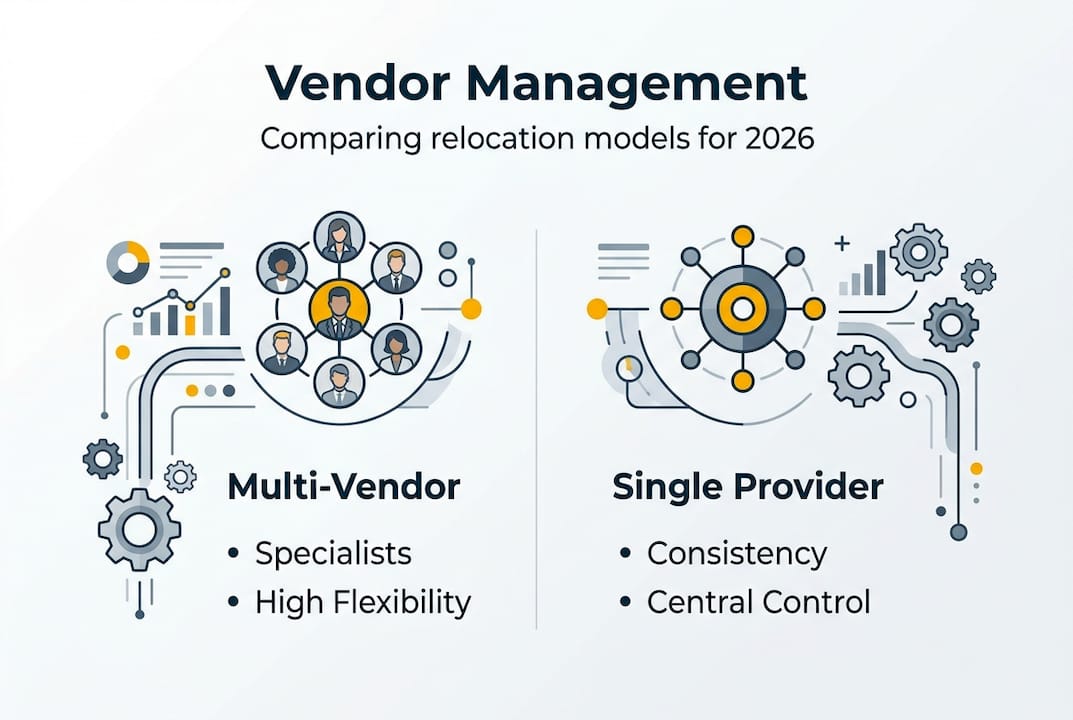
| Dimension | Multi-vendor model | Single provider model |
|---|---|---|
| Specialization | High, access to best-in-class experts | Variable, depends on provider scope |
| Compliance coordination | Complex, requires active oversight | Simpler, provider manages internally |
| Cost control | Harder to benchmark across invoices | Easier to negotiate and monitor |
| Flexibility | High, adaptable to destination needs | Lower, constrained by provider network |
| Scalability | Requires significant management capacity | Easier to scale operationally |
| Transparency | Fragmented across systems | Consolidated, but provider-controlled |
The choice is rarely absolute. Multi-vendor flexibility enables specialization and local expertise, but introduces compliance coordination risk that grows in proportion to assignment volume. A single provider simplifies governance but may lack the depth of local knowledge required for complex destinations.
Organizations should consider a multi-vendor approach when:
- Assignments are concentrated in high-complexity jurisdictions requiring specialized local expertise.
- The internal mobility team has sufficient capacity to manage vendor relationships actively.
- Destination services or immigration requirements vary significantly by country.
Conversely, a single provider or consolidated model is more appropriate when:
- Assignment volume is high and internal HR bandwidth is limited.
- Standardization across the program is a higher priority than local specialization.
- Budget predictability and simplified invoicing are organizational priorities.
Pro Tip: Vendor marketplaces offer a compelling hybrid. Platforms that aggregate pre-vetted specialists under centralized oversight allow organizations to access multi-vendor specialization without absorbing the coordination burden independently. This is the model that mobility technology tools are increasingly designed to support, combining the flexibility of a broad provider network with the governance controls of a structured program.
Best practices for centralizing and optimizing global vendor management
With the risks and model tradeoffs clearly defined, the practical question becomes how to build a vendor management program that delivers consistent compliance outcomes at scale. Centralized governance, integrated platforms, and a marketplace approach create coherent workflows and scalable vendor relationships that individual coordination methods cannot replicate.
The following steps provide a structured path to building or refining a centralized vendor management program:
- Conduct a vendor audit. Identify every provider currently engaged across your mobility program, including informal or one-off relationships that may have bypassed procurement review.
- Standardize vendor onboarding. Require all vendors to complete a consistent onboarding process, including compliance certifications, data handling agreements, and SLA acknowledgments.
- Select an integrated platform. Choose a global mobility technology platform that consolidates case management, vendor communication, milestone tracking, and document storage in a single environment.
- Establish a vendor governance committee. Assign internal ownership of vendor relationships, with clear escalation paths for performance issues and compliance concerns.
- Automate compliance monitoring. Configure the platform to generate alerts for upcoming deadlines, document expirations, and SLA breaches across all active assignments.
- Review and refresh vendor relationships annually. Market conditions, regulatory environments, and provider capabilities change. Annual reviews prevent vendor relationships from becoming outdated liabilities.
When evaluating an integrated platform, prioritize the following features:
- Real-time case and milestone tracking across all active assignments
- Centralized document management with version control
- Automated workflow triggers for compliance events
- Vendor performance dashboards with SLA monitoring
- Integrated cost management and budget forecasting
- Access to a pre-vetted global centralized vendor management guide marketplace
For detailed guidance on managing the full relocation cycle, reviewing employee relocation steps alongside platform selection will help ensure that your governance framework covers all phases of the assignment, from pre-departure planning through final repatriation.
Our take: Why the reality of global vendor management surprises most HR leaders
Textbook guidance on global vendor management tends to focus on high-volume programs and well-established corridors, such as US-to-UK or Singapore-to-Germany. The implicit assumption is that straightforward destinations carry low risk. In practice, that assumption is where many compliance investigations begin.
Some of the most significant regulatory exposures we observe arise from assignments that were classified internally as simple or low-risk, often involving smaller countries, short durations, or infrequently used vendors. A one-time move to a jurisdiction where your preferred immigration vendor has no local presence can quietly create work authorization gaps that surface months later during an audit.
The uncomfortable reality is that mobility compliance mistakes rarely occur in the assignments that receive the most scrutiny. They occur in the ones that receive the least. Proactive governance, applied consistently across all assignments regardless of perceived complexity, is the differentiator that separates programs with clean audit records from those that face recurring regulatory exposure. Treating every assignment as high-stakes, even when it appears routine, is not overcaution. It is professional discipline.
Next steps: Tap expert support and technology for seamless global mobility
The principles outlined in this article point to a clear operational conclusion: uncoordinated vendor management is a structural risk, and the solution requires both technology and governance, not just process improvements.
xpath.global provides HR leaders and global mobility managers with a compliance-ready platform and a curated vendor marketplace features that spans more than 60,000 services across 183 countries. The platform centralizes case management, automates compliance workflows, and connects organizations with pre-vetted providers, eliminating the coordination gaps that create regulatory exposure. If you are evaluating options, exploring choosing mobility technology guidance is a practical starting point. To discuss your program’s specific requirements, contact our HR team for a consultation.
Frequently asked questions
What is global vendor management in the context of employee relocation?
Global vendor management means coordinating and overseeing all third-party providers involved in international employee moves, covering immigration, tax, housing, and logistics. A typical assignment involves 7 or more vendors, making centralized oversight essential for program integrity.
What are the main compliance risks with unmanaged global vendors?
Unmanaged vendors increase the likelihood of missed deadlines, inconsistent data, and regulatory violations across immigration, tax, and labor law requirements. Fines of $1,000 to $25,000 per violation are a direct financial consequence of inadequate oversight.
How does integrated technology improve relocation vendor management?
Integrated platforms provide real-time case tracking, automated compliance alerts, and centralized document management across all active vendors and assignments. Real-time collaboration tools within these platforms make it significantly easier to identify and resolve compliance issues before they escalate.
When should companies centralize vendor management?
Centralization becomes essential as soon as relocations involve multiple countries, complex cases, or more than a few concurrent vendor relationships. Centralized governance is particularly critical for multi-jurisdictional programs where compliance requirements vary significantly by destination.
Recommended
- Managing relocation vendors for global mobility success
- Relocation best practices: Optimize global mobility in 2026
- Strategies for Managing Vendor Relationships in Global Mobility – xpath.global
- Global mobility best practices: streamline relocation & boost engagement
- Guide to relocation logistics: smooth and stress-free moves