






TL;DR:
- Workflow automation significantly reduces manual tasks, saving time and costs in global mobility programs.
- True automation involves software that manages end-to-end processes without manual intervention, not just digitization.
- Successful adoption requires mapping current workflows, establishing governance, and treating automation as a process redesign effort.
Organizations that have replaced manual processes with automated mobility workflows report eliminating up to 90% of manual tasks, saving more than 5,000 staff hours and $200,000 annually. Yet most global mobility programs still depend heavily on spreadsheets, email chains, and disconnected vendor communications, creating serious compliance exposure and operational drag. For HR professionals managing international assignments across multiple jurisdictions, the gap between what automation can deliver and what teams currently experience is significant. This article defines workflow automation in precise terms, examines its real impact on global mobility programs, and equips HR leaders with actionable guidance for implementation.
Key Takeaways
| Point | Details |
|---|---|
| Automation streamlines HR tasks | Workflow automation can dramatically reduce manual work and compliance risk in managing international assignments. |
| End-to-end process control | HR teams gain stronger visibility and control by automating each stage from assignment planning to repatriation. |
| Tech ingredients matter | Key components like triggers, integrations, and AI make automation flexible and adaptive to HR needs. |
| Document before automating | Mapping existing processes is essential to avoid automating inefficient or broken workflows. |
| Scalable for any team size | Both large enterprises and smaller HR teams can access workflow automation with the latest low-code or no-code solutions. |
Defining workflow automation for HR and global mobility
Workflow automation is frequently misunderstood as a synonym for digitization. Moving from paper forms to PDFs does not constitute automation. Neither does storing documents in a shared drive. These steps reduce paper volume, but they do not remove the manual coordination required to move work forward.
True workflow automation, as defined by enterprise software practitioners, is the use of software to design, execute, and monitor digital processes that automate repetitive tasks and orchestrate end-to-end business processes without manual intervention, often involving sequential, rule-based, event-driven, or hybrid workflows integrated with AI for decision-making.
In practice, this means the system itself advances work through stages, applies rules, routes tasks to the right people, and flags exceptions automatically. No one needs to manually check a spreadsheet, send a reminder email, or copy data between systems.
For HR teams managing international assignments, this distinction matters enormously. Consider the four primary types of workflow automation relevant to global mobility:
- Sequential workflows: Tasks complete in a fixed order, such as triggering a visa application only after offer letter approval is confirmed.
- Rule-based workflows: Logic branches based on specific conditions, for example routing a tax briefing to a specialist only when an assignment exceeds 183 days.
- Event-driven workflows: External signals initiate actions automatically, such as a passport expiry date triggering a renewal reminder 90 days in advance.
- Hybrid workflows: Combinations of the above, often with AI augmenting decision points where data patterns inform routing or prioritization.
AI’s role in modern HR process automation deserves specific mention. Large language models and reasoning engines now support intelligent document classification, anomaly detection in cost projections, and predictive compliance flagging. This pushes workflow automation well beyond simple task routing.
Workflow automation in global mobility is not about eliminating human judgment. It is about reserving human judgment for decisions that genuinely require it, while the system handles everything else.
Practical examples of automated HR mobility workflows include automated onboarding checklists sent to relocating employees upon assignment confirmation, real-time alerts when work permit deadlines approach, and automatic escalation when a compliance milestone is missed. These capabilities form the foundation of modern global mobility management.
Why workflow automation matters in global mobility
Global mobility programs involve dozens of interdependent tasks across immigration, tax, payroll, housing, and vendor coordination. Managing these manually creates compounding risk. A missed tax filing deadline, for instance, does not just generate a fine. It can jeopardize an employee’s work authorization or trigger a host-country audit.
Workflow automation streamlines international assignment lifecycles including pre-move planning, immigration compliance, tax and payroll adjustments, on-assignment support, and repatriation, using digital platforms for document management, deadline tracking, and cost projections. This is not a marginal improvement. It restructures how global mobility functions operate.

The business case is well-supported by evidence. Case studies show that organizations implementing automated global workforce management achieve 90% reductions in manual work, saving over 5,000 hours and $200,000 annually. Separate optimization audits have produced $1.1 million in savings, while policy harmonization efforts enabled by unified platforms have generated $2 million in avoided costs.
The table below illustrates the contrast between manual and automated approaches across key mobility process areas:
| Process area | Manual approach | Automated approach |
|---|---|---|
| Immigration tracking | Spreadsheet updates, email alerts | Real-time dashboard, automatic reminders |
| Tax compliance | Advisor check-ins, manual calendar | Event-driven alerts, integrated tax tracking |
| Cost projections | Static spreadsheet models | Dynamic calculators with live data |
| Vendor coordination | Email threads, fragmented contracts | Centralized marketplace with tracked deliverables |
| Document management | Shared drives, manual filing | Structured digital workflows with audit trails |
The practical advantages of automation over traditional processes can be organized as follows:
- Consistent process execution: Every assignment follows the same verified steps, eliminating variations that create compliance risk.
- Reduced administrative burden: HR teams shift time from coordination tasks to strategic program management.
- Improved visibility: Real-time dashboards replace status-check emails, giving leadership accurate assignment data at any moment.
- Audit readiness: Automated systems generate complete process logs, supporting regulatory audits without additional preparation.
- Faster assignment initiation: Pre-built templates and automated triggers compress the time from assignment approval to mobilization.
For a structured overview of how automation fits into the full relocation lifecycle, the international relocation workflow guide provides detailed process mapping. Teams evaluating the broader strategic case will also find value in reviewing mobility technology impact analysis.
Pro Tip: When building your automation business case internally, anchor ROI estimates to hours saved per assignment type, not just total program volume. Assignment-level data is more credible to finance teams and easier to validate against actual experience.
For teams seeking to understand how smart HR automation translates to day-to-day efficiency gains, the evidence points consistently to compliance and time savings as the two most measurable early returns.
Key components and technologies powering workflow automation
Understanding what makes workflow automation function gives HR leaders the foundation to evaluate platforms, ask better questions of technology vendors, and avoid purchasing systems that underdeliver.
According to enterprise automation research, the mechanics of automation include triggers (events and webhooks), data normalization, reasoning engines such as AI and large language models for decisions, actions through API integrations and robotic process automation, guardrails for error handling and escalations, and human-in-the-loop mechanisms for approvals. Methodologies encompass low-code and no-code designers, declarative workflows as code, and agentic AI for adaptive processes.
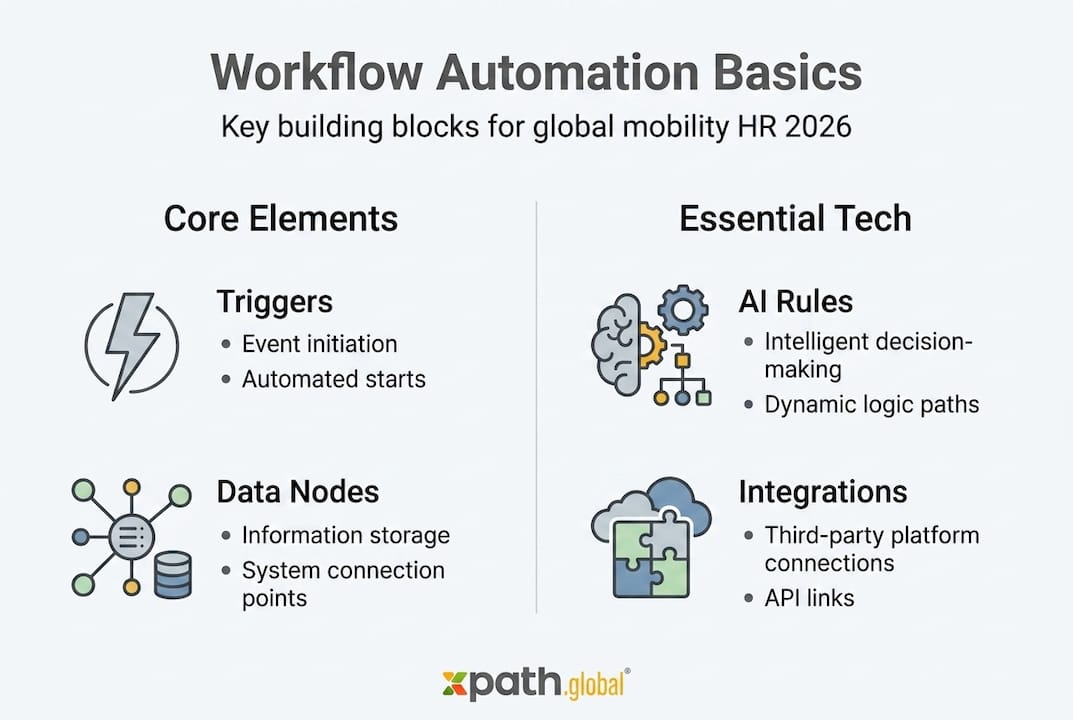
The following table summarizes the core components and their relevance to global mobility:
| Component | Function | Global mobility application |
|---|---|---|
| Triggers | Initiate workflows from events | Passport expiry, visa approval, assignment start date |
| API integrations | Connect systems across platforms | HR systems, payroll, immigration portals |
| AI reasoning engines | Support complex decision-making | Tax risk flagging, cost anomaly detection |
| RPA (robotic process automation) | Automate repetitive data tasks | Form filling, data transfer between systems |
| Human-in-the-loop | Preserve human control at key steps | Policy exception approvals, compliance sign-offs |
| Low-code/no-code tools | Enable non-technical configuration | HR team workflow customization without IT dependency |
Several components deserve additional attention for global mobility contexts:
- API integrations connect your mobility platform to payroll systems, HRIS platforms, and government immigration portals, removing manual data entry between systems.
- Robotic process automation handles repetitive, rules-based tasks such as populating visa application fields from existing employee records.
- Human-in-the-loop design is critical in mobility contexts where policy exceptions, cost overruns, and legal variations require human judgment before the system proceeds.
- Low-code and no-code tools allow HR professionals to build and adjust workflows without depending on IT teams for every configuration change, dramatically accelerating adoption.
For teams focused on streamlining workforce ops across multiple jurisdictions, understanding these building blocks helps prioritize which capabilities matter most for their program scale. Teams exploring cloud platforms for HR will find that cloud-native architectures also improve scalability and security for cross-border programs.
For a detailed practical framework, reviewing a step-by-step AI workflow design approach can help teams structure their implementation planning before selecting technology.
Best practices for adopting workflow automation in international HR
The most common failure mode in workflow automation is not a technology problem. It is a process problem. As Forrester research notes, automation amplifies inefficiency negatively, meaning that automating a broken process produces broken results faster, not better outcomes. Mapping and documenting workflows first, piloting in low-risk areas, and embedding governance early are essential to balancing speed with compliance in international contexts.
HR teams adopting workflow automation for global mobility programs should follow a structured approach:
- Map existing workflows before automating anything. Document every step, decision point, and handoff in your current processes. This exercise frequently reveals redundant steps, ambiguous responsibilities, and compliance gaps that no automation platform can fix on its own.
- Identify and prioritize high-volume, low-risk processes for initial pilots. Document collection, deadline notifications, and onboarding checklists are strong starting points. These deliver visible ROI without exposing the organization to compliance risk during the learning phase.
- Define governance structures early. Establish who owns each workflow, who approves exceptions, and how errors are escalated. Without this, automated systems create accountability gaps.
- Plan for change management. Employees and vendors who interact with automated workflows need clear communication about what has changed and why. Resistance to new systems is a leading cause of poor adoption.
- Build compliance checkpoints into every workflow. Automation should enforce policy, not bypass it. Every stage involving immigration status, tax obligations, or social security compliance should include a verification step before the workflow advances.
Workflow automation is a forcing function for organizational clarity. Teams that resist mapping their processes before automating them often discover, too late, that they have digitized confusion rather than eliminated it.
Pro Tip: Use your first automation pilot as an opportunity to audit your document management for mobility processes. Document handling is almost always an early pain point, and improvements here generate immediate, measurable efficiency gains that build internal momentum for broader automation adoption.
If your team is uncertain whether the program has reached sufficient scale to justify a dedicated platform, the guidance on when to use mobility software provides a practical decision framework based on assignment volume, compliance complexity, and program growth trajectory.
Expert perspective: The hidden challenges and rewards of workflow automation
Most guides on workflow automation focus on the technology. The more important conversation is about organizational readiness. In our experience working with global mobility programs across multiple industries, the teams that achieve the greatest gains from automation share one characteristic: they treated the implementation project as a process redesign effort, not a software deployment.
Automation reveals ambiguity. When you try to configure a rule-based workflow for assignment cost approval, you quickly discover that your policy has three interpretations depending on who you ask. That is not a technology problem. It is a governance problem that automation forces you to resolve. This is uncomfortable, but it is also an opportunity. HR teams that approach workflow automation with this mindset use it to drive broader clarity in their mobility policies and to secure leadership buy-in for process standardization.
The teams that struggle treat automation as a way to move faster without changing anything. They automate the same fragmented, exception-heavy processes they have always used, and then wonder why the results disappoint. The strategic steps for mobility that produce durable outcomes always begin with process clarity, not platform selection. Automation rewards organizations that do the hard work first.
Next steps: Enhance your global mobility program with workflow automation
Workflow automation is not a future capability for global mobility programs. It is a current competitive requirement. Organizations that automate now gain compliance reliability, cost visibility, and operational efficiency that manual programs cannot match.
xpath.global provides the unified platform that makes this transition practical. From automated assignment workflows and compliance tracking to a marketplace of 60,000 services across 183 countries, the platform is built specifically for the complexity of international HR. To understand how automation fits your current program, speak to global mobility HR experts for a personalized consultation. You can also explore the xpath.global advantages and review guidance on selecting mobility technology to inform your next decision.
Frequently asked questions
What are typical HR processes that benefit the most from workflow automation?
Global mobility processes such as document management, compliance monitoring, assignment cost tracking, and deadline notifications see the fastest gains. Automation covers pre-move planning, immigration compliance, tax and payroll adjustments, on-assignment support, and repatriation.
How does workflow automation improve compliance for international HR assignments?
Automation enforces defined process steps, tracks regulatory deadlines, and generates full audit trails, significantly reducing non-compliance risk. Deadline tracking and compliance monitoring are embedded directly into the workflow rather than managed manually.
Is workflow automation only for large companies, or can smaller HR teams benefit too?
Both large enterprises and smaller HR teams can achieve significant benefits, particularly given the availability of low-code and no-code platforms that require minimal technical expertise to configure and maintain.
What preparatory steps should my HR team take before automating workflows?
Map and document workflows first, identify pain points, prioritize low-risk process pilots, and embed governance structures early to avoid replicating inefficient processes at scale.