






TL;DR:
- Effective assignment tracking ensures compliance, cost control, and employee well-being across borders.
- Digital platforms improve accuracy, scalability, and reporting speed over manual spreadsheets.
- Strong processes and data discipline are essential to unlock insights and strategic benefits from mobility data.
Even the most experienced HR teams in multinational organizations can lose track of international assignments. A visa renewal date slips by unnoticed. A cost projection goes unreviewed. An employee lands in a new country without the right documentation in place. These are not rare edge cases—they are predictable consequences of managing global mobility without a structured, centralized tracking approach. Assignment tracking, when done well, is the operational backbone of any successful international mobility program. This guide explains what it involves, why it matters, and how to implement it effectively across your organization.
Key Takeaways
| Point | Details |
|---|---|
| Track assignments proactively | Early and consistent assignment tracking prevents compliance gaps and costly mistakes. |
| Use digital tools for scale | Modern platforms streamline tracking, reduce errors, and offer actionable insights. |
| Integrate tracking with compliance | Automated alerts and documentation workflows keep global assignments on the right side of legal requirements. |
| Focus on employee experience | A transparent tracking system leads to fewer surprises and happier relocating employees. |
| Review and optimize regularly | Continuous monitoring of assignment data helps HR teams adapt and improve global mobility programs. |
What is assignment tracking?
To start, let’s break down what assignment tracking actually involves.
In the context of global mobility, assignment tracking refers to the systematic monitoring and management of all data, milestones, documentation, and compliance requirements associated with an employee’s international assignment. This spans the full lifecycle of a relocation, from the initial assignment letter and immigration filing through to repatriation or permanent transfer.
Assignment tracking methods for global mobility teams cover a broad set of responsibilities, including:
- Monitoring visa and work permit expiration dates
- Recording assignment start and end dates
- Tracking tax and social security compliance obligations
- Managing relocation costs and budget approvals
- Maintaining documentation for each assignee
- Coordinating with immigration lawyers, tax advisors, and destination service providers
“Assignment tracking is central to global mobility management, ensuring compliance and employee well-being across borders.”
When organizations lack a coherent tracking framework, the consequences are significant. Missed permit renewals can result in illegal work situations, exposing both the employee and the company to regulatory penalties. Incomplete documentation creates audit vulnerabilities. Poor cost visibility leads to budget overruns that are difficult to justify retroactively. Beyond compliance, inadequate tracking erodes employee trust, particularly when relocating staff feel unsupported or uninformed about their own assignment status.
Effective assignment management tools address these risks by creating a single source of truth for every active and historical assignment, giving HR teams the visibility they need to act proactively rather than reactively.
Core components of an efficient assignment tracking system
Now that you understand why tracking assignments matters, let’s explore what robust tracking actually looks like.
Not all tracking systems are created equal. A spreadsheet with a few key dates is technically a tracking tool, but it falls far short of what multinational HR teams actually need. A purpose-built assignment tracking system captures and manages a much wider set of data points.
International assignment management platforms capture the following core data categories:
| Data category | What it includes | Why it matters |
|---|---|---|
| Assignment details | Duration, location, role, host entity | Determines compliance obligations |
| Employee profile | Dependents, nationality, tax residency | Shapes immigration and tax strategy |
| Immigration status | Visa type, permit expiry, renewal timelines | Prevents illegal work situations |
| Cost tracking | Relocation budget, actuals, forecasts | Controls spend and enables reporting |
| Compliance milestones | Filing deadlines, renewals, approvals | Reduces regulatory risk |
| Vendor coordination | Provider assignments, service status | Ensures service delivery |
Beyond data collection, a strong system incorporates workflow automation. Automated alerts for upcoming deadlines, structured approval workflows, and milestone tracking reduce the manual burden on HR coordinators who are often managing dozens of assignments simultaneously.

Analytics and reporting capabilities are equally important. The ability to generate real-time dashboards showing assignment status by country, compliance risk by employee, or cost trends by business unit transforms raw data into actionable intelligence. HR leaders can identify patterns, anticipate problems, and report to senior stakeholders with confidence.
Pro Tip: Automate reminders for critical milestones such as visa renewals, tax filing deadlines, and assignment end dates. Set alerts at 90, 60, and 30 days before each deadline so your team has enough lead time to act without scrambling.
A well-structured tracking system also maintains a complete audit trail. Every document uploaded, every status change recorded, and every approval granted should be logged with a timestamp and user attribution. This level of documentation discipline is invaluable during regulatory audits or internal reviews.
Comparing assignment tracking methods: Manual vs. digital solutions
Understanding the core features is only the beginning—the next decision is how you actually implement tracking.
Many HR teams still rely on spreadsheets, shared inboxes, and disconnected vendor communications to manage international assignments. This approach may work for a handful of assignees, but it breaks down quickly as program volume grows. The structural weaknesses of manual tracking are well-documented.
Manual tracking limitations:
| Factor | Manual approach | Digital platform |
|---|---|---|
| Scalability | Difficult beyond 20 assignments | Handles hundreds simultaneously |
| Error risk | High, due to manual data entry | Reduced through automation |
| Compliance visibility | Limited, reactive | Real-time, proactive |
| Reporting speed | Slow, requires manual compilation | Instant, customizable dashboards |
| Vendor coordination | Email-based, fragmented | Centralized within the platform |
| Cost | Low upfront, high in labor hours | Investment offset by efficiency gains |
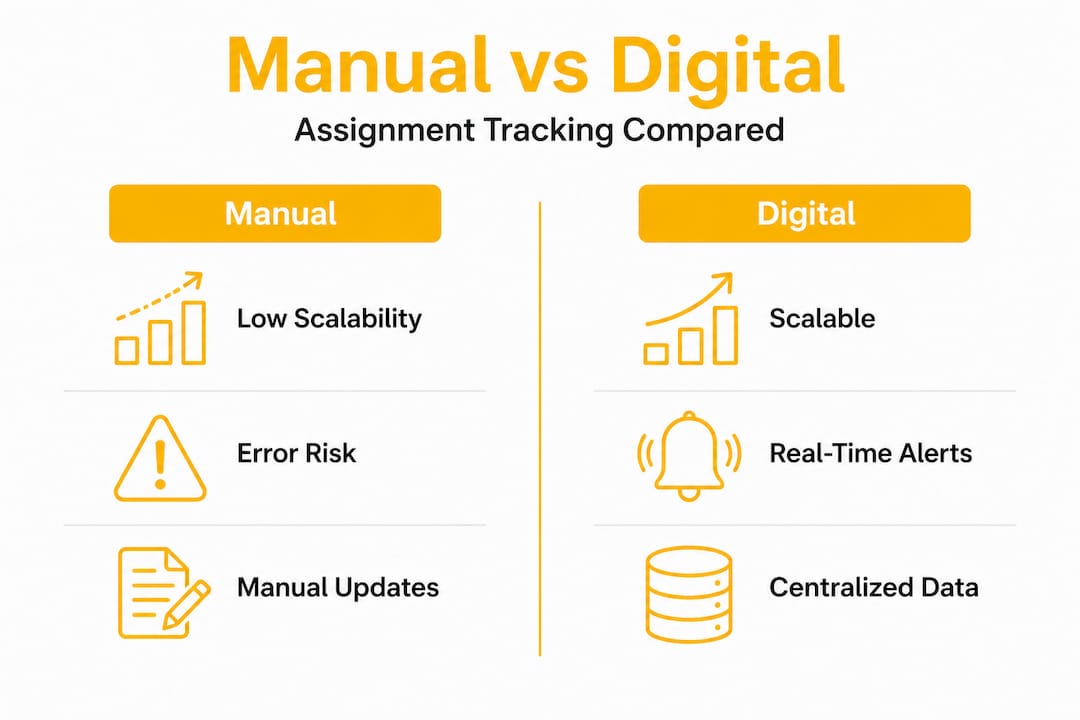
Digital platforms can reduce administrative work by up to 40% compared to manual tracking. For HR teams managing international mobility programs across multiple jurisdictions, that efficiency gain directly translates to fewer errors, faster response times, and lower operational costs.
Transitioning from manual to digital tracking does not need to be disruptive. Here is a structured approach:
- Audit your current process. Document every step your team currently takes to manage an assignment, from initiation to close. Identify where data lives, who owns it, and where gaps exist.
- Define your requirements. Determine what data points, workflows, and integrations your ideal system must support. Include input from HR coordinators, finance, legal, and IT.
- Evaluate platform options. Assess solutions based on functionality, scalability, vendor network, compliance coverage, and user experience. A digital mobility ecosystem should connect all stakeholders in one environment.
- Run a pilot program. Implement the platform with a subset of assignments before full rollout. Use this phase to refine workflows and train users.
- Migrate and standardize. Move historical data into the new system and establish data governance standards to maintain consistency going forward.
Effective assignment cost control is one of the most compelling arguments for digital platforms. When cost data is centralized and updated in real time, HR teams can flag budget variances early, compare actuals against projections, and build more accurate cost estimates for future assignments.
Global assignment tracking in action: Benefits and outcomes
So how does this translate to measurable impact for both your HR team and your relocating employees?
The practical benefits of structured assignment tracking extend well beyond administrative convenience. When implemented thoughtfully, tracking systems produce measurable improvements across three critical dimensions: employee experience, financial control, and regulatory compliance.
Employee experience improvements:
Relocating employees consistently report that uncertainty is one of the most stressful aspects of an international assignment. When they do not know the status of their visa application, when their housing arrangement will be confirmed, or what their tax obligations will look like, anxiety increases and productivity suffers. A well-implemented tracking system provides employees with direct visibility into their own assignment progress through self-service portals and mobile applications. This transparency reduces the volume of status inquiry calls to HR and gives assignees confidence that their relocation is being managed competently.
Mobility optimization tools also enable HR teams to deliver more personalized support. When all assignee data is centralized, coordinators can quickly identify which employees are approaching critical milestones and proactively reach out with guidance rather than waiting for issues to escalate.
Budget and cost control:
International assignments are expensive. A long-term expatriate assignment can cost two to three times the employee’s home country salary when housing, schooling, tax equalization, and relocation logistics are factored in. Without precise tracking, cost overruns are common and often discovered too late to course-correct. A centralized tracking system with integrated cost management capabilities gives finance and HR teams a clear view of committed and forecasted spend at any point in the assignment lifecycle.
Compliance risk reduction:
Regulatory requirements for internationally mobile employees vary significantly by country and can change with little notice. Tax residency rules, social security contribution obligations, work authorization requirements, and reporting deadlines all demand careful monitoring. Short-term assignment trends are also increasing the complexity of compliance, as frequent cross-border movement creates tax and immigration exposure that is easy to overlook without systematic tracking.
“Strategic assignment tracking enhances employee satisfaction and reduces compliance incidents.”
Pro Tip: Build a regular cadence of tracking data reviews into your mobility program governance. A monthly review of assignment status reports allows your team to identify patterns, spot recurring issues, and make policy adjustments before problems compound.
Best practices for implementing assignment tracking in multinational organizations
To put these concepts into practice, here’s how you can get started without getting overwhelmed.
Implementing an effective assignment tracking program requires more than selecting the right technology. Process design, data governance, and user adoption are equally important factors. Mobility compliance essentials depend on getting these foundational elements right from the start.
Step-by-step implementation guide:
- Establish data ownership. Assign clear responsibility for each category of assignment data. HR owns employee profile data; finance owns cost data; legal or immigration counsel owns permit and visa data. Ambiguity in data ownership is a primary cause of duplication and error.
- Standardize your data model. Define consistent naming conventions, date formats, and field definitions across all assignment records. Inconsistency in how data is entered makes reporting unreliable and audits painful.
- Integrate with existing HR systems. Your tracking platform should connect with your HRIS (Human Resources Information System), payroll, and expense management tools to eliminate manual data re-entry.
- Train all users thoroughly. System adoption fails when users do not understand how to use the platform or why it matters. Invest in role-specific training for HR coordinators, managers, and employees.
- Monitor and iterate. Treat your tracking program as a living process. Review system usage, data quality, and process adherence regularly, and adjust workflows based on what you learn.
Common pitfalls to avoid:
- Collecting data without a clear plan for how it will be used or reviewed
- Failing to update records when assignment parameters change mid-assignment
- Relying on a single person to maintain all tracking data, creating a single point of failure
- Underestimating the time required to migrate historical data from spreadsheets to a new platform
- Neglecting the employee-facing components of the tracking system
Clear data ownership, user training, and system integration are key factors in successful assignment tracking. Organizations that invest in these foundational elements consistently outperform those that focus exclusively on platform selection.
Pro Tip: Create a “tracking health scorecard” that measures data completeness, milestone adherence rates, and compliance incident frequency. Review this scorecard quarterly with your mobility program leadership to maintain accountability and drive continuous improvement.
The reality of assignment tracking: What most guides won’t tell you
Most articles on assignment tracking focus on the mechanics: what data to collect, which features to look for in a platform, and how to build a transition plan. That guidance is valuable, but it misses a more fundamental challenge that determines whether tracking programs actually deliver results.
Technology is a necessary condition for effective tracking. It is not a sufficient one. Organizations that invest in sophisticated platforms but fail to redesign their underlying processes and mindset around those tools often find themselves with an expensive system that is poorly adopted and underutilized. The spreadsheet habits persist. The data quality problems remain. The compliance risks continue.
The real value of efficient tracking insights lies not in the act of recording data, but in the organizational discipline to act on it consistently. This requires a shift in how HR leaders think about global mobility data. Tracking data should not be treated as a compliance record-keeping exercise. It is a strategic asset that can inform workforce planning, policy design, and employee experience investments.
Consider what becomes possible when you have clean, complete, longitudinal data across your entire assignment population. You can identify which assignment types generate the highest compliance risk. You can measure the correlation between relocation support quality and assignment success rates. You can model the cost implications of different policy scenarios before committing to them. You can spot early warning signs of assignment failure and intervene before a high-value employee decides to abandon the role.
Predictive analytics, built on a foundation of rigorous assignment tracking, represents the next frontier for global mobility programs. The organizations that invest in tracking discipline today are building the data infrastructure that will give them a genuine strategic advantage in workforce planning tomorrow. That is a more compelling argument for tracking investment than any compliance risk calculation.
Move from confusion to clarity with the right assignment tracking partner
Ready to transform how you handle international assignments? Here’s how xpath.global can help.
Managing international assignments across multiple countries, compliance frameworks, and vendor relationships is genuinely complex. The good news is that you do not have to build the solution from scratch.
xpath.global provides a unified global mobility platform designed specifically for HR teams in multinational organizations. From centralized case management and automated compliance tracking to a global marketplace of over 60,000 vetted mobility services, the platform gives your team the tools to manage every assignment with precision and confidence. Whether you are looking to select the right mobility technology for your program or need expert guidance on building a relocation program that actually works, xpath.global’s team of global mobility professionals is ready to support you. Connect with global mobility experts today to discuss your assignment tracking needs and explore how the platform can reduce your administrative burden while strengthening compliance across every jurisdiction you operate in.
Frequently asked questions
How does assignment tracking help with global compliance?
Assignment tracking centralizes documentation, ensures timely renewals, and provides real-time status visibility to prevent compliance lapses. As noted in global mobility best practices, tracking is central to ensuring compliance and employee well-being across borders.
What data should an assignment tracking system collect?
Critical data includes assignment duration, location, compliance paperwork, costs, and key milestones for each employee. Robust tracking systems also capture employee status, dependent information, and vendor coordination details to support end-to-end assignment management.
Can assignment tracking improve employee relocation experiences?
Yes, by reducing errors and providing faster, more transparent support throughout the relocation process. Strategic assignment tracking enhances employee satisfaction and measurably reduces the frequency of compliance incidents that disrupt assignee well-being.
How do I transition from manual to digital assignment tracking?
Start by mapping your current process, identify gaps, and pilot a digital platform with structured user training and support. Digital platforms reduce administrative work by up to 40% compared to manual tracking, making the transition a strong operational investment for growing mobility programs.