






TL;DR:
- Effective international relocation requires thorough planning, stakeholder coordination, and compliance management.
- Digital tools streamline workflows, increase accuracy, and enhance employee experience throughout the process.
- Most relocation failures stem from underestimated complexity, poor documentation, and neglecting employee feedback.
Managing an international employee relocation is one of the most operationally demanding tasks an HR team can face. Across immigration, tax compliance, housing logistics, and vendor coordination, a single missed step can trigger legal penalties, assignment delays, or a disengaged employee who questions the move entirely. Inadequate initial planning is a leading cause of relocation project delays, and the downstream effects compound quickly. This guide walks HR professionals and global mobility managers through every critical stage of an optimized international relocation workflow, from pre-assignment assessment through settling-in support, so your organization can move talent across borders with confidence, compliance, and efficiency.
Key Takeaways
| Point | Details |
|---|---|
| Preparation prevents delays | Upfront planning and checklists reduce costly mistakes and timeline overruns. |
| Compliance is continuous | Legal and tax requirements must be checked at every stage to avoid penalties. |
| Leverage technology | Digital tracking and automation save time and boost relocation accuracy. |
| Employee experience counts | Feedback loops and communication keep employees engaged and satisfied during moves. |
Assessing needs and preparing for international relocation
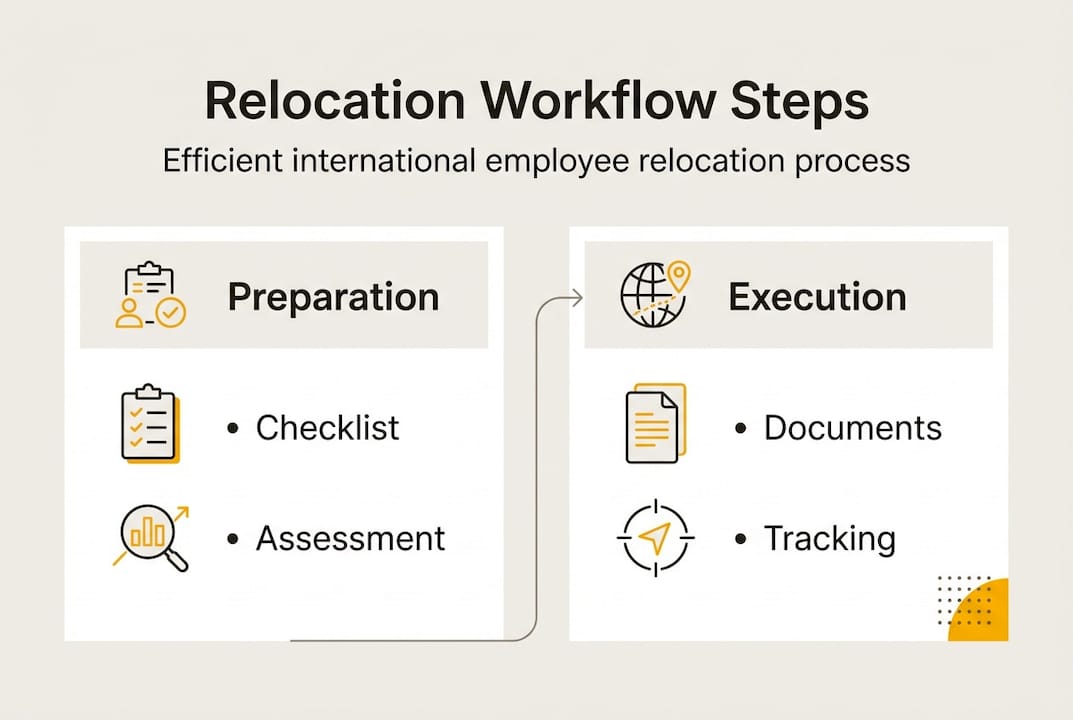
Every successful international relocation begins long before a visa application is filed or a moving truck is booked. The preparation phase is where most programs either build a strong foundation or set themselves up for costly missteps. Relocation program preparation is not a formality; it is the structural backbone of everything that follows.
Start by clearly defining the business objective for the relocation. What role will the employee fill in the host country? Is this a short-term project assignment, a long-term transfer, or a permanent move? The answers directly shape visa category selection, tax treatment, benefits eligibility, and the scope of support services required.
Once the assignment type is confirmed, identify every stakeholder who must be involved:
- HR and global mobility team: Policy application, documentation, and employee communication
- Legal and immigration counsel: Work permit eligibility, right-to-work verification, and host-country compliance
- Finance and payroll: Cost projections, tax equalization calculations, and split payroll arrangements
- The relocating employee and their family: Personal circumstances, dependent needs, and cultural readiness
- External vendors: Immigration firms, destination service providers, and moving companies
With stakeholders mapped, build a pre-relocation checklist that captures assignment details, required documentation, regulatory deadlines, and vendor engagement timelines. Applying global mobility planning rigor at this stage prevents the reactive scrambling that derails timelines later.
| Information category | Key data points to collect |
|---|---|
| Assignment details | Role, host location, start date, duration |
| Employee profile | Nationality, family status, existing visas |
| Immigration requirements | Visa type, permit processing time, sponsorship needs |
| Tax and payroll | Home and host tax obligations, social security treaties |
| Relocation support | Housing, schooling, language training, cultural orientation |
Following relocation best practices at this stage also means conducting a pre-assignment assessment for each employee. This assessment should flag personal risk factors such as medical needs, dependent school enrollment timelines, and any prior immigration history that could affect permit approval.
Pro Tip: Run a structured pre-assignment risk assessment at least 90 days before the planned start date. Identifying complications early, such as a dual-nationality issue or a country-specific permit backlog, gives your team time to adapt without jeopardizing the business timeline.
Step-by-step workflow: moving an employee internationally
Once your groundwork is solid, you are ready for a structured, step-by-step international move. Successful relocations rely on standardized, adaptable workflows that can flex to country-specific requirements without losing process integrity.
Here is a practical sequence that covers the full relocation lifecycle:
- Policy briefing: Present the employee with the full relocation package, including allowances, benefits, timelines, and expectations. Clarity at this stage prevents disputes later.
- Visa and work permit application: Engage immigration counsel to identify the correct permit category, compile required documentation, and submit applications within regulatory timelines.
- Tax and payroll setup: Establish split payroll if applicable, initiate tax equalization calculations, and confirm social security obligations under any applicable bilateral agreement.
- Housing and logistics coordination: Secure temporary housing in the host location, arrange household goods shipment, and confirm school enrollment for dependents if relevant.
- Home-country offboarding: Manage lease terminations, utility transfers, and any local deregistration requirements.
- Host-country onboarding: Coordinate local bank account setup, national registration, health insurance enrollment, and orientation services.
- Family relocation support: Arrange spousal career assistance, language training, and cultural orientation programs.
- Settling-in support: Provide ongoing check-ins during the first 90 days to address emerging issues before they affect assignment success.
For efficient assignment management, the difference between traditional and digital workflows is significant:
| Workflow stage | Traditional approach | Digital workflow |
|---|---|---|
| Document collection | Email chains, manual follow-up | Automated requests, centralized portal |
| Visa tracking | Spreadsheets, phone calls | Real-time status dashboards |
| Vendor coordination | Separate contracts, siloed updates | Unified platform with integrated providers |
| Compliance monitoring | Manual calendar reminders | Automated alerts and audit trails |
| Employee communication | Ad hoc emails | Structured in-app messaging and task lists |
Reviewing the international assignment process across industries confirms that organizations using structured digital workflows consistently report fewer delays and higher employee satisfaction scores.

Pro Tip: Integrate a digital task management tool that assigns ownership and deadlines to every workflow step. When each stakeholder knows exactly what they are responsible for and by when, handoff failures drop dramatically.
Ensuring compliance at every workflow stage
Compliance is not a checkpoint at the end of a relocation. It is an ongoing obligation that runs parallel to every stage of the workflow. Compliance oversights remain a top reason for global mobility program failures, and the consequences range from financial penalties to forced assignment terminations.
Map out your compliance obligations by stage:
- Pre-departure: Right-to-work verification, visa approval confirmation, tax residency status assessment
- During relocation: Payroll registration in the host country, social security enrollment, benefits plan alignment
- Post-arrival: Local registration with immigration authorities, ongoing permit renewal tracking, annual tax filing coordination
- Assignment end: Repatriation tax filing, permit cancellation, payroll deregistration in the host country
Country-specific differences add significant complexity. A transfer to Germany requires different social security documentation than one to Singapore or Brazil. Each jurisdiction has its own rules on payroll tax compliance, and assuming that a process that worked in one country will transfer cleanly to another is a common and costly mistake.
Regulatory reality: Organizations that fail to register employees correctly with host-country tax authorities can face back-tax assessments, interest charges, and in some jurisdictions, personal liability for the HR manager responsible for the filing. A single missed payroll registration in a high-scrutiny market can cost more than the entire relocation budget.
The data reinforces the urgency. Reviewing mobility risk management frameworks from leading advisory firms confirms that the majority of compliance failures in global mobility programs are preventable with structured checklists and regular internal audits.
Applying mobility best practices means building compliance checkpoints directly into your workflow calendar, not treating them as separate tasks. Assign a named owner to each compliance obligation, set automated reminders for renewal deadlines, and maintain a centralized audit log that documents every action taken.
Optimizing workflow: technology, tracking, and employee experience
Once your workflow is compliant, there is still meaningful room to improve its efficiency, scalability, and impact on the relocating employee. Digital relocation tools boost assignment tracking accuracy by up to 40%, a gain that translates directly into fewer missed deadlines and lower administrative overhead.
The right technology stack for a global mobility team typically includes:
- Assignment management platforms: Centralized case tracking, document storage, and milestone monitoring
- Compliance monitoring tools: Automated regulatory alerts, audit trails, and country-specific requirement libraries
- Vendor management portals: Integrated provider networks with transparent pricing and service delivery tracking
- Employee self-service apps: Mobile access to assignment status, document upload, and direct communication with HR
- Analytics dashboards: KPI tracking for time to onboard, cost per assignment, and employee satisfaction scores
Exploring mobility technology tools reveals that the most effective platforms are those that connect HR teams, employees, and vendors in a single environment rather than requiring users to toggle between multiple disconnected systems.
Employee feedback is an underused optimization resource. Most organizations collect satisfaction data at the end of an assignment, but by then the opportunity to fix in-flight problems has passed. Building structured feedback touchpoints at 30, 60, and 90 days post-arrival gives HR teams actionable data while the assignment is still active.
Key performance indicators worth tracking for every assignment include:
- Time from assignment approval to employee arrival in host country
- Cost per assignment versus budget projection
- Permit processing time by country and permit type
- Employee satisfaction score at 30 and 90 days post-arrival
- Number of compliance exceptions or missed deadlines per quarter
For organizations managing remote mobility programs, tracking these metrics across distributed assignment types adds another layer of complexity that only purpose-built platforms can reliably handle. Reviewing global mobility technology trends confirms that investment in assignment tracking and analytics is accelerating across industries as mobility volumes grow.
Pro Tip: Automate status update notifications to both HR stakeholders and the relocating employee at each workflow milestone. Transparency reduces anxiety, cuts inbound inquiry volume, and builds trust in your mobility program.
Why most relocation workflows fail—and how to fix it
After working through hundreds of international assignments, a clear pattern emerges in programs that struggle. The root cause is rarely a lack of intent. It is a persistent underestimation of process complexity combined with a reluctance to invest in the unglamorous work of documentation and workflow design.
Relocation success frequently hinges on unglamorous but thorough workflow documentation. Yet many organizations still rely on institutional memory held by one or two experienced mobility professionals. When those individuals leave, the program degrades rapidly.
A second common failure is selecting technology based on feature lists rather than operational fit. A platform with impressive dashboards that your team cannot integrate into daily workflows adds cost without adding value. Pragmatic, adaptable tools consistently outperform feature-rich but complex alternatives.
The third failure is neglecting the employee feedback loop entirely. HR teams optimize for compliance and cost, which are measurable and defensible. Employee experience, which is harder to quantify, gets deprioritized. But assignment failure rates, which carry enormous financial and reputational costs, are strongly correlated with poor employee experience during the first 90 days.
The fix is structural. Invest in documented, repeatable workflows. Choose tools your team will actually use. And run post-move debriefs with every relocating employee to surface the bottlenecks that never appear in your KPI reports. Addressing future mobility challenges starts with getting the fundamentals right today.
Enhance your relocation workflow with xpath.global
Building a compliant, efficient, and employee-centered international relocation workflow is achievable, but it requires the right infrastructure.
xpath.global provides HR and global mobility teams with a unified platform that covers every stage of the relocation lifecycle, from compliance tracking and assignment management to vendor coordination and employee self-service. With access to 60,000+ mobility services across 183 countries, your team gains the operational depth to manage any assignment type at scale. Whether you are comparing mobility platforms to replace a fragmented process or following a relocation steps guide to build your first structured workflow, xpath.global offers the tools and expertise to support your program. Connect with our HR experts to discuss your organization’s specific mobility needs.
Frequently asked questions
What tools are essential for managing an international relocation workflow?
Digital platforms for assignment tracking, documentation management, and compliance monitoring are vital for efficient relocations. Assignment tracking tools can improve tracking accuracy by up to 40%, directly reducing missed deadlines and administrative errors.
How can HR teams ensure compliance across different countries?
By mapping legal requirements for each host location, using structured compliance checklists, and leveraging platforms with built-in regulatory updates, HR teams can significantly reduce exposure. Compliance oversights remain a leading cause of global mobility program failures, making proactive monitoring essential.
What is the biggest risk during international employee moves?
Missed compliance steps or delayed documentation are the primary risks, often resulting in legal penalties or assignment disruptions. Inadequate planning at the outset is consistently identified as the leading driver of relocation project delays.
How can employee experience be improved during international relocations?
Structured communication, proactive settling-in support, and regular feedback touchpoints at 30, 60, and 90 days post-arrival are the most effective strategies. Thorough workflow documentation that includes employee-facing milestones ensures the experience side of relocation receives the same rigor as logistics and compliance.
Recommended
Previous article