











Italy Checklist: Sponsoring Highly Skilled Migrant Visas
Grab a copy of a guide to international employee relocation
View E-book
Managing international employee relocations involves countless moving parts, from immigration paperwork to housing logistics. Yet one aspect often flies under the radar until it becomes a crisis: expense tracking. Many HR and global mobility teams assume manual processes are sufficient, but manual expense report processing costs $20-58 per report, with error rates reaching 19-20% that demand an additional $52 per correction. These hidden costs compound quickly across global mobility programs managing hundreds of relocations annually. Automation transforms this landscape by slashing processing expenses, eliminating errors, and ensuring compliance across multiple tax jurisdictions. This guide reveals why automated expense tracking is essential for modern global mobility management and how to implement it effectively.
| Point | Details |
|---|---|
| Manual processing is expensive | Each manual expense report costs $20-58 to process, with 19-20% containing errors that require $52 corrections. |
| AI ensures tax compliance | Automated systems apply VAT, GST, and other jurisdiction-specific tax rules in real time using geolocation data. |
| Dramatic efficiency improvements | Organizations achieve 90% automation rates, 79% cost reductions, and 472% efficiency increases through automation. |
| Strategic implementation matters | Success requires cloud platforms with ERP integration, multi-level approvals, and continuous compliance training. |
| Compliance gains are substantial | Automated tracking delivers 55-90% improvements in policy adherence and regulatory compliance across global programs. |
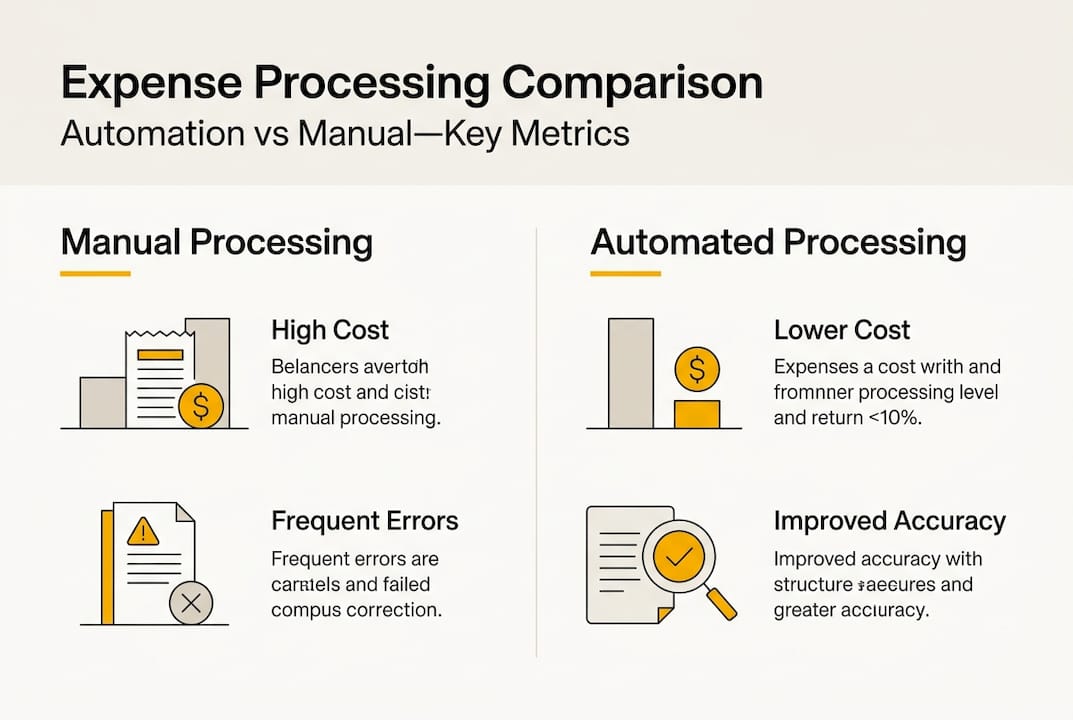
Every manual expense report your team processes carries a price tag most organizations never calculate. The administrative burden extends far beyond the obvious labor hours spent reviewing receipts and entering data. Manual expense report processing costs $20-58 per report, with 19-20% error rate costing additional $52 per correction, creating a compounding financial drain that automation eliminates entirely.

These figures become staggering when applied to global mobility programs managing dozens or hundreds of international assignments simultaneously. A company processing 500 expense reports monthly at the conservative estimate of $35 per report spends $210,000 annually on processing alone. Add error corrections for the 19-20% containing mistakes, and you’re looking at an additional $49,920 in annual waste. For expense tracking for HR teams overseeing complex international relocations, these costs multiply across multiple currencies, tax jurisdictions, and compliance requirements.
The consequences of manual processing extend beyond direct financial costs:
Pro Tip: Conduct a 90 day audit tracking actual time spent processing expense reports, error correction cycles, and compliance issues. Multiply these hours by loaded labor costs to reveal the true financial impact of manual processes before presenting automation proposals to leadership.
“Organizations processing expenses manually face error rates of 19-20%, with each correction adding $52 in additional processing costs on top of the initial $20-58 per report expense.”
| Metric | Manual Processing | Automated Processing |
|---|---|---|
| Cost per report | $20-58 | $6-12 |
| Error rate | 19-20% | 1-3% |
| Processing time | 20-45 minutes | 3-8 minutes |
| Correction cost | $52 per error | Minimal |
| Annual cost (500 reports/month) | $210,000+ | $60,000-80,000 |
Global mobility programs operate across a maze of tax regulations that vary dramatically by jurisdiction. VAT rates, GST requirements, deductibility rules, and reporting obligations change not just between countries but often between states, provinces, or municipalities. Manual tracking simply cannot keep pace with this complexity while maintaining accuracy. AI-powered automation enables real-time geolocation-based tax compliance across VAT, GST, and other jurisdiction-specific requirements, zero-touch reporting, and automated policy enforcement for global enterprises.
Modern AI systems analyze expense data the moment it’s captured, applying the correct tax treatment based on where the expense occurred, the nature of the purchase, and current regulations in that jurisdiction. When an employee relocating to Germany submits a meal receipt from Frankfurt, the system automatically applies the appropriate VAT rate, determines deductibility limits, and flags any policy violations. This happens in seconds without human intervention.
Zero-touch reporting represents the pinnacle of expense automation. Employees photograph receipts or use corporate cards, and the system handles everything else: categorization, tax calculation, policy checking, approval routing, and accounting integration. For global tax compliance solutions, this automation proves invaluable when managing assignees across dozens of countries simultaneously.
Key AI capabilities transforming global mobility expense management:
Policy enforcement becomes seamless rather than confrontational. Instead of finance teams manually reviewing every expense against company policy, the system prevents violations before they occur. When an employee attempts to submit a business class flight on a route where policy requires economy, the system flags it immediately with clear policy language and required approvals. This protects both the organization and the employee from inadvertent violations.
Pro Tip: Configure your AI expense system to provide real-time policy guidance as employees incur expenses, not just during submission. Mobile apps that show per diem limits and approved vendor categories before purchase prevent violations rather than catching them after the fact, improving both compliance and employee experience.
For organizations maintaining a secure compliance platform, AI-driven expense automation integrates seamlessly with broader compliance frameworks, creating unified visibility across immigration, tax, and financial compliance requirements.
The business case for expense automation rests on concrete, measurable outcomes that directly impact your bottom line and operational efficiency. Case studies show 90% automation rate, 79% cost reduction in processing, 472% efficiency increase, with 55-90% compliance gains documented across global and non-profit organizations implementing automated expense tracking systems.
These aren’t marginal improvements. A 79% reduction in processing costs transforms expense management from a significant overhead burden into a streamlined, value-adding function. The 472% efficiency increase means tasks that previously consumed hours now complete in minutes, freeing your global mobility team to focus on strategic initiatives rather than administrative drudgery.
Compliance improvements of 55-90% dramatically reduce audit risk and potential penalties. When every expense automatically adheres to tax regulations and company policy, you eliminate the exposure that keeps finance leaders awake at night. For tools for optimizing global mobility, automated expense tracking ranks among the highest ROI investments available.
| Benefit Category | Manual Process | Automated Process | Improvement |
|---|---|---|---|
| Automation rate | 10-20% | 90%+ | 450-800% increase |
| Processing cost per report | $35-58 | $6-12 | 79% reduction |
| Time per report | 30-45 min | 5-8 min | 472% efficiency gain |
| Policy compliance rate | 45-60% | 90-95% | 55-90% improvement |
| Error rate | 19-20% | 1-3% | 85-95% reduction |
Top benefits realized from expense automation:
These improvements compound over time as machine learning algorithms refine categorization accuracy and policy enforcement becomes more sophisticated. Organizations typically see ROI within 6-12 months, with benefits accelerating in subsequent years.
Pro Tip: Establish baseline KPIs before implementing automation, then track these metrics monthly for the first year. Document improvements in processing time, error rates, compliance scores, and employee satisfaction to build internal case studies that justify expanding automation to other finance functions and demonstrate value to leadership.
For teams focused on avoiding policy mistakes, automated expense tracking provides the consistency and enforcement mechanisms that prevent common pitfalls in global mobility program management.
Successful automation requires more than purchasing software. Strategic implementation ensures your system handles the unique complexities of global mobility while integrating seamlessly with existing processes. Cloud platforms with AI categorization, multi-level approvals, ERP integration, embedded jurisdiction-specific rules, and continuous training represent the methodology leading organizations follow.
Your implementation roadmap should follow these phases:
The customization phase deserves particular attention for global mobility applications. Your system must handle scenarios like split billing when assignments span multiple cost centers, tax treatment differences for permanent transfers versus temporary assignments, and currency conversion using appropriate rates for compliance reporting. Generic expense systems often struggle with these nuances.
Pro Tip: Embed local tax and legal rules directly into automated workflows rather than relying on post-processing corrections. Configure your system so expenses incurred in Germany automatically apply German VAT rules, French expenses follow French regulations, and so on. This prevents compliance issues rather than catching them after they occur.
Continuous adaptation is essential because tax regulations, company policies, and business needs evolve constantly. Schedule quarterly reviews of your expense automation configuration, updating rules to reflect regulatory changes, policy adjustments, and lessons learned from the previous period. This ongoing refinement ensures your system remains effective and compliant over time.
For organizations choosing global mobility technology, expense automation should integrate with your broader mobility platform rather than operating as an isolated system. Unified platforms provide better visibility, simpler administration, and more comprehensive compliance management.
Managing expenses across international relocations demands specialized expertise and technology designed specifically for global mobility complexity. xpath.global combines enterprise-grade automation with deep global mobility knowledge, helping HR teams and mobility managers eliminate manual expense tracking inefficiencies while ensuring compliance across every jurisdiction where your assignees operate.
Our unified platform integrates expense tracking with immigration management, tax compliance, vendor coordination, and assignment administration, giving you complete visibility and control over your global mobility program. Whether you’re managing a handful of international assignments or coordinating hundreds of relocations annually, xpath.global provides the global mobility solutions that transform operational chaos into strategic advantage.
Explore how choosing the right mobility technology can revolutionize your expense management and compliance processes. Visit xpath.global to discover tools, resources, and expertise that help forward-thinking global mobility teams build efficient, compliant, and employee-friendly programs. Whether you’re launching a new global mobility program or optimizing an existing one, we provide the technology and support you need to succeed.
Manual expense tracking costs $20-58 per report to process, with 19-20% containing errors that require an additional $52 each to correct. Beyond direct processing costs, organizations face delayed reimbursements that frustrate employees, inaccurate reporting that undermines budget forecasting, and compliance violations that expose the company to tax penalties and audit risks.
AI systems use geolocation and real-time data to automatically calculate taxes like VAT and GST based on where expenses occur, applying jurisdiction-specific rules without human intervention. Automated workflows simultaneously enforce company spending policies, flagging out-of-compliance expenses immediately and routing them for appropriate approvals before reimbursement, preventing violations rather than catching them after the fact.
Start by assessing your specific needs and choosing automation technology that integrates seamlessly with existing ERP and HRIS systems. Embed jurisdiction-specific tax rules and configure multi-level approval workflows that reflect your organizational hierarchy and policy requirements. Invest in comprehensive training for all stakeholders, from employees submitting expenses to finance teams managing approvals, and establish processes for continuous updates as regulations and policies evolve.
Most organizations achieve ROI within 6-12 months of implementing automated expense tracking, with benefits accelerating in subsequent years. The 79% reduction in processing costs and 472% efficiency improvements begin immediately upon deployment, while compliance gains and employee satisfaction improvements compound over time as the system learns and refines its accuracy.

Italy Checklist: Sponsoring Highly Skilled Migrant Visas
Grab a copy of a guide to international employee relocation
View E-book