






TL;DR:
- AI enhances global mobility by improving compliance, cost forecasting, and personalized employee experiences.
- It automates routine tasks, enabling faster, lower-risk, and more cost-effective international assignments.
- Combining AI with human expertise ensures better decision-making and employee support in mobility programs.
Global mobility programs now sit at the intersection of workforce strategy and operational risk. As multinationals expand into new markets and cross-border assignments multiply, HR teams find themselves managing an increasingly complex web of immigration requirements, tax obligations, and employee expectations with tools that were not designed for this scale. Organizations with evolved mobility programs are 1.8x more likely to drive business growth and 3.7x more likely to solve talent shortages. AI is the common thread connecting those high-performing programs, and this article explains precisely how it works, what it delivers, and how your team can adopt it.
Key Takeaways
| Point | Details |
|---|---|
| AI boosts mobility ROI | AI-driven programs optimize relocation, retention, and productivity for multinational companies. |
| Compliance made simple | AI automates documentation and regulatory checks, reducing risk for HR teams. |
| Hybrid models work best | Combining AI with human judgment delivers more efficient and employee-centric global mobility. |
| Start with high-impact integration | Adopt AI in admin-heavy areas and build from core processes outward for maximum results. |
Understanding global mobility: Modern challenges and demands
Global mobility, in its modern form, extends well beyond physically moving an employee from one country to another. It encompasses immigration case management, international tax compliance, social security coordination, cost forecasting, vendor oversight, and the ongoing employee experience across an entire assignment lifecycle. For HR teams in multinational organizations, this means managing dozens or hundreds of concurrent cases, each with its own regulatory environment and timeline.
The value of global mobility to a business is well established: it enables talent deployment where it is most needed, supports organizational growth, and builds leadership pipelines through international experience. Yet the operational burden is substantial. The most common pain points that mobility teams report include:
- Compliance fragmentation: Regulations differ by country, and they change frequently. Tracking these shifts manually across multiple jurisdictions is both time-consuming and error-prone.
- Cost overruns: Without accurate forecasting tools, mobility budgets frequently exceed projections. Containing costs remains one of the top priorities for mobility leaders.
- Speed to assignment: Business units expect fast deployment. Slow administrative processes create friction with internal stakeholders.
- Personalization gaps: Employees have different needs depending on family situation, seniority, and destination. One-size-fits-all relocation packages drive dissatisfaction and early assignment failures.
- Vendor fragmentation: Managing multiple immigration lawyers, tax advisors, and relocation firms without a centralized system leads to inconsistent service and poor visibility.
Traditional methods, primarily spreadsheets, email threads, and disconnected vendor portals, simply cannot keep pace with this level of complexity. The volume of data, the speed of regulatory change, and the expectation for personalization demand a fundamentally different approach. Programs that have made this shift toward data-driven, technology-enabled models are, as noted, significantly more likely to achieve both business growth and effective talent placement. The question is no longer whether to modernize, but how quickly and effectively you can make that transition.
The core ways AI is revolutionizing global mobility
With these challenges in mind, here is how AI reshapes the landscape for HR and mobility professionals.
AI’s impact on global mobility is not limited to a single function. It operates across the entire assignment lifecycle, from initial planning through repatriation. The table below summarizes the primary application areas:

| AI Application | Traditional Approach | AI-Enabled Outcome |
|---|---|---|
| Workforce planning | Manual headcount review | Predictive talent gap analysis |
| Cost forecasting | Static spreadsheet models | Dynamic, real-time cost projections |
| Relocation package design | Standardized tiers | Personalized, data-driven packages |
| Compliance monitoring | Periodic manual checks | Continuous automated alerts |
| ROI measurement | Basic cost tracking | Retention and productivity metrics |
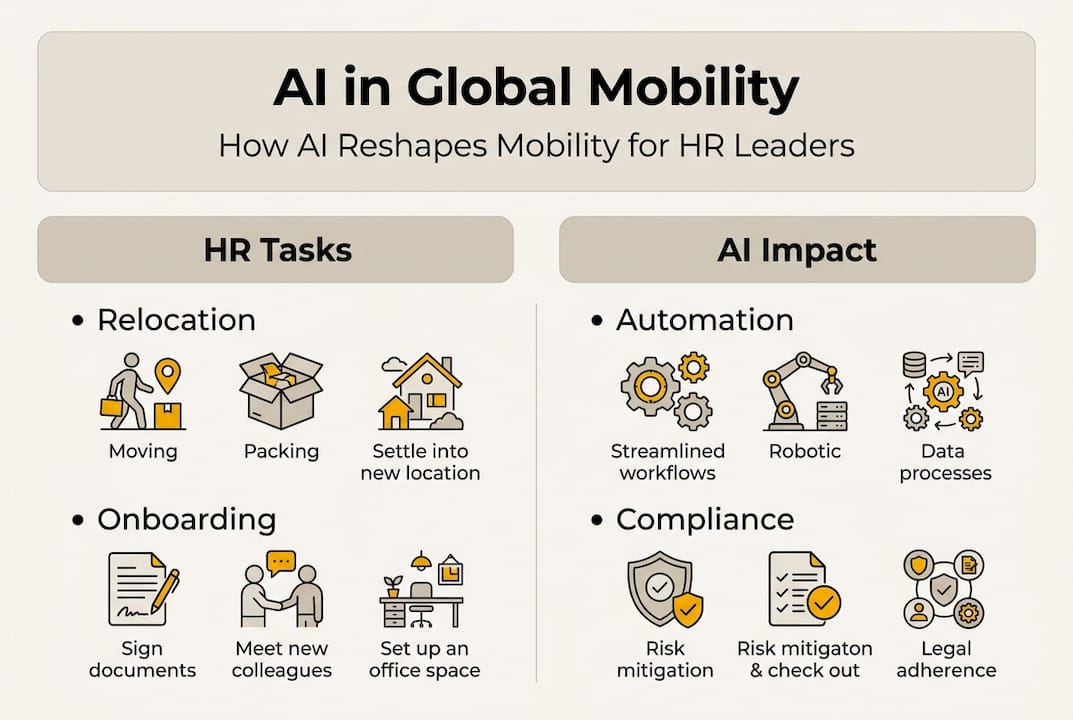
The rise of AI in HR has created opportunities that were not practical even five years ago. Here is how these capabilities translate into concrete advantages:
- Predictive workforce planning: AI analyzes historical assignment data, business unit growth patterns, and external labor market signals to identify where talent will be needed before the need becomes urgent. This allows mobility teams to prepare immigration pathways and vendor relationships in advance.
- Automated relocation management: Routine tasks such as document collection, deadline tracking, and vendor coordination are handled automatically, reducing the administrative load on HR staff.
- Personalized relocation packages: AI models assess employee profiles, family circumstances, and destination-specific data to recommend tailored benefit structures rather than rigid policy tiers.
- Multidimensional ROI measurement: Beyond cost-per-move, AI platforms now track time-to-productivity and retention rates, giving HR leaders a far more complete picture of program performance.
A reliable digital mobility ecosystem is the infrastructure that makes these capabilities operational at scale.
Pro Tip: Before selecting an AI-enabled mobility platform, audit your current data sources. AI tools are only as accurate as the data they process, so clean, structured assignment and cost data is the foundation of every subsequent benefit.
AI-powered compliance and risk management
Regulatory risk is where mobility programs face their most serious exposure. A missed work authorization deadline, an incorrectly filed tax form, or a failure to register for local social security can result in fines, reputational damage, or an employee being unable to work legally in their host country. These are not hypothetical risks. They occur regularly in organizations that rely on manual compliance workflows.
AI changes this equation in several important ways. Compare the two approaches directly:
| Compliance Task | Manual Process | AI-Driven Process |
|---|---|---|
| Document verification | HR reviews each file individually | Automated checks flag missing or expired documents |
| Regulatory change tracking | Periodic review of government updates | Continuous monitoring with real-time alerts |
| Audit trail creation | Manually logged emails and spreadsheets | Automatically generated, timestamped records |
| Deadline management | Calendar reminders set by HR | System-triggered notifications with escalation logic |
| Error rate | High due to volume and complexity | Significantly reduced through automation |
The xpath.global in-house compliance team model combines AI-powered monitoring with expert human review, which is critical because regulations are not always straightforward. AI handles the volume; specialists handle the interpretation.
For HR managers dealing with immigration compliance challenges across multiple jurisdictions, the shift from reactive to proactive compliance management is significant. Rather than discovering a compliance gap after an audit, AI systems surface risks before they materialize, providing time to correct course. This is particularly valuable in jurisdictions where regulations change with limited notice.
AI also accelerates onboarding for internationally mobile employees. Automated document collection, identity verification, and pre-arrival task management reduce the time between assignment approval and productive deployment. When you consider that cost forecasting and personalized packages are also AI-enabled, the combined effect is a mobility program that is faster, cheaper, and substantially lower-risk than its manual predecessor.
Pro Tip: Map your highest-risk compliance touchpoints, typically work permit renewals and tax filing deadlines, and prioritize those for AI automation first. Quick wins in high-risk areas build internal confidence in the technology and demonstrate ROI early.
Integrating AI into your global mobility strategy
After exploring compliance and automation, here is how to bring AI into practice in your own HR program. A structured integration approach is essential. Organizations that treat AI adoption as a technology project rather than a change management initiative consistently underperform.
- Define your integration roadmap. Identify which mobility functions will benefit most from AI, assign ownership across HR, IT, and finance stakeholders, and set realistic timelines. Avoid attempting to automate everything simultaneously.
- Invest in data quality. AI efficacy depends entirely on the quality of the data it processes. Audit existing case data, standardize vendor information, and establish data governance protocols before go-live.
- Adopt a hybrid model from the outset. AI handles data processing, document verification, deadline tracking, and reporting. Human mobility specialists manage exceptions, sensitive employee situations, and strategic decisions. This division produces better outcomes than full automation.
- Train your team to interpret AI outputs. Staff need to understand what the system is recommending and why, so they can exercise informed judgment rather than simply accepting algorithmic outputs.
- Measure multidimensional ROI. Track retention rates, time-to-productivity, compliance incident rates, and cost-per-move. These metrics provide a complete view of program performance that cost data alone cannot deliver.
“Prioritize hybrid AI-human models; invest in data quality and integration for AI efficacy; focus AI on administrative tasks to free humans for strategy and edge cases; measure multidimensional ROI including retention and productivity.” This framework for AI adoption reflects what high-performing mobility programs consistently apply.
The role of service provider digitalization also matters here. When your vendors operate within the same digital environment, data flows seamlessly and coordination costs drop. Choosing a platform that integrates vendor management with AI-driven workflows eliminates the handoff friction that often undermines otherwise well-designed programs.
Finally, connecting AI-enabled mobility to talent retention outcomes should be an explicit goal. Employees who receive personalized, well-managed relocation experiences are significantly more likely to complete their assignments successfully and remain with the organization afterward.
Why blending AI with human expertise outperforms automation alone
Most discussions of AI in global mobility focus on what the technology can do. Fewer address the conditions under which it falls short, and that is where the most important management decisions lie.
AI excels at processing structured data, identifying patterns, and executing rule-based tasks consistently at scale. It does not understand organizational politics, an employee’s reluctance to relocate for family reasons, or the nuances of a bilateral agreement that a local immigration specialist would immediately recognize. These situations require human judgment, and they arise in every mobility program.
Organizations that achieve the strongest results treat AI as infrastructure rather than as a decision-maker. They use AI to handle data, documentation, forecasting, and routine compliance tasks, while keeping experienced mobility professionals in the role of strategic advisor, exception handler, and employee advocate. The enhanced employee experience that drives retention and assignment success comes from that human layer, supported and informed by the intelligence that AI provides.
The practical implication is this: when building your mobility technology stack, design workflows that route routine tasks to automation and escalate complex or sensitive cases to specialists. Empower your team to question AI outputs when context demands it. The organizations that get this balance right consistently outperform those that either over-automate or fail to adopt AI at all.
Unlock world-class mobility with AI-driven solutions
xpath.global gives HR and global mobility teams the technology and expert support needed to put these principles into practice immediately.
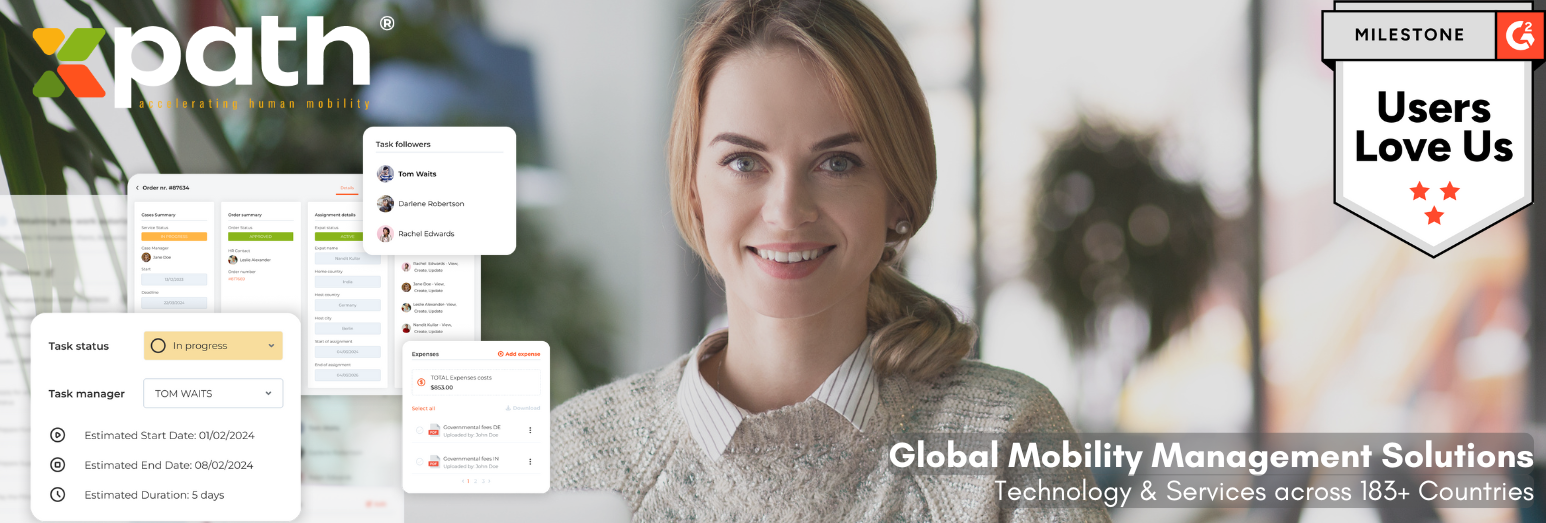
The platform combines AI-powered case management, compliance automation, and a marketplace of 60,000+ services across 183 countries, all within a single digital environment. Whether you are looking to redesign your mobility program from the ground up or add AI capabilities to an existing function, AI-powered mobility solutions are available to match your scale and complexity. Review relocation program best practices to benchmark your current approach, or contact our HR technology experts to discuss a tailored solution for your organization.
Frequently asked questions
What are the main benefits of using AI in global mobility?
AI enables predictive workforce planning, cost forecasting, and personalized relocation packages while giving HR teams measurable ROI metrics including time-to-productivity and retention rates. The combined effect is a faster, more cost-effective, and lower-risk mobility program.
How does AI help with international compliance risks?
AI continuously monitors regulatory changes, automates document verification, and generates audit trails, replacing error-prone manual processes with real-time alerts and structured workflows. This shifts compliance management from reactive to proactive across multiple jurisdictions simultaneously. AI cost forecasting tools also reduce budget exposure by surfacing financial risks before they escalate.
What is the best way to start integrating AI into my mobility program?
Begin by auditing your data quality and identifying the highest-risk or highest-volume compliance tasks as initial automation targets. Adopting a hybrid AI-human model from the start, with AI handling administration and humans managing strategy and exceptions, produces faster results and stronger stakeholder buy-in.
Is AI replacing HR jobs in mobility?
No. AI automates routine administrative tasks so that mobility professionals can redirect their time toward strategy, employee support, and complex case management. The hybrid AI-human approach consistently outperforms full automation because human judgment remains essential for exceptions, sensitive situations, and long-term program design.
Recommended
- Employee experience – how Global Mobility can enhance this
- Exploring the link between global mobility and retaining top talent
- AI Rise and Role in HR Business Processes – xpath.global
- How technology empowers smaller HR teams to manage complex global assignments. – xpath.global
- Employee Relocation | Shepherd International Movers
Previous article