






TL;DR:
- The best global mobility platforms in 2026 automate compliance, streamline workflows, and provide employee self-service tools.
- Leading solutions like xpath.global integrate immigration, taxation, and vendor management across multiple countries.
- Modern platforms offer measurable benefits such as reduced penalties, lower costs, and improved employee experience.
Global mobility software is far more than a digital filing cabinet for visa documents and relocation checklists. The best platforms in 2026 are actively reducing compliance penalties, cutting administrative overhead by automating multi-jurisdiction workflows, and giving employees self-service tools that accelerate productivity from day one. Modern platforms offer immigration, compliance, and analytics features that would have required entire teams to manage manually just a few years ago. This guide covers the must-have features, leading vendors, measurable business benefits, and critical workflow challenges that HR leaders and global mobility managers need to navigate as they evaluate and upgrade their technology stack for the year ahead.
Key Takeaways
| Point | Details |
|---|---|
| Essential features | Immigration management, automation, self-service, and integration are non-negotiable for effective mobility platforms in 2026. |
| Top platforms | Leading providers like Deel, Cartus, and SIRVA stand out for global coverage and advanced technology. |
| ROI and compliance | Sophisticated software delivers tangible ROI by reducing admin burden and regulatory risk. |
| Future trends | Unified, agile platforms outperform point solutions in an evolving HR and compliance landscape. |
Must-have features of global mobility software in 2026
Now that you’ve seen what’s possible, let’s break down the essential features driving top-rated global mobility platforms in 2026.
Immigration and visa management remains the non-negotiable baseline. Any platform worth evaluating must track visa expirations, permit renewals, and host-country work authorization requirements in real time. Without this foundation, every other capability is built on fragile ground. Automated compliance alerts sit directly on top of that foundation, notifying HR teams and employees when deadlines approach, regulations change, or documentation gaps emerge.
Employee self-service portals are no longer optional. Employees assigned abroad expect mobile access to their relocation status, document uploads, tax calendars, and service provider communications. Platforms that reduce admin work by shifting routine tasks to employees free up HR bandwidth for higher-value decisions.
Cost estimation and budgeting tools have matured significantly. Leading platforms now integrate cost-of-living data, tax equalization calculators, and vendor pricing directly into assignment planning, giving finance and HR teams the visibility they need before an offer letter is signed.
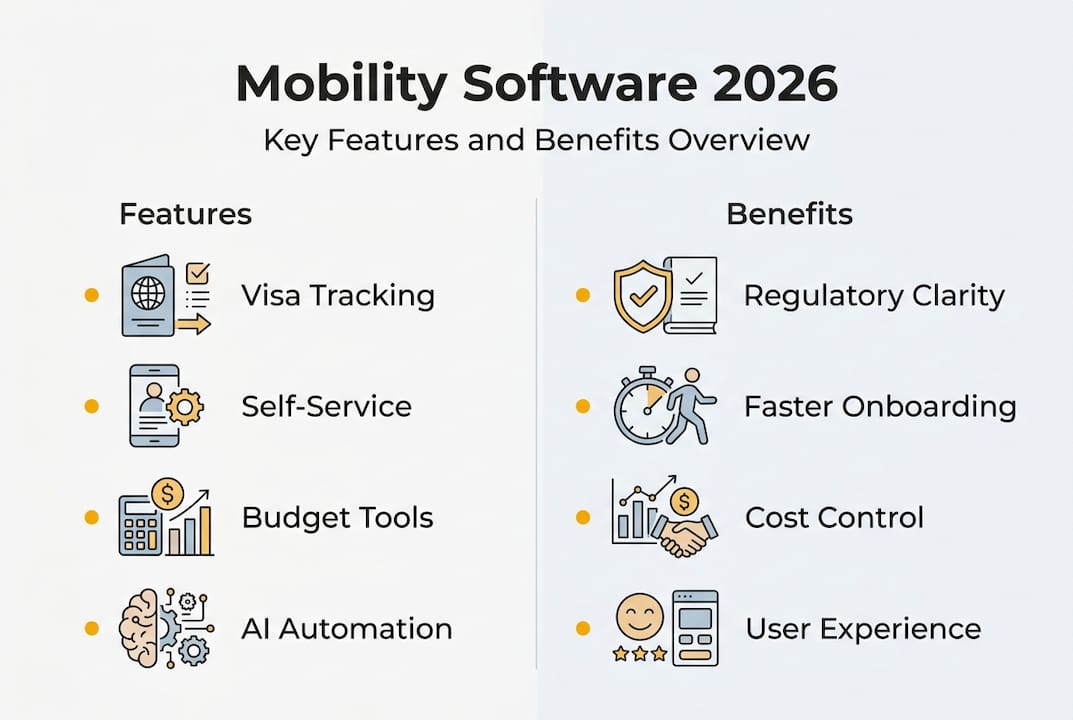
AI-driven automation is reshaping the operational layer. 43% of organizations use AI automation for administrative mobility tasks, and 62% plan new technology investments in the near term. Integration with HRIS, ERP, and payroll systems closes the data loop, ensuring that assignment changes propagate correctly across all downstream systems.
| Feature | Importance | Adoption rate |
|---|---|---|
| Immigration and visa tracking | Critical | High |
| Automated compliance alerts | Critical | Growing |
| Employee self-service portal | High | High |
| AI workflow automation | High | Moderate |
| HRIS and payroll integration | Critical | Moderate |
| Cost estimation and analytics | High | Growing |
| Mobile access | Moderate | High |
The advantages of cloud mobility platforms extend beyond convenience. Cloud delivery means faster updates to regulatory content, easier vendor ecosystem access, and lower IT overhead.

Pro Tip: When evaluating AI capabilities, ask vendors for specific examples of decisions the AI automates versus decisions it merely flags. Automation of routine administrative tasks delivers real time savings. AI that only surfaces data for human review adds a layer of complexity without reducing workload.
A unified mobility platform approach connects all these features in a single environment rather than requiring HR to switch between disparate tools, which is where many programs lose efficiency and introduce compliance gaps.
Leading global mobility platforms compared
With those must-have features in mind, let’s see how leading platforms stack up and which partners are shaping the mobility landscape in 2026.
Cartus, SIRVA, Deel Mobility, Phaedra, Xpath.global, and AltoVita are all recognized as 2026 leaders, each with distinct strengths suited to different program sizes and organizational needs.
Cartus holds an impressive 9.6 out of 10 rating and is recognized for its deep relocation management experience, extensive supplier network, and strong client service infrastructure. It suits large enterprises with complex, high-volume programs. SIRVA offers a comparable end-to-end model with strong global logistics capabilities and a broad international presence.
Deel Mobility focuses on the employer-of-record and contractor management angle, making it a strong fit for organizations with distributed workforces and rapidly changing headcount across multiple countries. Its compliance layer is built around payroll and employment law rather than traditional physical relocation.
Phaedra Solutions is a specialist in immigration case management, offering deep workflow automation for legal processes and strong integration options for firms where immigration volume is the primary driver.
AltoVita focuses on temporary corporate housing and accommodation, providing a curated marketplace for furnished rentals globally. It excels in the accommodation layer but is not a full-spectrum relocation platform.
xpath.global occupies a distinct position as an integrated ecosystem combining SaaS technology with direct vendor marketplace access across 183 countries. Its robust digital ecosystem covers immigration, tax, relocation logistics, and vendor coordination in one interface.
| Platform | Global reach | Primary strength | Best for |
|---|---|---|---|
| Cartus | Extensive | Full-service RMC | Large enterprise |
| SIRVA | Global | Logistics and RMC | Mid to large |
| Deel Mobility | 150+ countries | EOR and payroll | Distributed teams |
| Phaedra Solutions | Multi-region | Immigration workflows | Immigration-heavy |
| AltoVita | 150+ countries | Corporate housing | Accommodation focus |
| xpath.global | 183 countries | Unified ecosystem | All program sizes |
The digital marketplace advantages that platforms like xpath.global offer matter because direct vendor access reduces procurement friction and improves pricing transparency compared to traditional relocation management company models. A 2026 relocation platform guide confirms that integrated, all-in-one solutions consistently outperform point products when organizations prioritize compliance consistency and program scalability.
Key benefits: ROI, efficiency, and employee experience
Beyond the platforms themselves, what real-world results can you expect from implementing advanced global mobility solutions in 2026?
Mobility software streamlines compliance and boosts ROI while reducing the risk of regulatory penalties and improving the relocation experience for employees. Those are not marketing claims. They reflect measurable outcomes that organizations track when they move from spreadsheet-based programs to centralized platforms.
The most concrete benefits include:
- Reduced compliance penalties through automated monitoring of permit expirations, tax deadlines, and regulatory changes across multiple jurisdictions
- Lower administrative costs as workflow automation replaces manual data entry, email coordination, and document chasing
- Faster assignment initiation because standardized templates and pre-vetted vendor connections eliminate the startup lag on each new case
- Improved cost forecasting through integrated cost-of-living data, tax equalization tools, and real-time budget tracking
- Higher employee satisfaction as self-service portals give assignees visibility, control, and timely support throughout their relocation
Demonstrating ROI remains a persistent challenge for global mobility leaders. Many HR teams struggle to quantify the value of mobility programs because data is fragmented across multiple vendors and internal systems. A centralized platform aggregates that data, making it possible to report on cost per assignment, compliance incidents avoided, and average time-to-productivity for relocated employees.
“Organizations that streamline workflows with integrated mobility platforms gain not just operational efficiency, but the analytics foundation needed to demonstrate strategic value to executive stakeholders.”
Employee self-service tools cut ramp-up time meaningfully. When employees can track their own relocation progress, access housing resources, and manage documentation without waiting for HR responses, they arrive at their destination more prepared and less stressed. That translates directly to faster productivity and lower assignment failure rates.
Pro Tip: Before selecting a platform, map your current mobility workflow end to end and identify every compliance penalty or near-miss from the past two years. Use that data as your baseline. Platforms that address your specific key compliance challenges will show the clearest ROI from day one.
Critical workflows, compliance, and integration challenges
To unlock these benefits, you need to understand where global mobility workflows succeed or fail, especially as compliance and integration challenges intensify.
The full mobility lifecycle follows a clear sequence that many organizations still manage inconsistently:
- Policy and program design including assignment type, benefits structure, and eligibility criteria
- Pre-departure compliance covering immigration applications, work authorization, and risk assessments
- Tax and payroll setup including shadow payroll, tax equalization, and social security treaty analysis
- Logistics coordination covering housing, schooling, moving services, and destination support
- Ongoing monitoring of visa status, tax filing deadlines, and regulatory changes throughout the assignment
- Repatriation planning to ensure the returning employee’s payroll, benefits, and role are correctly restored
Integration with core HR, ERP, and payroll systems is where many implementations stall. Data silos between the mobility platform and the HRIS mean that assignment changes do not flow automatically to compensation calculations or headcount reporting. Establishing clean API connections at the outset prevents these gaps from compounding over time.
Edge-case compliance risks are growing more significant in 2026:
- Business travel compliance: Short-term business trips can create unexpected tax obligations or social security exposure if not tracked systematically
- Permanent establishment risk from remote and hybrid work: Employees working remotely from a foreign country can inadvertently create a taxable presence for the employer, a risk explored in detail through remote work tax risks
- AI Act and governance factors: Platforms operating in the EU must now account for AI governance requirements, adding a new compliance dimension to technology selection
Addressing immigration compliance challenges before an assignment begins is far less costly than resolving violations after the fact. According to 2026 mobility trend analysis, permanent establishment risk and AI governance are two of the four most consequential trends reshaping strategy and risk management this year.
Pro Tip: If your workforce includes employees in hybrid or remote arrangements across borders, conduct a permanent establishment risk audit before your next platform selection. Build that audit into your requirements document so vendors must demonstrate how their platform tracks remote work locations and flags jurisdictional exposure automatically.
The real future of global mobility: Integration and agility over point solutions
After unpacking critical workflows and edge cases, it’s time for an honest assessment of which strategies really work in today’s evolving global mobility landscape.
Most HR teams over-invest in specialized point solutions, accumulating separate tools for immigration, tax, housing, and vendor management, and then wonder why their data is fragmented and their compliance posture is reactive. The answer is not more tools. It is fewer, better-integrated ones.
Employee experience is not a soft metric. It is a compliance and productivity engine. Assignees who are poorly supported disengage faster, and disengaged assignees cut corners on documentation and compliance reporting. Platforms that prioritize self-service and real-time communication reduce that risk structurally.
Prioritizing integrated platforms over point solutions produces unified compliance visibility and a better user experience, and that combination is increasingly non-negotiable as AI governance requirements and remote work tax risks add new layers of complexity. Agility matters more in 2026 than exhaustive customization. A platform that adapts quickly to regulatory changes across jurisdictions will outperform a highly customized but slow-moving solution. The integrated ecosystem model is not just convenient. It is the architecture best suited to a compliance environment that changes faster than most customization cycles can keep pace with.
Next steps: Choosing the right solution for your organization
Ready to put these strategies into action? Let’s connect the dots between what you need and the right partner to help deliver measurable results.
Selecting the right global mobility platform requires more than a feature checklist. It demands a clear understanding of your program’s current gaps, integration requirements, and compliance risk profile. Start by reviewing guidance on choosing the right global mobility technology to frame your evaluation criteria before engaging vendors.
xpath.global’s unified platform combines SaaS technology, a global vendor marketplace, and expert consulting to support programs of every size across 183 countries. Whether you are scaling an existing program or building compliance infrastructure from the ground up, connect with mobility experts at xpath.global for a tailored consultation. You can also explore practical guidance on how to master employee relocation steps for a seamless operational foundation.
Frequently asked questions
What key features should global mobility software have in 2026?
Modern mobility platforms must include automated immigration and compliance tracking, real-time analytics, employee self-service portals, and AI-driven workflow automation to meet the demands of international programs in 2026.
How does global mobility software improve compliance?
Centralized tracking and automated alerts reduce regulatory risk by flagging permit expirations, deadline conflicts, and documentation gaps before they become violations, lowering the likelihood of costly penalties.
Which platforms are leaders in global mobility software for 2026?
Deel Mobility, Cartus, SIRVA, Phaedra, AltoVita, and xpath.global are all recognized leaders, each offering distinct strengths across relocation management, immigration, corporate housing, and unified ecosystem capabilities.
What edge-case compliance challenges do HR leaders face?
Business travel, remote work PE risks, and AI governance factors are among the most demanding edge cases in 2026, requiring platforms that can track jurisdictional exposure and adapt to rapidly evolving regulatory frameworks.
Recommended
- International mobility benefits: 42% of firms reviewed in 2026
- 6 advantages of using a digital marketplace for global mobility services
- Strategies For Managing Employee Benefits Across Borders – xpath.global
- The Essential Role of Global Mobility Software – xpath.global
- Benefits of localisation for global business growth
Previous article