






TL;DR:
- Effective international mobility procurement requires strategic RFQ and RFP processes tailored to complexity and goals.
- Proper preparation of policies, spend data, and stakeholder alignment is crucial before issuing procurement documents.
- Focusing on service quality and compliance in vendor evaluation improves employee retention and program success.
Managing international employee mobility requires more than operational know-how. It demands a procurement strategy that can stand up to regulatory complexity, cross-border compliance obligations, and the growing relocation market now valued at $5.42 billion and expanding at a 7.1% CAGR. Yet many HR and global mobility teams approach supplier selection without a structured process, leaving programs vulnerable to cost overruns, compliance gaps, and poor vendor fit. This guide walks through the RFQ (Request for Quote) and RFP (Request for Proposal) process specifically for international mobility programs, providing the frameworks, checklists, and strategic insight you need to make procurement work in your favor.
Key Takeaways
| Point | Details |
|---|---|
| Know RFQ vs. RFP | Choose the right process based on service complexity and supplier evaluation needs. |
| Preparation drives success | Gathering the right data, policies, and compliance requirements is crucial before contacting vendors. |
| Follow a stepwise approach | Executing a clear process from drafting to post-selection review minimizes errors and maximizes fit. |
| Stay flexible and compliant | Adapt your process for risk, compliance, and unique mobility needs—avoid rigidity for best outcomes. |
Understanding RFQs and RFPs for global mobility programs
With the foundation set, it is vital to clarify what RFQs and RFPs actually are and why they matter for mobility program success.
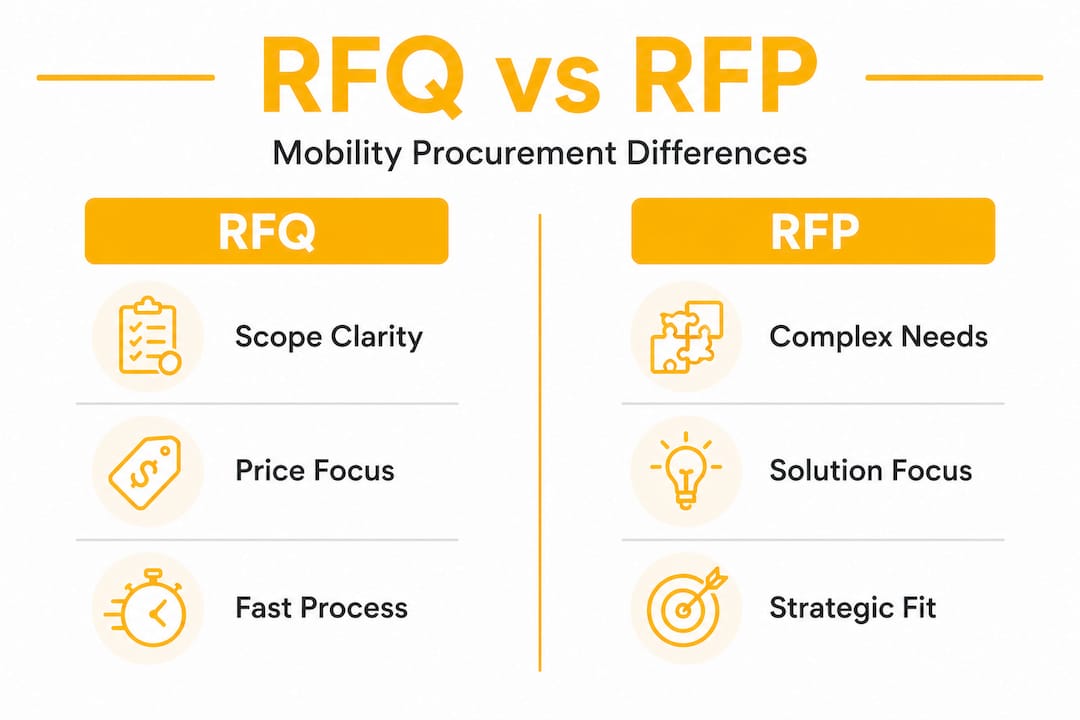
An RFQ, or Request for Quote, is a procurement document issued when the scope of services is well defined and the primary evaluation factor is price. In a mobility context, this typically applies to standardized relocation services such as household goods shipping, temporary housing sourcing, or visa filing for a specific destination market. The buyer knows exactly what is needed and wants to compare costs across a shortlist of qualified suppliers.
An RFP, or Request for Proposal, is a more sophisticated instrument. It invites potential vendors to propose solutions, not just prices, for complex or customized requirements. In global mobility, RFPs are appropriate when you are selecting a relocation management company (RMC), a global immigration provider, or a technology platform to manage your entire assignment lifecycle. The evaluation weighs service design, compliance capability, technology infrastructure, and cultural fit alongside pricing.
One widely underestimated challenge is that procurement unfamiliarity with mobility can significantly hinder program effectiveness. Procurement professionals skilled in IT or facilities procurement may not appreciate the nuances of tax equalization policy, immigration compliance timelines, or assignment allowance structures. This knowledge gap often produces RFP documents that are too generic to generate genuinely differentiated supplier responses.
Organizations investing in digital RFQ and RFP systems specifically built for mobility gain a significant structural advantage, because those tools encode mobility-specific evaluation criteria from the outset.
When to use each document:
- Use an RFQ when scope is clearly defined, volume is predictable, and price is the dominant variable
- Use an RFP when requirements are complex, customization is needed, or vendor methodology matters as much as cost
- Use an RFQ for specific point services: household goods, destination orientation, or airport transfers
- Use an RFP for program-level vendor selection: RMC, immigration counsel, assignment management technology
- Use an RFP when evaluating providers across multiple jurisdictions with varying compliance requirements
RFQ vs. RFP comparison for global mobility services:
| Factor | RFQ | RFP |
|---|---|---|
| Scope clarity | High, well defined | Moderate to complex |
| Primary evaluation criterion | Price | Solution, capability, and price |
| Appropriate use case | Transactional services | Strategic vendor partnerships |
| Response format | Standardized pricing table | Narrative proposal with pricing |
| Typical timeline | 2 to 4 weeks | 6 to 12 weeks |
| Stakeholder involvement | Procurement and mobility lead | Cross-functional committee |
| Risk of poor outcome | Moderate | High if poorly structured |
Preparing to launch your RFQ/RFP: Key prerequisites and materials
Once you know which process to use, preparation is the factor that most reliably determines success. Here is what every well-run RFQ/RFP needs before you contact a single supplier.
Internal preparation begins with documenting your current mobility policy in precise terms. Suppliers cannot propose appropriate solutions if they are working from vague or incomplete policy descriptions. You need to articulate service tiers by assignment type, benefit categories, cost thresholds, and exception handling protocols before the document goes out.
Spending data is equally critical. You must know your current annual relocation spend by category, service type, and geography. Without this baseline, you cannot set realistic cost benchmarks, evaluate supplier pricing accurately, or identify where consolidation opportunities exist.
Stakeholder alignment is not optional. Finance must approve the budget parameters you intend to signal to the market. Legal must confirm what compliance certifications and data handling standards you require. Tax needs to weigh in on social security contribution obligations and bilateral agreement considerations. Mobility leaders must define the operational requirements and employee experience standards that any incoming vendor must meet.
Geopolitical risks require robust risk protocols and GDPR compliance provisions to be explicitly addressed in your RFP documentation. Failure to embed risk management criteria at this stage regularly results in contract gaps that become expensive problems during program delivery.
A useful starting point is conducting a mobility compliance checklist review before you launch, ensuring your own program is fully mapped before asking vendors to respond to it. You can also draw on established mobility compliance strategies to identify areas where current program gaps might influence what you require from a new vendor.
Typical RFQ/RFP prerequisites:
| Prerequisite | Details required | Owner |
|---|---|---|
| Mobility policy documentation | Current tiers, benefits, exceptions | Global mobility lead |
| Annual spend data by category | Last 2 to 3 years by service type | Finance and mobility |
| Vendor evaluation criteria | Weighting by category | Cross-functional committee |
| Compliance requirements | GDPR, immigration, data security | Legal and tax |
| Employee volume projections | By destination and assignment type | HR analytics |
| Risk management protocols | Geopolitical and supply chain risk | Risk and legal |
Key internal documents to prepare:
- Current mobility policy and assignment framework
- Historical spend reports segmented by service and geography
- Approved vendor evaluation scoring matrix
- Data security and GDPR compliance requirements
- List of prioritized destination countries and volumes
Pro Tip: Before issuing any RFP, conduct an internal alignment session with every decision-making stakeholder. RFPs that launch without true executive commitment often stall during vendor selection because new objections emerge late in the process. A signed-off internal brief before distribution prevents this.
Step-by-step guide: Executing an RFQ or RFP for employee relocation
With all materials in hand, you are ready to run the RFQ/RFP. Here is how to put it into action with confidence and structure.
The most common failure point in mobility procurement is a poorly drafted requirements section. Vague language like “competitive pricing” or “global coverage” invites equally vague supplier responses, making meaningful comparison impossible. Every requirement should be specific, measurable, and linked to a defined mobility program objective.
Following the steps for seamless global relocation is itself a form of process discipline. The same logic applies to procurement: structure, sequence, and clarity drive better results than improvisation.
Step-by-step RFQ/RFP execution workflow:
-
Define objectives. Document what you are trying to achieve: cost reduction, compliance improvement, vendor consolidation, technology integration, or program expansion. Objectives drive every subsequent decision.
-
Draft the RFQ/RFP document. Structure the document with an introduction, scope of services, mandatory requirements, evaluation criteria, response format, timeline, and terms and conditions. Use consistent formatting to make supplier comparison manageable.
-
Conduct a supplier pre-qualification review. Before distributing the document, screen potential respondents against baseline criteria including financial stability, jurisdictional coverage, certifications, and reference availability.
-
Distribute the document. Send to a shortlisted group of qualified suppliers, typically four to six for an RFQ and three to five for a full RFP. A larger pool rarely improves outcomes and significantly increases evaluation workload.
-
Manage the Q&A period. Issue all supplier questions and your responses in writing to all participating vendors simultaneously. This preserves fairness and prevents information asymmetry from distorting proposals.
-
Receive and normalize responses. Once submissions arrive, standardize data into a comparable format. Pricing structures often vary significantly between vendors, requiring careful normalization before meaningful comparison is possible.
-
Score proposals against the evaluation matrix. Apply predetermined weightings to each evaluation category. Involve a cross-functional committee rather than a single decision-maker to reduce bias.
-
Conduct finalist presentations. Invite top-scoring vendors to present in person or via video. Use structured questions to probe compliance capability, account management approach, and technology integration.
-
Conduct reference checks and compliance verification. Speak directly with current clients in comparable industries and geographies. Verify all compliance certifications independently.
-
Select and notify vendors. Communicate decisions promptly to all participants, providing brief feedback to unsuccessful vendors. This preserves market relationships and supports your reputation as a fair procurement partner.
Research confirms that 65% of relocated employees who receive strong support report high satisfaction, and 72% remain with the organization for more than two years. This retention value must be factored into vendor evaluation, because a lower-cost provider that delivers a poor employee experience generates turnover costs that far exceed any fee savings.

Following proven relocation workflow tips at each stage ensures your process remains structured and outcome-focused throughout the vendor selection cycle.
Rigid processes favor conformity over best fit. Scoring systems that penalize creative proposals or non-standard formatting can systematically eliminate the most innovative and capable vendors from consideration.
Pro Tip: Build a structured “compliance response” section into every RFP, requiring vendors to describe how they manage immigration compliance, data protection, and cross-border tax obligations. This section alone will reveal significant differences in vendor maturity and capability.
Common pitfalls and advanced tips for a robust procurement process
After execution, the final hurdle is avoiding known mistakes and raising your procurement standards to an advanced level.
The most frequently observed failure modes in global mobility procurement follow predictable patterns. Recognizing them in advance allows you to design them out of your process before they cause damage.
Top mobility procurement mistakes to avoid:
- Issuing vague or incomplete service specifications that prevent accurate or comparable vendor responses
- Failing to weight compliance and risk management criteria heavily enough in the evaluation matrix
- Treating price as the dominant evaluation factor without adequately measuring service delivery capability
- Launching an RFP without genuine organizational intent to change vendors, which wastes supplier resources and damages market credibility
- Neglecting to verify supplier claims through independent reference checks and compliance documentation review
- Omitting GDPR and data security requirements, particularly when employee personal data will be processed in multiple jurisdictions
- Failing to define escalation protocols for geopolitical disruptions, immigration policy changes, or natural disasters affecting assignment destinations
Compliance warning: In an international RFP context, omitting robust data protection and GDPR provisions is not merely an administrative oversight. It constitutes a material compliance risk. Any vendor processing employee data across borders must demonstrate adherence to applicable data protection frameworks. Contracts that fail to specify these obligations expose organizations to regulatory penalties and reputational damage.
Edge cases including geopolitical risks, process rigidity, compliance gaps, and fake RFPs collectively represent the most common causes of wasted procurement resources in the mobility industry.
Post-selection, the work is not finished. Build a formal onboarding and performance review framework into every vendor contract. Establish KPIs (key performance indicators) covering case processing timelines, employee satisfaction scores, compliance audit results, and cost variance against projections. Review these metrics quarterly and include formal annual strategic reviews.
Investing in smarter mobility procurement practices pays measurable dividends in program quality, compliance assurance, and cost predictability. Organizations that systematize vendor performance feedback loops make significantly better procurement decisions in subsequent cycles.
Embedding continuous improvement into the process is not optional for programs operating at scale. After each RFQ/RFP cycle concludes, conduct a structured debrief covering what evaluation criteria proved most predictive, where supplier responses were strongest or weakest, and how internal stakeholders rated the process experience. These findings directly inform relocation best practices for the next procurement round.
Pro Tip: After vendor selection, issue a brief anonymous survey to all participating suppliers asking how they experienced your RFP process. The responses reveal whether your documentation was clear, your timeline was realistic, and your evaluation criteria were transparent. Suppliers who feel respected are more competitive and innovative in future rounds.
Why most mobility RFPs miss the mark—and what actually works
The standard RFP playbook for global mobility procurement was largely written by procurement generalists, not mobility specialists. And that fundamental mismatch still shapes how most programs select vendors today.
Conventional RFPs prioritize conformity: standardized response templates, rigid scoring rubrics, and price-weighted evaluation matrices that systematically disadvantage innovative providers in favor of established but often mediocre incumbents. The result is procurement processes that perpetuate the status quo rather than elevating program performance.
What makes this particularly problematic in mobility is that the stakes extend beyond cost. A poorly selected immigration provider can jeopardize work authorization timelines, create visa compliance exposure, and damage employee relations in high-value talent populations. A relocation management company that wins on price but underdelivers on service directly contributes to assignment failure and attrition.
Fake or compliance-driven RFPs waste resources on a significant scale. When organizations issue RFPs without genuine intent to change providers, they signal to the market that their procurement process lacks credibility. Over time, the best vendors deprioritize these opportunities, and program quality suffers as a result.
What actually works is a procurement approach built on strategic intent rather than process compliance. The most effective mobility RFPs are those where the organization has done the internal work first, defined what genuine program success looks like, and structured evaluation criteria that reward meaningful capability rather than polished documentation.
The emphasis on boosting employee satisfaction through high-quality service selection is not a soft consideration. It is a measurable business outcome. Organizations that select vendors based on demonstrated service quality rather than lowest cost consistently report stronger retention metrics and lower assignment failure rates.
Procurement success in global mobility ultimately comes from treating the process as a strategic exercise rather than an administrative one. That means allocating adequate internal resources, building evaluation committees with genuine mobility expertise, and approaching vendor dialogue as a collaborative discovery process rather than a one-way examination.
Ready to transform your global mobility procurement?
A well-structured RFQ/RFP process is one of the most powerful levers HR and mobility teams have for improving program quality, controlling costs, and managing compliance risk. But building that capability from scratch, while managing ongoing mobility operations, is genuinely demanding.

xpath.global is built specifically to support this challenge. From global mobility technology solutions that centralize vendor management and compliance workflows to a marketplace of more than 60,000 vetted services across 183 countries, the platform gives HR teams the infrastructure they need to optimize your relocation process at every stage of the procurement cycle. Whether you are running your first formal RFP or redesigning an existing vendor selection framework, the xpath.global team brings deep mobility expertise and proven technology to every engagement. To explore how the platform supports smarter procurement outcomes, connect with HR mobility experts today.
Frequently asked questions
What is the main difference between an RFQ and an RFP in mobility procurement?
An RFQ requests price quotes for clearly defined services, while an RFP solicits both proposals and pricing for more complex or custom mobility solutions. Since procurement unfamiliarity with mobility can hinder program effectiveness, understanding when to use each instrument is a foundational skill for mobility leaders.
How do you ensure compliance and security in an international RFQ/RFP?
Incorporate robust risk assessment, GDPR compliance, and clear supplier vetting protocols at every process stage. Because geopolitical risks require robust risk protocols, these provisions must be embedded in the RFP document itself rather than addressed only during contract negotiation.
What are common mistakes to avoid during the RFQ/RFP process?
Avoid vague requirements, rigid process rules, and issuing RFPs without true intent or executive buy-in. Fake and compliance-driven RFPs waste significant organizational and supplier resources while reducing program credibility in the vendor marketplace.
How does a better RFQ/RFP process impact employee retention?
Well-run procurement improves relocation support quality, which directly drives satisfaction and organizational loyalty. Data shows that 65% employee satisfaction with relocation support translates to 72% of relocated employees remaining with the organization for more than two years, making vendor quality a measurable retention driver.
Recommended
Previous article