






TL;DR:
- Global mobility budgeting involves many variable costs that can easily cause budgets to exceed projections if overlooked. Proper collaboration among HR, Finance, Tax, and vendors, supported by technology, is essential for accurate and compliant budgets. A structured, repeatable process with continuous monitoring and post-assignment analysis enhances cost control and organizational accountability in international mobility programs.
International assignments regularly exceed their approved budgets, not because HR professionals fail to plan, but because global mobility budgeting involves dozens of interdependent variables that change across jurisdictions, tax regimes, and assignment lifecycles. A single overlooked item, whether it is shadow payroll obligations, family relocation costs, or currency fluctuation adjustments, can turn a well-structured program into a financial liability. This guide delivers a practical, sequential framework that HR and global mobility managers can use to build accurate budgets, maintain compliance, and drive continuous improvement across their international assignment programs.
Key Takeaways
| Point | Details |
|---|---|
| Budgeting risks | Missing key budget items or compliance checks drives up costs and can harm global assignments. |
| Collaboration is key | Cross-functional teams must work together for accurate and compliant budgets. |
| Process matters | A structured budgeting framework reduces surprises and helps manage relocations smoothly. |
| Continuous improvement | Regular review and lessons learned from past assignments enable better forecasting and outcomes. |
| Use the right tools | Technology platforms make it easier to track and control global mobility expenses. |
The financial risks of poor global mobility budgeting
The consequences of inadequate budgeting extend well beyond a single line item on a balance sheet. Failed assignments, compliance penalties, and vendor overcharges are among the most direct financial impacts, but the indirect costs are equally damaging and often harder to quantify.
When budgets are underprepared, organizations frequently encounter:
- Unexpected tax liabilities, including host-country income tax obligations, social security contributions, and tax equalization (a mechanism that ensures assignees pay neither more nor less tax than they would at home) adjustments that were never factored into the original estimate
- Vendor overcharges from unvetted relocation service providers operating without transparent pricing
- Failed assignment costs, which include repatriation expenses, replacement recruitment, and productivity loss that can total two to three times the original assignment cost
- Compliance violations resulting from missed filing deadlines, improper work authorization, or payroll structure errors
“Poor budgeting increases risk of compliance violations and unnecessary spend, exposing organizations to regulatory penalties and reputational harm.”
The indirect costs compound the picture further. Employee dissatisfaction arising from poorly managed relocations contributes to early assignment termination, which BGRS data consistently identifies as one of the most expensive outcomes in global mobility. Productivity losses during transition periods, combined with brand risk when employers are perceived as disorganized in their relocation programs, make the business case for structured budgeting impossible to ignore.
Organizations that implement cost containment policies early in the program design phase consistently outperform those that retrofit financial controls after problems emerge. The connection between proactive budget governance and reduced program risk is direct. Companies using digital solutions for budget overruns report measurably improved forecasting accuracy and lower variance rates compared to those relying on manual processes.
A structured approach to budgeting does not merely reduce costs. It builds organizational accountability, creates audit trails, and provides leadership with the visibility they need to approve and support international mobility investments with confidence.
Essential requirements for global mobility budgeting
Before any budget is built, the right inputs, stakeholders, and tools must be in place. Attempting to construct a global mobility budget without complete data is one of the most common and costly mistakes organizations make.
Building accurate budgets requires input from HR, Finance, Tax, and vendors, and each function contributes distinct information that cannot be substituted or approximated.
Key data inputs
The following categories of information are required before any budget line can be confidently established:
| Data category | Details required |
|---|---|
| Assignment parameters | Duration, location, assignment type, employee grade |
| Compensation package | Base salary, allowances, bonuses, equity treatment |
| Tax obligations | Host and home country tax rules, equalization approach |
| Relocation costs | Moving services, temporary housing, destination support |
| Vendor fees | Immigration counsel, tax advisors, relocation providers |
| Exchange rates | Current rates and hedging assumptions |
| Benefits and allowances | Housing, schooling, cost-of-living adjustments |
Stakeholder alignment
Cross-functional collaboration is not optional. HR manages policy and employee experience, Finance controls budget approval and forecasting, Tax advises on cross-border compliance structures, Payroll handles shadow payroll and split payroll requirements, and external vendors provide market pricing for services. When any one of these groups operates in isolation, budget gaps are almost certain to appear.
Pro Tip: Establish a standing global mobility budget committee that meets at least quarterly, with representatives from HR, Finance, Tax, and Payroll. This single structural change eliminates many of the communication failures that cause budget variances.
Technology also plays a foundational role. Mobility optimization tools allow teams to consolidate vendor data, run cost projections, and monitor real-time assignment spend. Dedicated expense tracking for HR platforms further ensure that individual transaction records align with approved budget categories, making variance analysis faster and more reliable.
Step-by-step budgeting process for global mobility
A phased, structured approach to budgeting reduces variability and improves predictability across assignment portfolios. The following six-step process provides a repeatable framework that scales from single assignments to complex multi-jurisdictional programs.
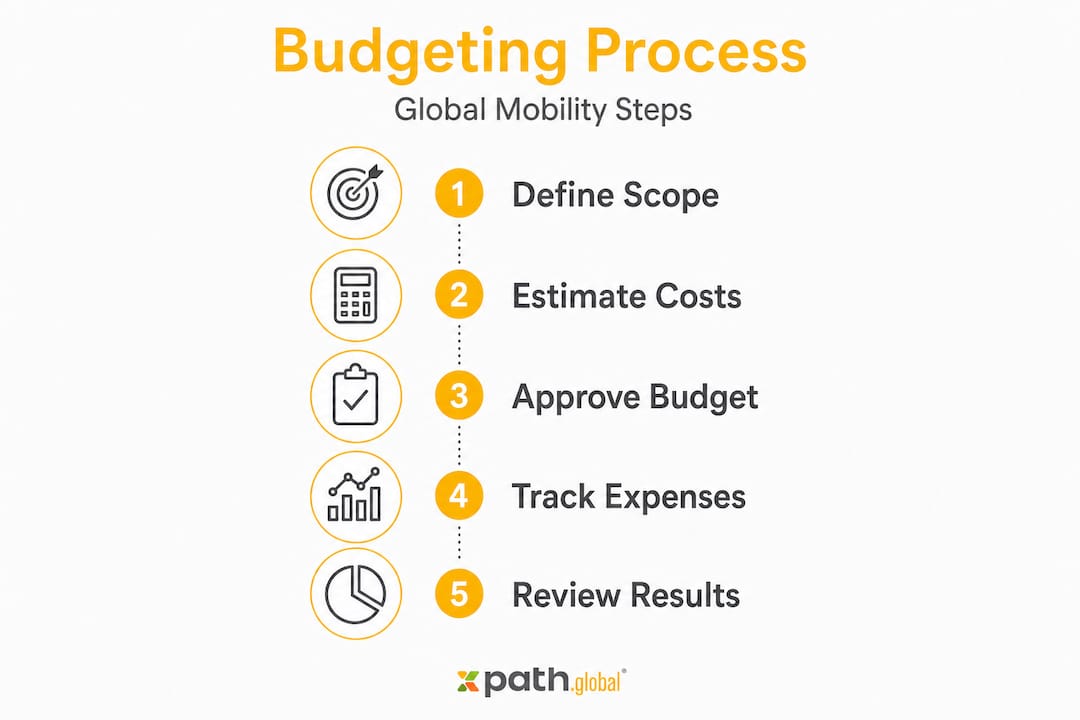
Step 1: Define assignment scope and parameters
Start by documenting the full scope of the assignment. This includes the employee’s home and host locations, expected assignment duration, job level, family situation (number of dependents being relocated), and the type of assignment, whether it is a long-term assignment, short-term assignment, or permanent transfer. Each of these variables directly affects every subsequent cost estimate.
Step 2: Gather cost estimates by category
Request formal quotes from all vendors involved in the assignment. Do not use previous assignment costs as proxies without first verifying that market conditions have not changed. Tax advisors should provide preliminary estimates of host-country tax liability, social security obligations, and any bilateral tax treaty (a formal agreement between two countries governing how income is taxed across borders) implications.
Step 3: Build the budget using defined categories
Structure the budget around standard categories to ensure comparability across assignments:
- Relocation costs: Moving, temporary housing, destination services, school search
- Tax costs: Tax equalization estimates, host-country filing fees, advisor fees
- Compensation adjustments: Cost-of-living allowances, housing allowances, hardship premiums
- Immigration costs: Visa fees, work permit applications, legal counsel
- Ongoing assignment costs: Monthly allowances, home leave travel, benefits continuation
- Contingency reserve: Typically 10 to 15 percent of total estimated costs
Step 4: Review, approve, and adjust
Submit the draft budget for review by Finance and Tax before final approval. Build in at least one formal revision cycle to capture items that emerge during stakeholder review. Approval authority levels should be clearly defined in the mobility policy to avoid bottlenecks.

Step 5: Monitor and track throughout the assignment
Use automated tracking for mobility budgets to capture expenses in real time as the assignment progresses. Monthly variance analysis, comparing actual spend against budget by category, surfaces issues before they become unmanageable. A well-designed expense tracking tutorial can help HR teams configure these systems for maximum accuracy.
Step 6: Conduct post-assignment review
After each assignment concludes, compare the final actuals against the original approved budget. Document the key sources of variance and feed those findings back into future budgeting templates. Effective management of international assignments depends on this continuous feedback loop.
| Budget phase | Key action | Responsible party |
|---|---|---|
| Scoping | Define assignment parameters | HR / Mobility Manager |
| Estimation | Gather vendor and tax quotes | HR, Tax, Vendors |
| Construction | Build categorized budget | HR, Finance |
| Approval | Review and sign off | Finance, Leadership |
| Monitoring | Track actuals and variances | HR, Payroll |
| Post-review | Analyze outcomes, update templates | HR, Finance, Tax |
Pro Tip: Create a standardized budget template that is preloaded with your most common assignment destinations and cost structures. This dramatically reduces the time required to build each new budget and ensures consistency across your program.
Avoiding common pitfalls in global mobility budgeting
Even experienced global mobility teams encounter recurring problems. Recognizing the most frequent mistakes, and building deliberate controls to prevent them, is what separates reactive programs from high-performing ones.
Common mistakes include underestimating local costs and missing hidden expenses, both of which erode budget accuracy and strain vendor relationships over time.
The most impactful pitfalls to address include:
- Failing to account for full tax and compliance costs: Organizations routinely budget for the tax advisor fee but not for the actual tax liability differential or gross-up (additional compensation paid to offset tax burden). These figures can be multiples larger.
- Overlooking dependent-related expenses: Spouse career support, school enrollment fees, childcare, and dependent travel frequently appear as budget surprises when families relocate.
- Inaccurate cost-of-living adjustments: Using outdated index data or applying home-country adjustment assumptions to significantly different host markets creates structural underfunding.
- Skipping the post-assignment review: Without retrospective analysis, teams repeat the same estimation errors across successive assignments.
- Insufficient vendor benchmarking: Relying on a single provider without periodic market comparisons leads to cost inflation over time.
Preventing these pitfalls requires three structural interventions: cross-departmental alignment through formal governance, vendor benchmarking conducted at least annually, and variance analysis embedded as a standard operating procedure rather than an ad hoc activity.
Reviewing policy mistake patterns in global mobility provides a useful framework for identifying where your current process is most vulnerable. Organizations that follow strategic budgeting advice frameworks also tend to build stronger contingency structures, ensuring that unexpected costs are absorbed without disrupting the overall mobility program.
Pro Tip: Build a “lessons learned” log after every assignment. Even a simple spreadsheet tracking which budget categories were most frequently over or under can identify systemic issues within two to three assignment cycles.
Measuring success and continuously improving your mobility budget
Accurate budgeting is not a one-time event. It is an iterative capability that improves with every assignment if the right measurement structures are in place. Organizations that treat post-assignment analysis as optional will consistently underperform those that make it a program standard.
Post-assignment analysis and data-driven KPIs are key to ongoing improvement, providing the factual basis for policy updates, vendor negotiations, and resource planning.
Effective global mobility programs track the following metrics:
- Budget variance rate: The percentage difference between approved budget and actual final cost, measured by category and in aggregate
- Assignment success rate: The proportion of assignments completed as planned, without early termination or significant scope change
- Cost per assignment by type: Enables benchmarking across assignment categories and geographies
- Compliance incident rate: Tracks the frequency of compliance-related issues, such as missed filings, permit delays, or tax penalty exposure
- Vendor performance scores: Assesses service quality and pricing accuracy from each provider relationship
Regular interdepartmental review meetings, held at least quarterly, ensure that these metrics translate into actionable decisions rather than passive reporting. Technology platforms that consolidate expense data, compliance status, and assignment progress into a single reporting environment give leadership real-time visibility into program health.
Closing the feedback loop, ensuring that findings from the measurement process directly inform the next budget cycle, is what drives year-on-year improvement. Teams that invest in tracking mobility budgeting metrics systematically build institutional knowledge that reduces risk and improves cost predictability with each successive program year.
The underestimated value of budgeting discipline in global mobility
There is a perspective worth stating plainly, one that does not always surface in technical guides: the real value of disciplined global mobility budgeting is not primarily in the numbers themselves. It is in the organizational behavior that rigorous budgeting demands.
When HR, Finance, Tax, and Payroll are required to collaborate formally on every assignment budget, something important happens. Information silos dissolve. Assumptions get tested. Accountability becomes visible. The process of building a budget, when done with discipline, surfaces policy gaps, vendor performance issues, and compliance risks that would otherwise remain invisible until they become expensive problems.
Teams that treat budgeting discipline as a strategic practice rather than an administrative necessity consistently report stronger assignment success rates and higher stakeholder confidence in the mobility function. They also find it easier to secure budget approvals, because leadership trusts the rigor behind the numbers.
The organizations that struggle most with global mobility costs are rarely those with the most complex programs. They are the ones where the budgeting process is informal, inconsistent, or siloed. Process maturity, not headcount or technology spend alone, is the decisive variable in long-term global mobility program performance.
How xpath.global helps HR leaders master global mobility budgeting
Managing global mobility budgets across multiple jurisdictions, vendors, and assignment types demands more than spreadsheet discipline. It requires a platform built specifically for the task.

xpath.global brings together cost projection tools, automated expense tracking, vendor management, and compliance monitoring in a single platform designed for global mobility teams. Whether you are managing five assignments or five hundred, the platform provides the financial visibility and process control your team needs to budget accurately and respond quickly when conditions change. HR leaders looking to strengthen their mobility programs can connect with global mobility experts for a personalized consultation, explore the competitive advantages built into the platform, or review how xpath.global supports mobility for remote work environments.
Frequently asked questions
What are the main cost drivers for global mobility budgets?
Assignment costs and compensation are the largest components, with relocation expenses, housing, tax obligations, and ongoing allowances contributing significantly to total program spend.
How can HR ensure compliance while budgeting for international assignments?
HR should align with Tax and Legal teams, use dedicated compliance tracking tools, and regularly update policies based on changing regulations, since compliance requires ongoing tracking and integrated policy management rather than a static, one-time review.
What technology tools are recommended for managing global mobility expenses?
Expense tracking platforms are vital for real-time budget monitoring, and when combined with integrated mobility management systems, they provide end-to-end financial visibility across all active assignments.
How often should mobility budgets be reviewed and updated?
Mobility budgets should be reviewed quarterly and adjusted whenever assignment conditions or regulatory environments change, as regular review and adjustment ensures that budget assumptions remain aligned with actual market and compliance realities.
Who should be involved in the global mobility budgeting process?
Multi-departmental collaboration improves budget accuracy, meaning HR, Finance, Tax, Payroll, and external service vendors should all contribute to assembling and validating assignment budgets.