






TL;DR:
- Fragmented HR systems cause compliance gaps and inefficiencies in global mobility management.
- Unified HR platforms consolidate workflows, data, and compliance, reducing admin burden by up to 70%.
- Hybrid models combine centralized governance with specialized tools to manage complex international employee relocations effectively.
Managing international employee relocations across disconnected systems is one of the most underestimated operational risks in global HR. Many enterprises run an average of five separate HR tools simultaneously, each generating its own data sets, workflows, and compliance gaps. The result is a fragmented environment where payroll teams miss tax deadlines, immigration files fall through the cracks, and mobility managers spend more time reconciling spreadsheets than managing assignees. A unified HR platform eliminates this structural chaos by consolidating workforce management, compliance, relocation, and payroll into a single, orchestrated ecosystem. This guide explains what unified platforms are, why they outperform fragmented stacks in global mobility, and what to evaluate when selecting the right solution.
Key Takeaways
| Point | Details |
|---|---|
| Centralize HR operations | Unifying HR systems streamlines compliance, reporting, and employee experience globally. |
| Reduce admin burden | HR leaders can save 40-70% in administrative overhead by using unified platforms. |
| Support global mobility | A single HR platform makes managing payroll, relocation, and regulations across countries far easier. |
| Balance innovation and control | Hybrid models blend unified cores with specialized modules for effective yet agile global HR. |
What is a unified HR platform?
A unified HR platform is a centralized technology environment that brings together the full spectrum of workforce management functions, including payroll, benefits, compliance tracking, immigration, relocation, and workforce analytics, within a single system of record. Rather than relying on multiple vendors that loosely integrate via APIs, a unified platform maintains consistent data governance and shared workflows across every HR function.
The contrast with a multi-vendor or best-of-breed environment is significant. In a fragmented setup, an organization might use one system for global payroll, a second for immigration case management, a third for relocation logistics, and a fourth for tax equalization. Each tool operates with its own data model, user access controls, and reporting logic. Integration between these systems requires custom middleware, ongoing maintenance, and careful reconciliation. When one vendor updates its API or changes a data field, downstream systems can break silently.
Unified HR platforms avoid this fragility by design. Key features that define a mature unified platform include:
- Workflow automation across HR, payroll, and mobility functions without manual handoffs
- Real-time data synchronization that eliminates duplicate data entry and version conflicts
- Cross-border compliance modules with jurisdiction-specific rule sets for immigration, tax, and social security
- Single sign-on access for HR administrators, employees, and external service providers
- Agentic AI capabilities that proactively surface compliance risks, recommend actions, and automate routine tasks
- Native global payroll with country-specific regulatory modules built in, not bolted on
Understanding the key HR platform benefits helps organizations make more informed architecture decisions before committing to a vendor. According to Forrester, unified platforms reduce admin burden by 40 to 70 percent and provide scalable compliance at enterprise scale.
Pro Tip: When evaluating vendors, prioritize platforms with native global payroll and regulatory modules built for edge-case market entry scenarios. A platform that handles Germany’s Lohnsteuer or Brazil’s eSocial natively will save significant configuration and compliance effort when entering new markets.
Exploring a unified mobility ecosystem gives HR leaders a clearer picture of what a truly integrated environment looks like in practice.
Why unified platforms excel for global mobility
Global mobility is where fragmentation causes the most acute damage. A single international assignment touches payroll, immigration, tax equalization, relocation logistics, social security contributions, and bilateral agreement compliance, often across two or more jurisdictions simultaneously. No single specialist can track all of these variables manually without errors at scale.

Unified HR platforms handle this complexity by consolidating every cross-border function under one governance layer. Payroll runs are reconciled against assignment records. Immigration milestones trigger tax planning workflows. Relocation vendor invoices are matched against approved cost projections in real time. The result is a mobility program that operates with far greater precision and far less manual coordination.
The evidence supports this outcome clearly. Research shows unified platforms reduce admin burden by 40 to 70 percent and enable predictive workforce planning at scale. For high-growth organizations managing frequent relocations across multiple jurisdictions, that efficiency gain translates directly into faster assignment deployment and lower total program costs.
| Capability | Unified HR platform | Fragmented multi-tool stack |
|---|---|---|
| Payroll and compliance sync | Real-time, native | Manual reconciliation required |
| Immigration case tracking | Integrated workflows | Separate system, separate login |
| Tax equalization management | Built-in calculators | External tool or spreadsheet |
| Vendor coordination | Centralized marketplace | Email and manual contracts |
| Reporting and analytics | Unified dashboard | Siloed reports per tool |
| Compliance updates | Automatic rule updates | Manual patches per vendor |
For organizations entering new markets rapidly, mobility platforms improve efficiency by replacing ad hoc coordination with structured, automated processes. Following relocation program best practices is significantly easier when the platform itself enforces consistency through built-in workflows.
Pro Tip: When deploying assignees into a new market for the first time, prioritize platforms with agentic AI and extensible service marketplaces. These capabilities accelerate “first-90-day” compliance by automatically surfacing required registrations, tax filings, and permit timelines before your team even asks.
The shift toward unified global mobility technology reflects a broader recognition that compliance and agility cannot coexist in a fragmented system.
Unified vs. best-of-breed: Pros, cons, and the rise of hybrid models
The debate between unified and best-of-breed HR technology is well established, but it has grown more nuanced as hybrid models have emerged. Understanding the genuine trade-offs helps HR leaders make architecture decisions that align with their organization’s growth trajectory.
Gartner research indicates that large enterprises operate an average of five HR systems per organization. Each integration point adds cost, maintenance burden, and latency. When a payroll system does not receive a timely update from an immigration case management tool, the organization may run payroll on stale assignment data, creating both financial and compliance exposure.
| Factor | Unified platform | Best-of-breed stack |
|---|---|---|
| Integration complexity | Low | High |
| Compliance consistency | Strong | Variable by vendor |
| Specialization depth | Moderate | High per category |
| Total cost of ownership | Predictable | Often higher due to integration |
| Implementation speed | Faster | Slower, phased by tool |
| Innovation velocity | Platform-dependent | Higher per specialized tool |
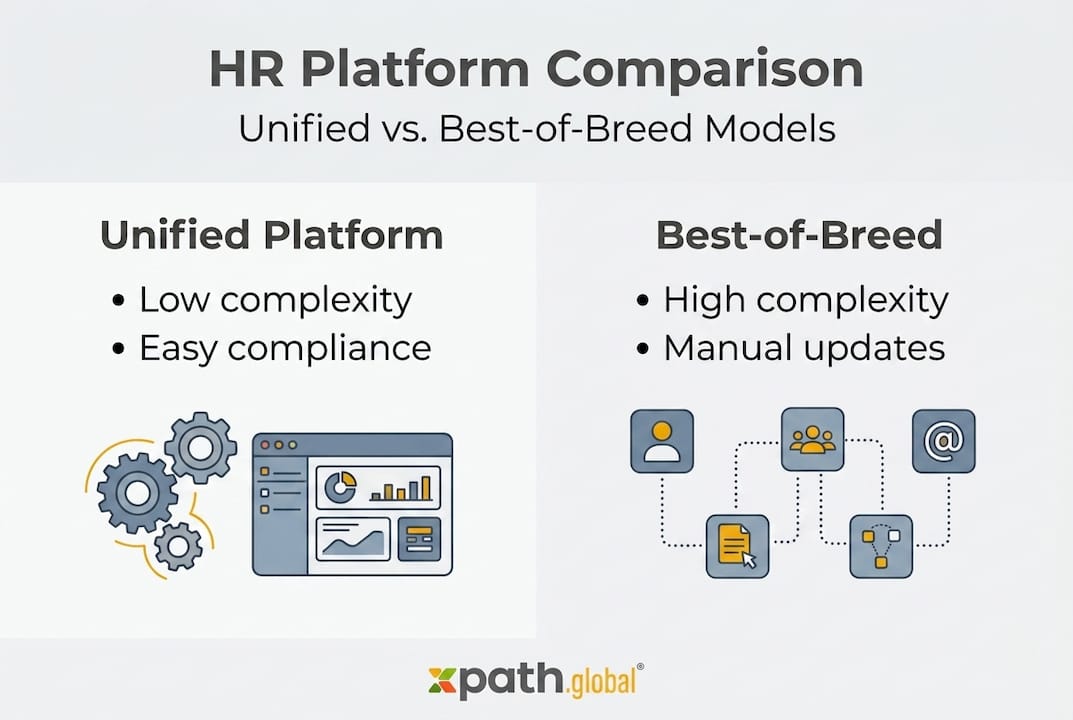
Best-of-breed tools can offer deeper specialization in specific categories, such as equity compensation management or specialized immigration case tracking. However, as noted in unified HCM vs. multi-platform research, unified platforms excel in simplicity and compliance while best-of-breed approaches risk silos and higher total costs.
The emerging answer for many mid-to-large enterprises is the hybrid model: a unified core platform that governs payroll, compliance, and mobility data, with select specialized modules or marketplace add-ons for advanced tasks. This model is particularly well suited to:
- Employer of Record (EOR) transitions into markets without legal entities
- Multi-jurisdictional tax equalization programs requiring specialized calculation engines
- Cross-border social security optimization under bilateral agreements
- Custom vendor procurement in high-complexity destination markets
“The best HR technology strategy is not about choosing the most capable individual tool in each category. It is about choosing the architecture that produces the most consistent, compliant, and scalable outcome across every jurisdiction where your people work.”
Understanding cloud HR platform benefits and investing in internal mobility process management are critical steps in designing a hybrid architecture that remains manageable over time.
What to look for in a unified HR platform for global mobility
Selecting a unified HR platform for global mobility requires evaluating capabilities that go well beyond standard HCM features. The following criteria reflect what high-performing global mobility programs consistently prioritize.
- Scalable cross-border compliance. The platform must maintain current, jurisdiction-specific rule sets for immigration, tax, and social security across all markets where you operate or plan to operate. Manual compliance updates are a liability.
- Real-time regulatory monitoring. As immigration laws and tax thresholds shift, the platform should alert mobility managers automatically rather than relying on external legal counsel for routine updates.
- Native global payroll integration. Payroll that is truly native to the platform, not integrated via third-party middleware, reduces reconciliation errors and supports accurate cost shadow reporting for assignment budgeting.
- Agentic AI and predictive analytics. Forrester recommends that organizations prioritize platforms with agentic AI, extensible marketplaces, and native global payroll to manage edge-case compliance scenarios in new or complex markets.
- Extensible marketplace for vendor services. A vetted global marketplace of immigration lawyers, relocation providers, and tax advisors gives HR teams immediate access to compliant service delivery without lengthy procurement cycles.
- API-based integration architecture. Even within a unified model, the ability to integrate with existing ERP, finance, or legal systems via well-documented APIs ensures the platform fits within the enterprise technology ecosystem.
For vendor due diligence, reference checks with organizations of similar scale and mobility volume are essential. Confirm that the vendor provides regional regulatory support, not just a centralized support desk, and request a detailed implementation roadmap with compliance milestone checkpoints.
The ability to maintain compliance internationally depends heavily on platform architecture. Reviewing immigration compliance challenges and HR compliance best practices alongside platform selection criteria strengthens the evaluation process. Understanding how AI in HR mobility is reshaping case management and compliance automation is also increasingly relevant to vendor assessment.
Pro Tip: Look for extensible policy modules that allow your team to adapt assignment benefit structures and cost thresholds as relocation policies evolve. Platforms that lock you into rigid policy templates will become obstacles as your mobility program matures.
Why the typical ‘bolt-on’ approach holds HR back
There is a persistent belief among HR technology buyers that adding a specialized tool on top of an existing system is the lowest-risk path forward. In practice, it is often the highest-risk one. Every new tool added to an already fragmented stack creates a new surface for compliance errors, data loss, and workforce confusion. An immigration update that does not propagate to payroll in time. A relocation milestone that closes in one system but remains open in another. These are not edge cases. They are the daily reality of piecemeal HR architectures.
The harder lesson that global mobility and compliance leaders learn over time is this: technology should enforce consistency, not multiply exceptions. When a platform has native compliance logic, automated workflows, and a shared data model, it reduces the number of decisions humans need to make manually under time pressure. That reduction in manual decision-making is where compliance risk actually decreases.
Rethinking the best-of-breed instinct does not mean abandoning specialization entirely. It means being deliberate about which functions genuinely require a specialized tool and which are better served by a cloud-based HR transformation approach that builds consistency from the ground up.
Take the next step: Accelerate global mobility with unified HR solutions
A unified HR platform is not merely a technology choice. It is a strategic decision about how your organization manages compliance risk, controls mobility costs, and delivers a consistent experience for internationally mobile employees.
xpath.global provides exactly this kind of unified environment, combining a global mobility SaaS platform with a marketplace of 60,000 services across 183 countries and expert consulting support. Whether you are scaling an existing program or building a mobility function from scratch, the right architecture matters. Explore how to choose the right global mobility technology for your organization, learn strategies to master employee relocation, or connect with HR experts at xpath.global to discuss your specific program requirements.
Frequently asked questions
How do unified HR platforms improve compliance in global mobility?
Unified platforms centralize compliance functions within a single data environment, providing real-time regulatory updates and significantly reducing the risk of cross-border errors. According to Forrester, admin burden decreases by 40 to 70 percent when organizations move from fragmented stacks to unified HCM solutions.
Can a unified HR system handle both payroll and relocation processes for international staff?
Yes. Leading unified HR platforms integrate payroll, relocation logistics, and cross-border compliance for over 150 countries within a single system. Forrester highlights that organizations should prioritize platforms with native global payroll and agentic AI to manage edge-case compliance at scale.
What are common drawbacks of integrating multiple HR tools instead of choosing a unified platform?
Multiple tools increase integration costs, create data silos across HR functions, and heighten compliance gap risk. Research confirms that best-of-breed approaches risk silos and higher total costs compared to unified alternatives.
How do hybrid HR models combine the benefits of unified platforms and best-of-breed tools?
Hybrid models use a unified core system to govern payroll and compliance data, while adding specialized modules for advanced tasks such as EOR transitions or multi-jurisdictional tax equalization. This approach, as noted in unified HCM vs. multi-platform research, balances governance with innovation for complex global mobility programs.