






TL;DR:
- Global mobility platforms automate and centralize all aspects of international workforce relocation.
- Integrated platforms outperform point solutions by reducing errors, ensuring compliance, and enhancing employee experience.
- Successful implementation requires careful planning, clear governance, data migration, and change management.
Multinational companies lose significant productivity and face serious regulatory exposure every time an international assignment is mismanaged. Despite this reality, many HR teams still rely on spreadsheets, disconnected email chains, and fragmented vendor relationships to coordinate work permits, tax compliance, housing, and payroll across multiple jurisdictions simultaneously. The operational cost of this approach is measurable and avoidable. Global mobility platforms represent a structural shift in how organizations manage the entire assignment lifecycle, replacing manual coordination with automated, centralized workflows that reduce errors, protect compliance, and improve the experience for relocating employees.
Key Takeaways
| Point | Details |
|---|---|
| Integrated platform advantage | Unified platforms centralize data and processes, increasing HR efficiency and compliance. |
| Compliance automation | Automation tools dramatically reduce the risk of regulatory errors in international mobility. |
| Feature priorities | Look for workflow automation, compliance tracking, scalability, and customization when choosing a platform. |
| Implementation strategies | Start with a pilot and plan for ongoing training to ensure successful adoption. |
What is a global mobility platform?
A global mobility platform is an enterprise software solution designed to centralize and automate every element of international workforce relocation, from initial assignment planning through to repatriation and program reporting. Unlike generic HR systems that treat relocation as a secondary function, these platforms are purpose-built for the complexity of cross-border assignments, where immigration, tax equalization, social security coordination, housing logistics, and vendor management must all function in concert.
The core components of a global mobility platform typically include:
- Assignment management: Structured case management for tracking assignment timelines, milestones, and employee data
- Immigration and visa tracking: Automated workflows for work permit applications, renewals, and compliance deadlines
- Tax and payroll coordination: Tools for managing shadow payroll, tax equalization, and cross-border payroll splits
- Vendor and service provider management: Integration with immigration attorneys, relocation companies, destination service providers, and moving companies
- Employee self-service portals: Interfaces that allow assignees to track their own relocation progress and upload documents
- Reporting and analytics: Dashboards that give HR leaders real-time visibility into costs, compliance risks, and program performance
The critical distinction, as noted in The Essential Guide to Global Mobility, is the gap between tools like Excel and purpose-built specialist software. Spreadsheets cannot enforce process consistency, trigger compliance alerts, or integrate with immigration portals in real time. They are static records, not dynamic management systems.
For multinational organizations managing dozens or hundreds of assignments simultaneously, this distinction is not academic. It is operational. Reviewing mobility platform features gives HR leaders a practical sense of what modern platforms deliver beyond basic case tracking. The cloud HR benefits of these systems extend further, enabling secure, real-time access across geographically distributed teams without the need for on-premise infrastructure.
Pro Tip: When evaluating platforms, prioritize solutions that integrate with your existing HRIS (Human Resources Information System) and can scale to support new countries without requiring custom development for each jurisdiction.
Why integrated platforms outperform point solutions
With the basics established, let’s look at whether an integrated platform or a series of isolated apps delivers better results.

Point solutions address specific tasks in isolation. One tool might handle immigration case tracking. Another might manage vendor invoicing. A third might support tax filing coordination. The problem is that these tools rarely communicate with each other, creating data silos where critical information does not flow between functions. When an immigration deadline is missed because the tax team was not notified of a delayed work permit, the cost is immediate and real.
Integrated platforms offer greater consistency and efficiency compared to point solutions by connecting every function within a single data environment, where updates in one module automatically trigger actions in related workflows.
The risks of relying on multiple disconnected tools include:
- Duplicate data entry across systems, which increases error rates
- Inconsistent process standards between regional HR teams
- Poor audit trails when compliance authorities request documentation
- Delayed notifications for critical regulatory deadlines
- Higher administrative overhead from managing multiple vendor relationships
- Reduced employee experience due to fragmented communication
| Dimension | Point solutions | Integrated platform |
|---|---|---|
| Data consistency | Low, manual reconciliation required | High, single source of record |
| Compliance tracking | Fragmented, risk-prone | Centralized, automated alerts |
| Vendor management | Multiple disconnected portals | Unified vendor marketplace |
| Reporting | Requires manual aggregation | Real-time dashboards |
| Employee experience | Disjointed, multiple logins | Single self-service portal |
| Implementation cost | Lower upfront, higher total cost | Higher upfront, lower long-term cost |
The mobility benefits of consolidating onto a single platform extend beyond HR efficiency. Finance teams gain accurate cost projections. Legal teams get reliable compliance audit trails. Relocating employees receive a consistent, professional experience regardless of which country they are moving to. Understanding the full mobility platform advantages helps organizations build a strong business case for technology investment that leadership can support.
Key features to look for in a global mobility platform
Understanding the advantages is one thing, but what makes a mobility platform truly effective for multinational teams?
Unified platforms streamline processes and reduce errors versus manual or piecemeal approaches, but not all platforms are created equal. When evaluating solutions, HR teams should assess each system against these seven core feature categories:
-
Automated workflow management. The platform should enforce consistent, configurable processes for every assignment type, whether short-term business travel, long-term relocation, or permanent transfer. Automated task assignment, deadline reminders, and milestone tracking eliminate the manual coordination burden on HR teams.
-
Real-time compliance tracking. Immigration regulations, tax treaties, and social security bilateral agreements change frequently and vary significantly by country. The platform should monitor regulatory changes and surface alerts when an assignee’s situation triggers a compliance action, such as a work permit renewal, a filing deadline, or a payroll split requirement.
-
Integrated vendor marketplace. Rather than managing vendor relationships through separate procurement processes, effective platforms provide access to a vetted network of service providers. This includes immigration counsel, relocation management companies, destination services, temporary housing, and international moving companies, all accessible from within the platform.
-
Cost estimation and budget management. International assignments represent significant financial commitments. Platforms with built-in cost projection calculators allow HR teams to model assignment costs before approval, incorporating housing allowances, tax gross-up provisions, school fees, and travel budgets with accuracy.
-
Data security and access controls. Mobility data includes sensitive employee information such as passport numbers, tax identification numbers, and family details. Platforms must comply with data protection regulations including GDPR and local equivalents, with role-based access controls that restrict data visibility to authorized users only.
-
Customizable reporting and analytics. Generic reports are not sufficient for program governance. HR leaders need the ability to build dashboards that track key performance indicators specific to their program, such as open permit applications, assignment costs by region, and compliance risk by country.
-
Employee self-service capabilities. Relocating employees need clear visibility into their own assignment status. Platforms that offer mobile-friendly portals reduce inbound queries to HR teams while improving assignee satisfaction and engagement throughout the relocation process.
Guidance on choosing mobility technology reinforces that the selection process should prioritize long-term program needs over short-term cost minimization. Understanding mobility optimization tools more broadly can also reveal complementary solutions that enhance platform performance.
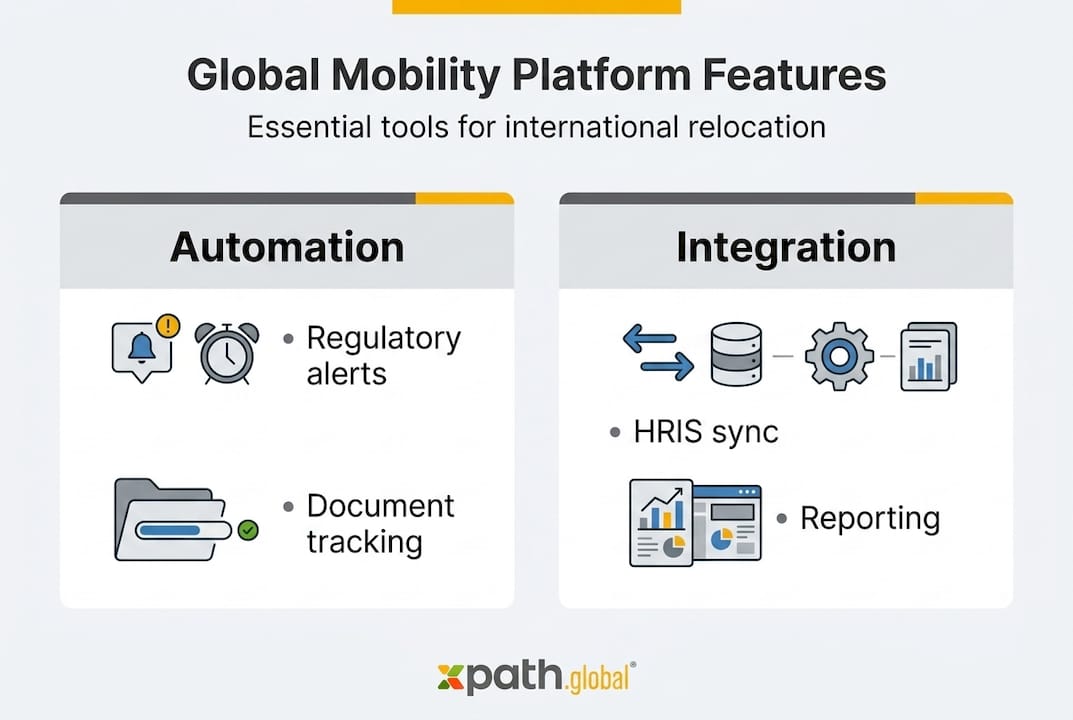
Pro Tip: Look specifically for platforms that automate regulatory update notifications, rather than relying on HR teams to manually monitor legislative changes across dozens of countries. This single capability can prevent costly compliance failures.
Ensuring compliance and operational excellence
Equipped with the right platform, the next critical metric is how you ensure compliance and continuity on a global scale.
Compliance failures in global mobility are rarely the result of deliberate negligence. They occur because information is fragmented, timelines are unclear, and accountability is distributed across too many parties without a single system of record. Common compliance failures and how platforms address them include:
- Missed permit renewals: Automated deadline tracking ensures permits are renewed before expiry
- Incorrect payroll splits: Shadow payroll modules calculate employer and employee obligations accurately across home and host jurisdictions
- Unreported business travel: Digital tracking of travel patterns identifies when business visitors cross treaty thresholds that trigger tax obligations
- Inadequate documentation: Document management modules ensure every required form is collected and stored with an auditable timestamp
The contrast between in-house compliance management and purely outsourced models is well documented. As The Essential Guide to Global Mobility notes, in-house versus outsourced approaches to mobility management have distinct effects on compliance consistency and program quality. The table below illustrates how compliance outcomes differ depending on management model and tool sophistication:
| Scenario | Compliance outcome | Process consistency |
|---|---|---|
| Manual, in-house, spreadsheet-based | High risk, reactive | Low, person-dependent |
| Outsourced to traditional RMC only | Moderate, vendor-dependent | Moderate |
| Integrated platform, in-house managed | Low risk, proactive | High, system-enforced |
| Integrated platform, hybrid model | Low risk, scalable | High, standardized |
“Organizations that move from manual processes to integrated mobility platforms consistently report improvements in audit readiness, deadline adherence, and data accuracy across their international assignment programs.”
Best practices for using automation to standardize mobility processes include establishing clear escalation rules within the platform, so that missed task deadlines automatically notify senior HR managers. Configuring country-specific workflows that reflect local regulatory requirements ensures that the system enforces the right steps in the right order for every destination. Exploring how compliance on assignments can be centralized, alongside strong process management practices, creates the governance infrastructure that global programs require.
Practical steps for implementing a mobility platform in your organization
Once you’re ready to realize the benefits, here’s how leading HR teams approach successful mobility platform rollouts.
Implementation is where many platform investments stall. The technology may be sound, but without a structured rollout plan, data migration errors, low user adoption, and inadequate training can undermine the entire initiative. A phased, deliberate approach delivers the best outcomes.
-
Conduct a program audit before selecting technology. Document your current assignment volumes, countries of operation, vendor relationships, and compliance gaps before evaluating platforms. This baseline prevents organizations from purchasing features they do not need and ensures the platform is configured for actual program requirements.
-
Define governance and ownership clearly. Designate a platform owner within the global mobility team who is responsible for configuration, user access, and ongoing governance. Without clear ownership, platforms drift into inconsistent use patterns that reproduce the fragmentation they were meant to eliminate.
-
Prioritize data migration planning. Historical assignment data should be cleaned, standardized, and validated before import. Migrating dirty data into a new platform does not solve data quality problems; it simply transfers them into a more expensive system.
-
Implement a pilot program with a defined assignee cohort. Select one region or assignment type to onboard first. A controlled pilot surfaces configuration issues, training gaps, and integration problems at a manageable scale before enterprise rollout.
-
Invest in structured change management. Both HR teams and relocating employees need clear communication about what the platform does, how it improves their experience, and what is expected of them. Change resistance is the most common cause of low adoption in mobility technology implementations.
-
Establish continuous improvement cycles. Schedule quarterly reviews of platform configuration, reporting outputs, and user feedback. Platforms should evolve as program needs change, not remain static after initial deployment.
As high-touch manual processes are demonstrably slower and less consistent than automated alternatives, the business case for structured implementation is strong. Detailed relocation program best practices provide additional frameworks for organizations building or restructuring their mobility programs around a platform-first model.
Pro Tip: Run your pilot with assignees in a country where your compliance risk is well understood. This allows you to focus on platform adoption without simultaneously managing unfamiliar regulatory complexity.
A reality check: What most guides miss about global mobility platforms
The guides that exist on global mobility technology tend to focus heavily on feature comparisons and ROI projections. What they underemphasize is the organizational change that a platform requires, not just the technology adoption.
Software vendors frequently present implementation as a clean, linear process. In practice, global mobility platforms succeed or fail based on factors that have nothing to do with the software itself. Local HR teams in host countries need to believe the platform serves their needs, not just the needs of the headquarters mobility team. Without that buy-in, local teams work around the platform rather than within it, recreating the same fragmentation the tool was meant to solve.
The “set and forget” assumption is the most dangerous misconception in mobility technology. Regulatory environments change. Assignment policies evolve. Organizational structures shift. A platform configured for your program’s needs in 2024 may not reflect your program’s reality in 2026 without active governance. Reviewing realistic software benefits helps set accurate expectations before committing to a platform.
The organizations that extract the most value from mobility platforms are not necessarily those with the most sophisticated technology. They are the ones with dedicated program governance, clear ownership, and a culture that treats global mobility data as a strategic asset rather than an administrative byproduct.
Explore solutions built for real-world HR challenges
Managing international assignments at scale requires more than good intentions and capable people. It requires the right infrastructure.
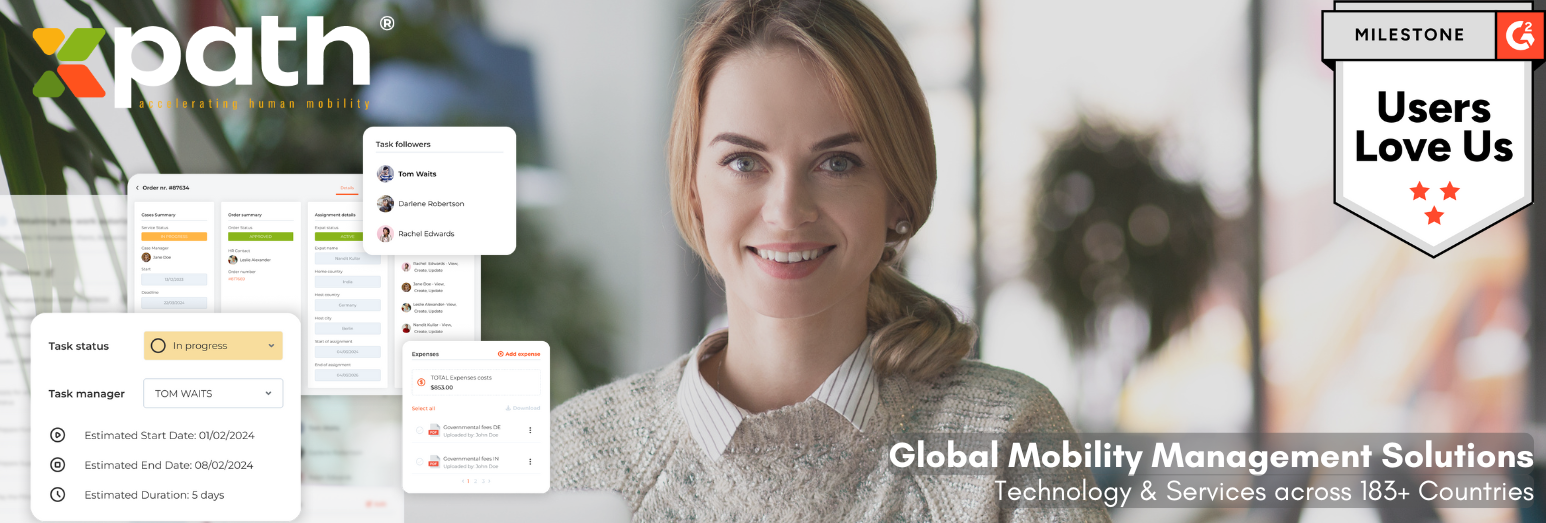
xpath.global provides a unified global mobility ecosystem that connects HR teams, relocating employees, and service providers within a single platform covering immigration, relocation, tax compliance, vendor coordination, and reporting. Whether you are restructuring an existing program or building one from scratch, connect with xpath HR experts to discuss your specific requirements. Explore how leading organizations design remote work mobility programs that balance flexibility with compliance, and use the mobility compliance checklist to assess where your current program stands before taking the next step.
Frequently asked questions
What are the biggest challenges in managing global mobility?
The biggest challenges include compliance with international regulations, ensuring process consistency, managing assignment data, and supporting relocating employees efficiently. High-touch manual processes are slower and less consistent than platform-based alternatives, which is why fragmented tools create compounding risk over time.
How does an integrated mobility platform improve compliance?
Integrated platforms streamline legal document tracking, automate compliance updates, and provide audit trails, reducing regulatory risk. Integrated mobility platforms ensure greater consistency and faster compliance response across multiple jurisdictions simultaneously.
Can a global mobility platform handle both in-house and outsourced processes?
Yes, modern platforms are designed to support hybrid models and can standardize operations whether managed internally or through partners. Flexibility for both in-house and partner-managed mobility models is a core design principle of leading enterprise platforms.
What are the main differences between point solutions and integrated platforms?
Point solutions address individual tasks while integrated platforms centralize all processes, which boosts efficiency, reduces error, and improves data visibility. The comparison of point solutions and unified platforms consistently shows that integration reduces administrative overhead and compliance risk at scale.
How long does it take to implement a global mobility platform?
Implementation time varies by company size and complexity, but most organizations can deploy a platform within three to six months when they follow a structured rollout plan that includes data migration, configuration, and change management.